
Cloudflare Spend Limits Are Availability Controls, Not Bill Caps
Cloudflare can pause supported Workers and Durable Objects operations at product-level limits. Learn the scope, billing gaps and service tradeoffs.
On this page
A cloud cost ceiling sounds like a finance setting until it starts changing production behavior. Cloudflare introduced Spend Management in beta for pay-as-you-go customers, starting with Workers and Durable Objects. The controls can stop supported operations after estimated usage reaches a threshold. The key design decision is therefore not just “how much can we spend?” It is “which account-wide workloads may stop, and what can still be billed while they do?” [1] [2]
A limit has a product-wide blast radius
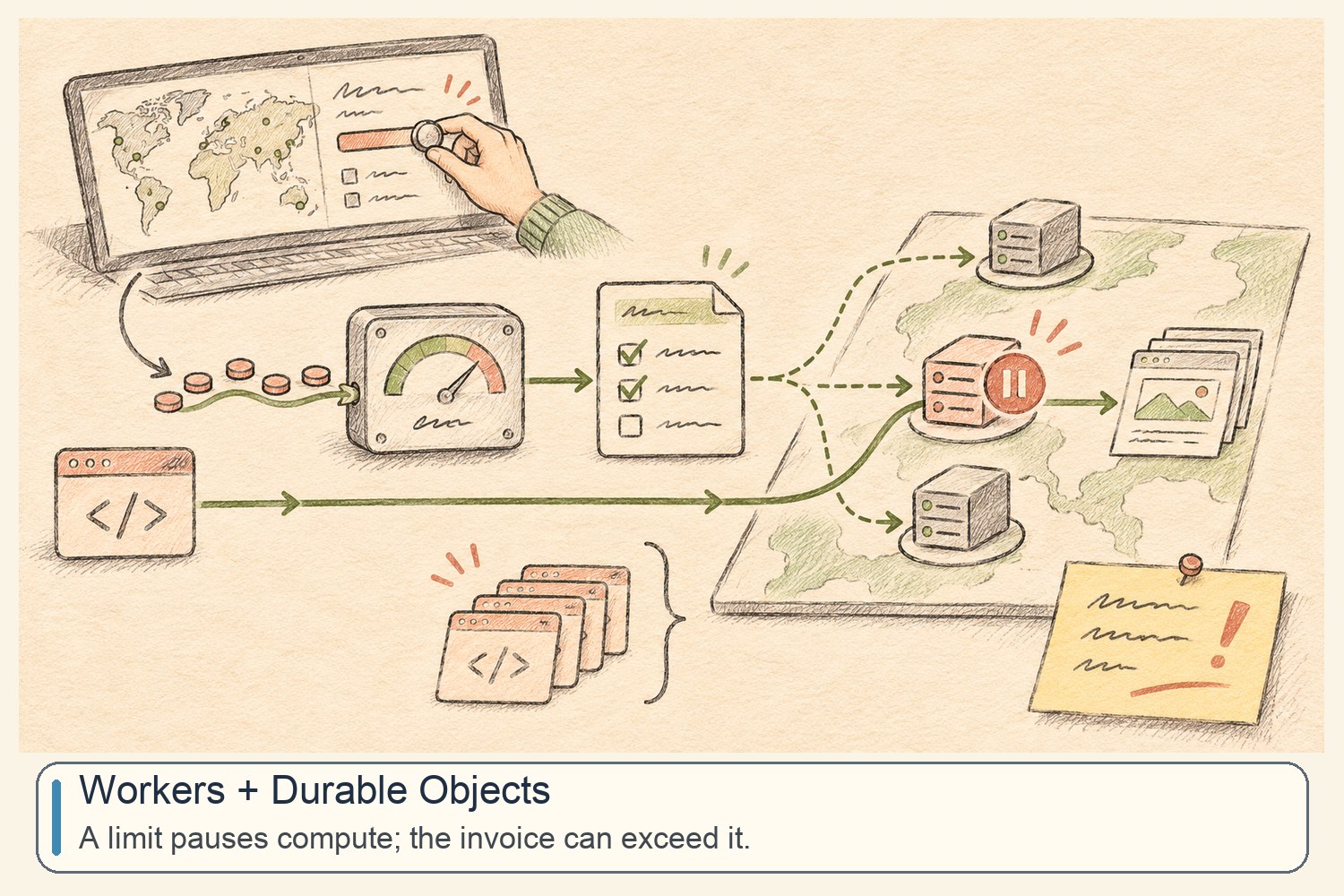
Workers and Durable Objects have separate limits. Each is applied across the account’s product usage; it cannot target one Worker script, Durable Object namespace or billing metric. An application that uses many Workers can therefore share one threshold, and reaching it may interrupt more than the workload that caused the spike. [2]
A limit is also different from an alert. An email alert notifies a configured address while the product keeps running. Cloudflare’s separate account-wide budget alerts likewise notify without blocking. If the requirement is “tell the team when spend rises,” choose an alert. If it is “stop supported usage when the threshold is reached,” a spending limit is the more disruptive control. [2]
The controls also do not collapse all of an application’s Cloudflare costs into one number. Workers AI, Durable Objects, KV, R2 and other products have separate charges and controls. AI Gateway can apply its own limits to requests routed through the gateway, including per-user or per-model budgets. An architecture that calls several products needs a cost map across them; a single Workers threshold is not an application-wide budget. [2]
What a pause does—and what it does not do
Cloudflare describes the threshold as estimated usage charges for the current subscription billing period, after included usage is deducted. For Workers, requests and CPU time count; the Workers Paid subscription fee and other products’ charges do not. Durable Objects count requests, duration, SQLite rows and key-value operations. Stored data is excluded and can continue to incur charges while Durable Objects are paused. A limit does not cancel the subscription or delete stored data. [2]
| Control | Scope | At its threshold |
|---|---|---|
| Workers spending limit | Workers product usage across the account | Blocks supported Worker operations |
| Durable Objects spending limit | Durable Objects usage across the account | Blocks supported Durable Objects operations |
| Email alert | Workers or Durable Objects product usage | Sends an email; usage continues |
| Budget alert | Account usage-based spend | Notifies recipients; products continue |
Even the blocking control is not an invoice cap. Usage reporting and policy enforcement take time. In-flight operations may continue, and an enforcement failure can let usage pass the configured amount. The final invoice is the record of charges, not the policy threshold. A policy created after the account has already accrued more usage than its new limit may trigger a pause as Cloudflare evaluates it. [2]
Treat the setting like a circuit breaker
Before enabling a limit, list the production services that use the account’s Workers or Durable Objects. Trace what happens if a request handler pauses: are static assets served independently, does an API return a clear error, do background queues retry into a failure loop, and can operators reach the dashboard to raise or remove the threshold? These are application-specific questions; the control cannot know which dependent workflow is safe to interrupt.
Set an email or budget alert below the action threshold so a person has time to investigate. Use a threshold only where a deliberate pause is safer than unbounded supported usage. Name an owner and a recovery path, and test how the application behaves after new invocations are blocked. For Durable Objects, include continuing storage charges in the runbook. [2]
Cloudflare’s edge runtime architecture and its Workers cold-start design show why compute controls sit inside broader delivery paths. A spend policy is one layer in that design, not a substitute for per-product budgets, usage monitoring or graceful degradation.
A useful control with a precise job
Spend limits add an automatic response to selected usage growth, but that response is service interruption. Budget for the possibility that metering overshoots the threshold; separate products where their failure modes differ; and choose notification-only alerts when preserving availability is the priority. The right limit is the one whose scope and pause behavior the engineering team has actually rehearsed—not the round number that looks like a guaranteed invoice maximum. [1] [2]
Frequently asked questions
Does a Cloudflare Workers spending limit cap the final invoice?
No. Usage reporting and enforcement take time, in-flight work may finish, enforcement can fail, and some subscription or other product charges are excluded. The invoice remains the final record.
Can a spending limit target one Worker?
No. A Workers limit applies across Workers usage on the account, while Durable Objects have a separate product-wide limit. Neither can target one Worker or namespace.
Sources & further reading
Keep reading
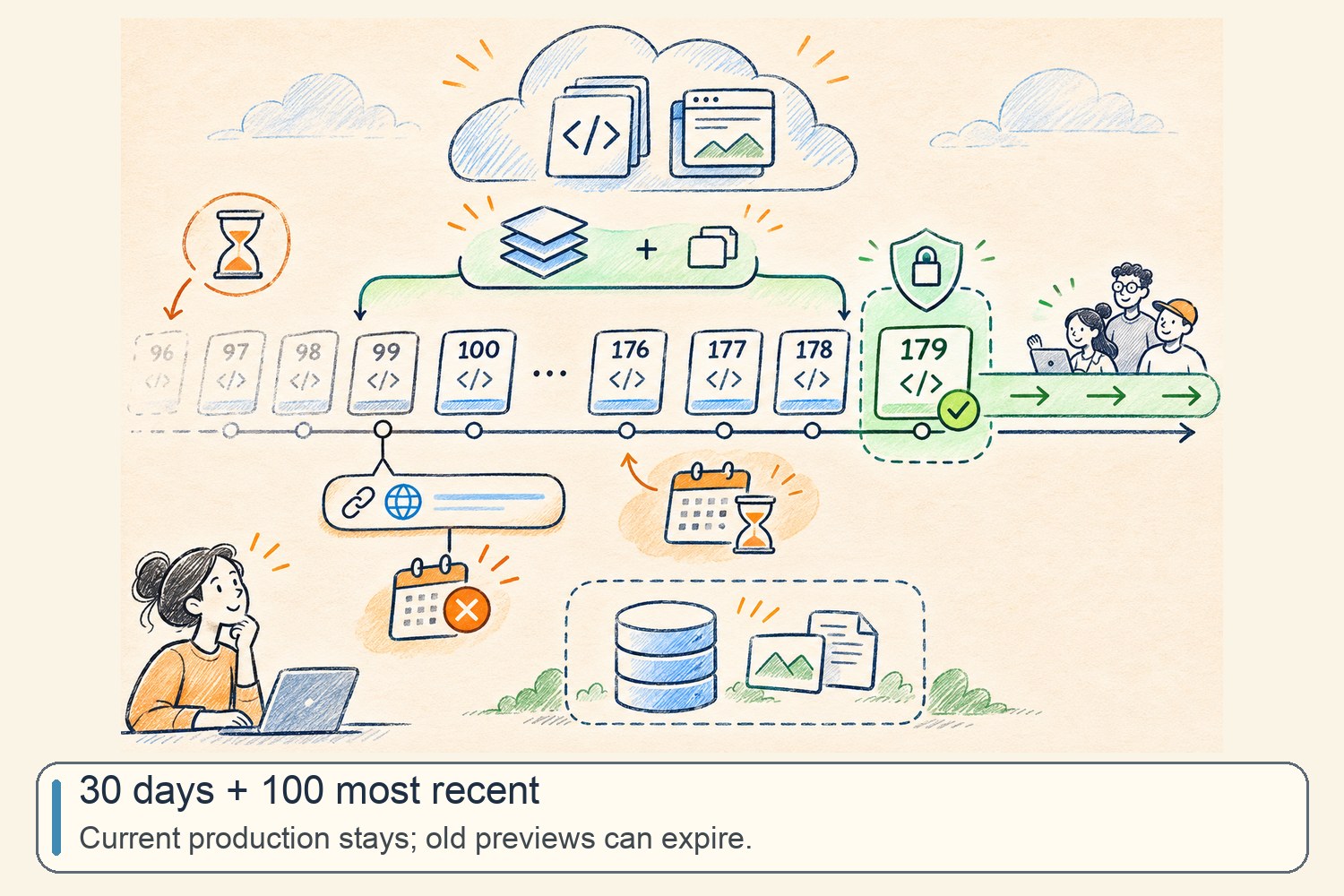
Cloudflare Workers and Pages Now Expire Old Test Deployments
Cloudflare retains only recent Worker versions and Pages deployments. Learn what the 30-day, top-100 rule means for preview URLs and rollback plans.
How Cloudflare Cut Serverless Cold Starts by 10x: Consistent Hash Sharding for V8 Isolates
How Cloudflare cut serverless cold starts 10x using consistent hash rings to route requests to warm V8 isolates across 300 data centers.
Inside Netflix Live Origin: Surviving 65 Million Concurrent Streams with Real-Time Validation
How Netflix built Live Origin: real-time quality validation, dual-pipeline redundancy, and low-latency packaging for 65 million concurrent live viewers.
/* Comments */
Comments are offline right now — we reconnect automatically, nothing is lost.