
Container Design Patterns for Distributed Systems: Sidecar, Ambassador, and Adapter
Master the three essential multi-container design patterns in Kubernetes: Sidecar, Ambassador, and Adapter architectures for modular cloud systems.
On this page
When Docker popularized Linux containers, developers initially treated them as lightweight virtual machines: monolithic images containing application code, background cron daemons, logging agents, and configuration watchers all packed into a single image.
This monolithic approach ruined the core promise of containers: modularity, composability, and single-responsibility lifecycles.
In distributed orchestration platforms like Kubernetes, the fundamental unit of deployment is not a single container, but a Pod: a co-located group of containers sharing the same network namespace (localhost), IPC namespace, and storage volumes.
This atomic grouping gave rise to Container Design Patterns (formalized by Brendan Burns and David Oppenheimer). By pairing a primary application container with specialized helper containers, engineers can enhance and modularize distributed systems without altering core application code.
This guide details the three fundamental single-node multi-container patterns: The Sidecar, The Ambassador, and The Adapter.
The Three Patterns Side by Side
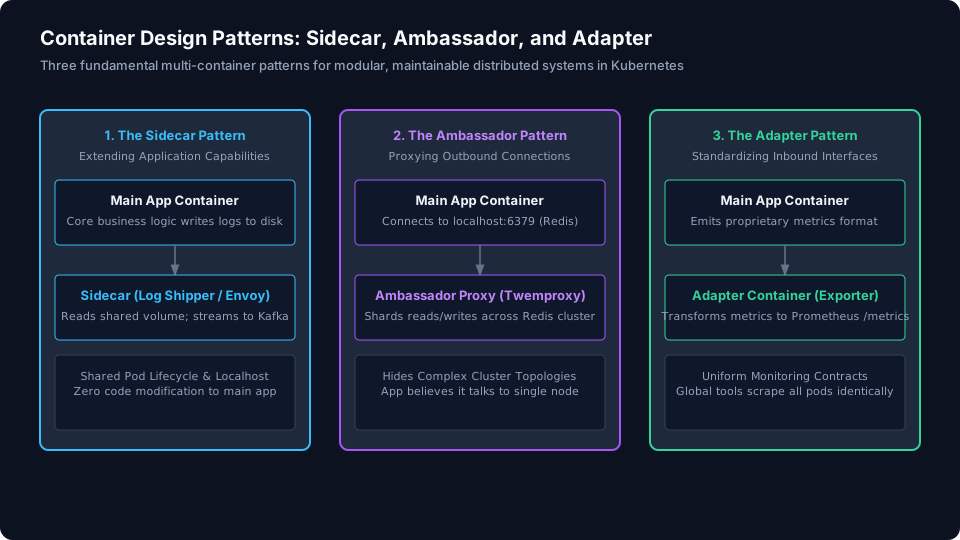
1. The Sidecar Pattern: Extending Capabilities
The Sidecar Pattern attaches a secondary container to extend or enhance the capabilities of the primary application container without modifying its source code.
Canonical Example: Log Shipping and TLS Offload
A legacy Java service writes unformatted access logs to a local disk directory (/var/log/app.log). Writing custom code to stream logs to a centralized Kafka cluster would require modifying, testing, and redeploying the legacy service.
Instead, a sidecar container (such as Fluentbit or Vector) mounts the shared log directory and streams records to Kafka asynchronously:
apiVersion: v1
kind: Pod
metadata:
  name: billing-service
spec:
  volumes:
    - name: shared-logs
      emptyDir: {}
  containers:
    # 1. Main Application Container
    - name: billing-app
      image: billing:v1.4
      volumeMounts:
        - name: shared-logs
          mountPath: /var/log/app

    # 2. Sidecar Container
    - name: log-shipper
      image: vector:latest
      volumeMounts:
        - name: shared-logs
          mountPath: /var/log/app
      args: ["--config", "/etc/vector/vector.toml"]
Key Advantages:
- Language Independence: The logging sidecar is written in Rust/Go, consuming minimal memory, while the main application can be Java, Python, or Ruby.
- Independent Lifecycles: Platform teams can update security certificates or log destinations without re-releasing application binaries.
2. The Ambassador Pattern: Proxying Outbound Access
The Ambassador Pattern acts as an intelligent proxy that simplifies outbound network communication for the primary container.
Canonical Example: Database Sharding and Circuit Breaking
Consider an application that needs to interact with a sharded Redis caching tier. Implementing client-side consistent hashing and failover routing directly inside application code couples the service to the physical topology of the cache.
With the Ambassador pattern:
- The application connects to
localhost:6379, treating it as a simple standalone Redis instance. - An ambassador proxy container (like Envoy or Twemproxy) intercepts the connection on localhost, calculates consistent hash slots, handles connection pooling, and routes queries across physical Redis nodes in the cloud.
[ Application Container ] ──► (localhost:6379) ──► [ Ambassador Proxy ]
                                                            │
                                         ┌──────────────────┼──────────────────┐
                                         ▼                  ▼                  ▼
                                  [ Redis Shard 1 ]  [ Redis Shard 2 ]  [ Redis Shard 3 ]
3. The Adapter Pattern: Standardizing Interfaces
The Adapter Pattern standardizes the heterogeneous output of the primary container, exposing a unified interface to the external world.
Canonical Example: Prometheus Monitoring Export
In an enterprise with 50 microservices, different services emit health and metrics in incompatible formats (JMX for Java, StatsD for Node.js, proprietary JSON endpoints for legacy services). A global monitoring cluster cannot scrape 50 bespoke APIs.
An adapter container runs alongside the legacy application, translates the proprietary format into standard Prometheus text format, and serves it on localhost:9090/metrics.
Architectural Comparison Matrix
| Pattern | Traffic Direction | Primary Responsibility | Classic Production Example |
|---|---|---|---|
| Sidecar | Local Volume / IPC | Augments local capabilities. | Fluentbit log shipper, Envoy mTLS sidecar. |
| Ambassador | Outbound (App → Ext) | Hides remote network topology. | Twemproxy Redis router, cloud SQL auth proxy. |
| Adapter | Inbound (Ext → App) | Normalizes disparate interfaces. | JMX-to-Prometheus metrics exporter. |
Key Lessons for Cloud-Native Engineers
- One Process Per Container: Keep containers focused on a single responsibility. Bundle them into Pods when they share lifecycle and storage needs.
- Leverage Localhost Communication: Inter-container calls within the same Pod travel over the Linux loopback interface (
localhost), adding sub-millisecond network overhead. - Decouple Platform from Business Logic: Use container patterns to deliver platform capabilities (mTLS, telemetry, sharding) transparently to product engineers.
Keep reading
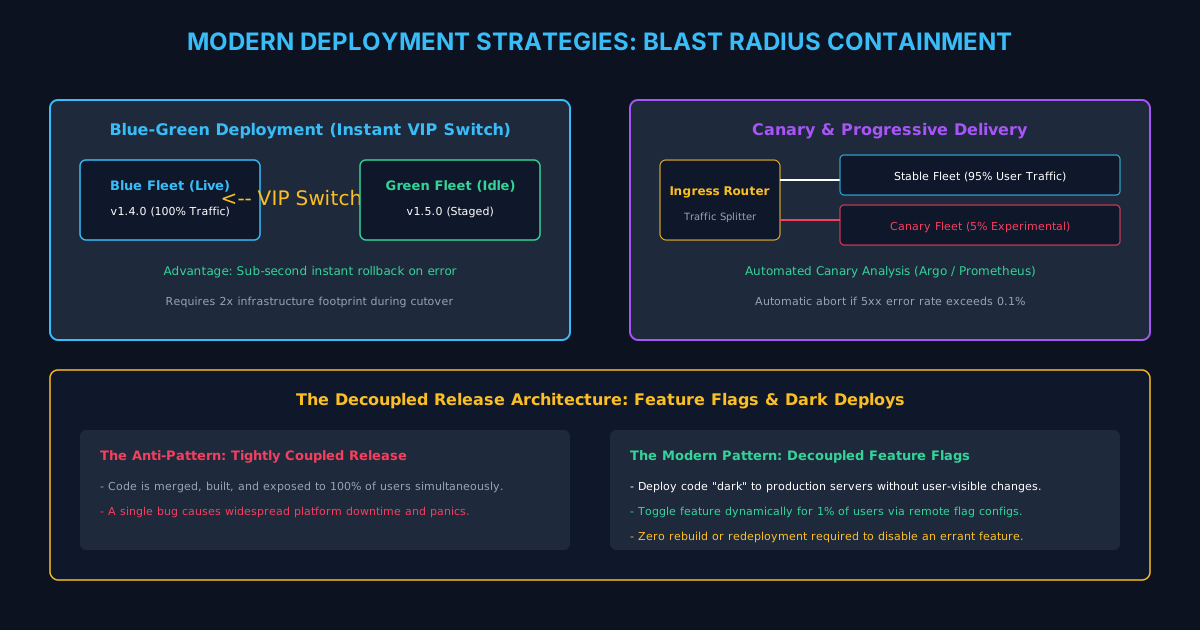
Modern Deployment Strategies: Blue-Green, Canary, and Progressive Delivery
Compare Big-Bang, Rolling, Blue-Green, Canary, and Progressive Delivery. Learn how modern platforms decouple deployment from release to eliminate downtime.
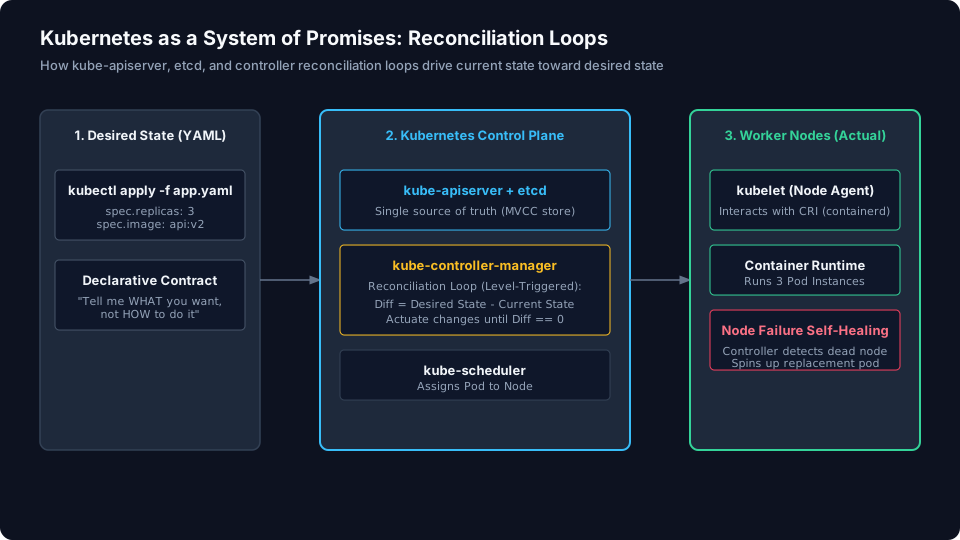
Kubernetes as a System of Promises: Reconciliation Loops and Desired State
Understand Kubernetes control plane architecture: declarative desired state, etcd, kube-apiserver, and controller reconciliation loops.
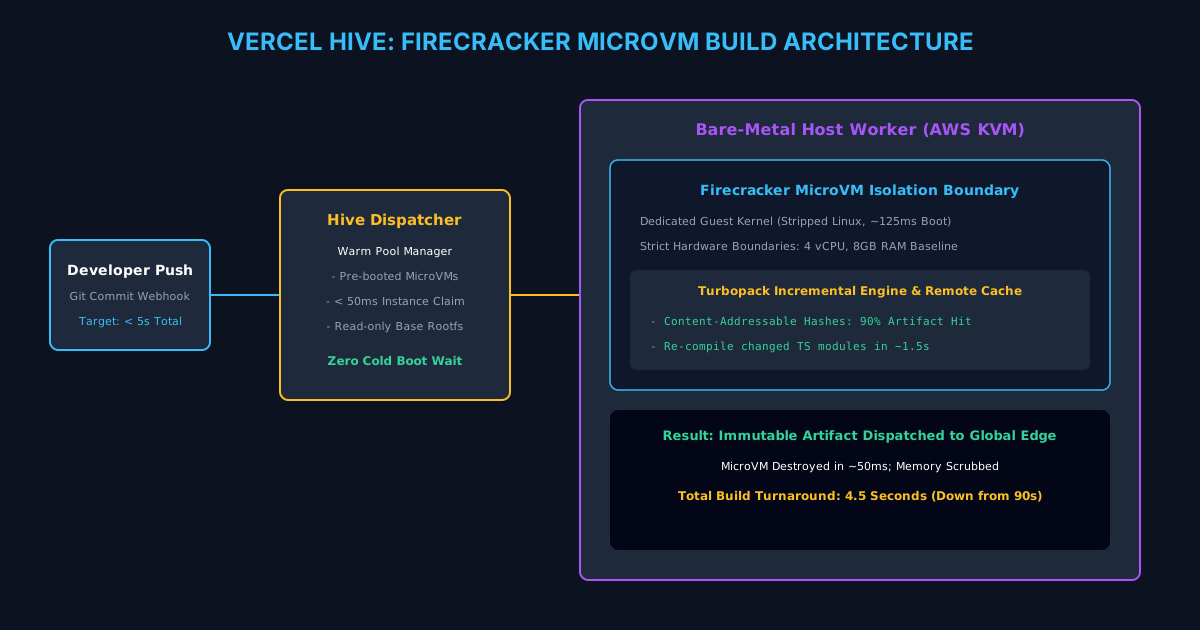
How Vercel Cut Multi-Tenant Build Times From 90 Seconds to 5
Inside Hive, Vercel's build infrastructure powered by Firecracker microVMs, warm worker pools, and layer caching for fast, isolated execution.
/* Comments */
Comments are offline right now — we reconnect automatically, nothing is lost.