
Modern Deployment Strategies: Blue-Green, Canary, and Progressive Delivery
Compare Big-Bang, Rolling, Blue-Green, Canary, and Progressive Delivery. Learn how modern platforms decouple deployment from release to eliminate downtime.
On this page
The most dangerous moment in software engineering is when freshly compiled code meets real production traffic. In the early days of web operations, deployments were high-stress “Big-Bang” rituals scheduled at 2:00 AM on Sunday mornings: engineers took servers offline, replaced application binaries, ran database migrations, and prayed the system rebooted cleanly.
If a bug escaped QA, the entire platform crashed, and rolling back required repeating the painful downtime window in reverse.
Modern continuous delivery completely decouples deployment (installing code on servers) from release (exposing code to end users). By leveraging smart traffic shifting, container orchestration, and automated health telemetry, engineering teams deploy thousands of times a day with zero downtime and minimal blast radius.
The Evolution of Deployment Patterns
+-----------------------------------------------------------------------+
|                 The Deployment Strategy Spectrum                      |
+----------------------+--------------------+---------------------------+
| Strategy             | Rollback Speed     | Cost / Resource Overhead  |
+----------------------+--------------------+---------------------------+
| Big-Bang (Recreate)  | Slow (Requires redown) | Lowest (1x capacity)  |
| Rolling Update       | Moderate (Pod rollback)| Low (1.2x capacity)   |
| Blue-Green           | Instant (< 1s DNS/VIP) | High (2x full capacity)|
| Canary Deployment    | Fast (< 10s traffic cut)| Low to Medium        |
| Progressive Delivery | Fully Automated Metric | Low to Medium         |
+----------------------+--------------------+---------------------------+
Deep Dive: Core Deployment Architectures
1. Rolling Deployments (The Kubernetes Default)
In a rolling deployment, an orchestrator progressively replaces old container replicas with new ones in batches:
Step 1: [ v1 ] [ v1 ] [ v1 ] [ v1 ] (100% v1)
Step 2: [ v1 ] [ v1 ] [ v1 ] [ v2 ] (25% v2)
Step 3: [ v1 ] [ v1 ] [ v2 ] [ v2 ] (50% v2)
Step 4: [ v2 ] [ v2 ] [ v2 ] [ v2 ] (100% v2)
Trade-offs:
- Advantage: Requires minimal excess infrastructure (typically only 10% to 25% extra capacity during rollout).
- Limitation: Both v1 and v2 run simultaneously for several minutes. Your database schema and API contracts must maintain strict backwards and forwards compatibility. If v2 has a critical bug, rolling back requires systematically tearing down v2 pods, which takes time.
2. Blue-Green Deployment (Zero-Downtime Instant Cutover)
Blue-Green deployment runs two identical physical production environments side-by-side:
- Blue Environment: Currently live, serving 100% of user traffic.
- Green Environment: Staged, idle environment running the new release version.
+-----------------------------------------------------------------------+
|                    Blue-Green Cutover Flow                            |
+-----------------------------------------------------------------------+
|                                                                       |
|  [ User Ingress Traffic ]                                             |
|        |                                                              |
|        v                                                              |
|  [ Load Balancer / Virtual IP Router ]                                |
|        |                                                              |
|        +---- (Current Route: 100%) ----> [ Blue Cluster: Live (v1) ]  |
|        |                                                              |
|        +---- (Instant Switch: 100%) ---> [ Green Cluster: Staged (v2)]|
|                                                                       |
|  * If Green throws 5xx errors -> Router switches VIP back to Blue in < 1s |
+-----------------------------------------------------------------------+
Once the Green environment passes smoke tests, the load balancer or router points its target group from Blue to Green in a single millisecond operation. If errors spike, switching back to Blue is instantaneous.
Trade-offs:
- Advantage: Instant, zero-downtime rollback; isolated pre-production validation.
- Limitation: Extremely expensive (requires doubling infrastructure capacity); requires careful database migration decoupling (expand-contract pattern).
3. Canary Deployments (Shifting Real Traffic by Percentage)
Rather than exposing 100% of users to new code, a canary deployment routes a tiny percentage of live traffic to the new version:
Ingress Router
     |
     +--- (98% Traffic) ---> [ Stable Fleet (v1): 20 Pods ]
     |
     +--- ( 2% Traffic) ---> [ Canary Fleet (v2): 1 Pod ]
The canary pod receives real production queries. If error rates, CPU metrics, and response latencies match healthy baseline thresholds, traffic expands progressively: 2% -> 10% -> 25% -> 50% -> 100%. If error rates spike, the router drops the canary route, affecting only a tiny fraction of users.
4. Progressive Delivery with Automated Canary Analysis (ACA)
Progressive Delivery takes canary deployments and removes human intervention entirely using tools like Argo Rollouts or Flagger.
An automated controller:
- Deploys a canary instance.
- Injects a canary traffic weight (e.g., 5%).
- Queries Prometheus or Datadog every 60 seconds:
- Does HTTP 5xx error rate remain under 0.1%?
- Does p99 latency stay within 5% of the stable version?
- If metrics pass, the controller steps traffic up automatically.
- If metrics fail, the controller executes an immediate automatic rollback without paging an on-call engineer.
Decoupling Deployment from Release: Feature Flags
The ultimate evolution in deployment architecture is feature flagging. By wrapping new features in remote evaluation flags (such as LaunchDarkly or self-hosted Unleash), code can be safely deployed to production weeks before it is activated for users.
Engineers test the code silently in production by toggling the flag exclusively for internal employee emails (@company.com), entirely eliminating staging environment drift.
Key Engineering Takeaways
- Decouple deploy from release: Deploy code dark behind feature flags; release user access dynamically when ready.
- Never allow Big-Bang deployments: Always use progressive rollout curves to bound the blast radius of unexpected defects.
- Automate canary health analysis: Human operators cannot stare at Grafana dashboards fast enough. Let automated controllers roll back releases when error budgets are threatened.
Keep reading
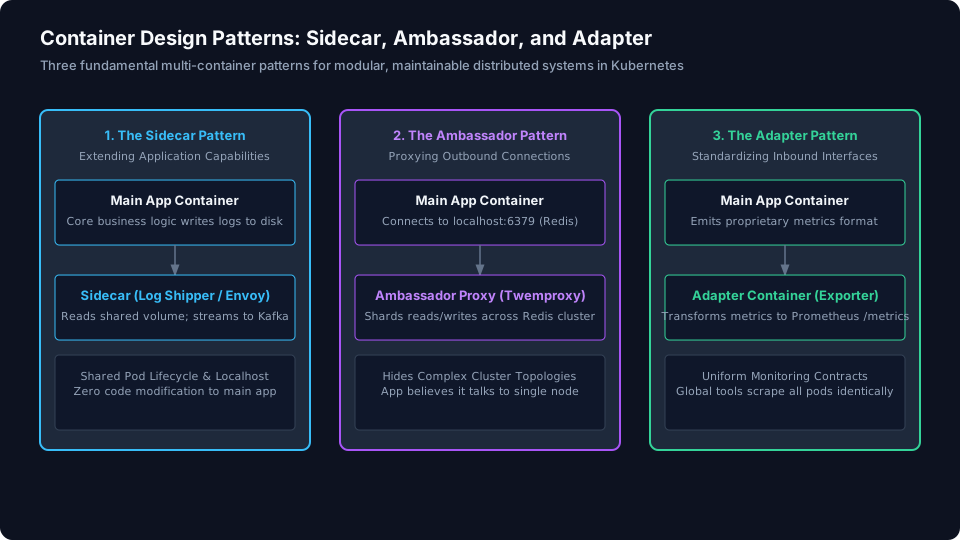
Container Design Patterns for Distributed Systems: Sidecar, Ambassador, and Adapter
Master the three essential multi-container design patterns in Kubernetes: Sidecar, Ambassador, and Adapter architectures for modular cloud systems.
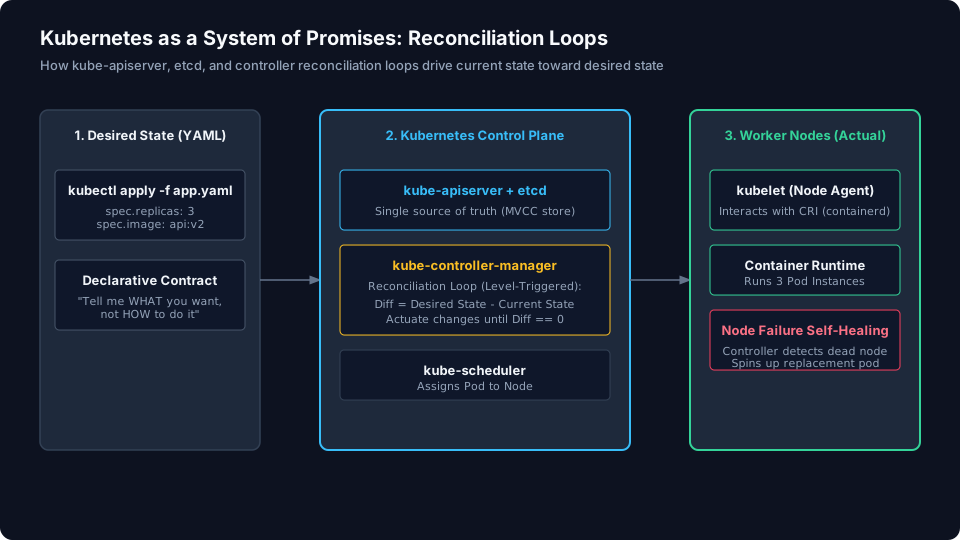
Kubernetes as a System of Promises: Reconciliation Loops and Desired State
Understand Kubernetes control plane architecture: declarative desired state, etcd, kube-apiserver, and controller reconciliation loops.
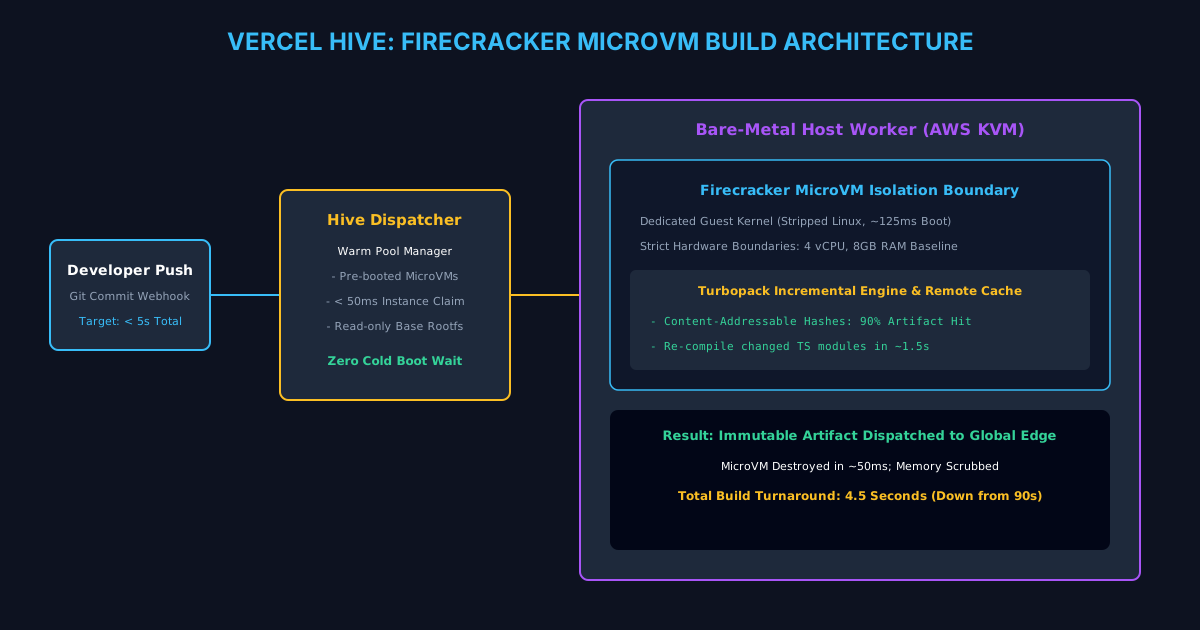
How Vercel Cut Multi-Tenant Build Times From 90 Seconds to 5
Inside Hive, Vercel's build infrastructure powered by Firecracker microVMs, warm worker pools, and layer caching for fast, isolated execution.
/* Comments */
Comments are offline right now — we reconnect automatically, nothing is lost.