
DLP Can See the Leak Without Stopping It
A CSA survey finds reported DLP incidents and limited pre-exfiltration blocking. The operational question is coverage, enforcement mode and alert usability.
On this page
A security dashboard can show that DLP is running while an organization still loses data. That is not necessarily a contradiction. “DLP deployed” says little about whether the relevant information is classified, which channels are inspected, or whether the policy blocks, warns or only records an event. A new Cloud Security Alliance survey makes that gap visible, although its sponsor and sample should keep the numbers in perspective.
What the survey says—and who answered
The Cloud Security Alliance’s October report summarizes an online survey of 433 IT and security respondents conducted in June and July 2026. The respondent mix spans organizations from fewer than 1,000 employees to 50,000 or more, but is concentrated in the United States and Canada. CSA says Jazz sponsored the work and co-developed the questionnaire, while CSA performed the analysis and interpretation. Those details matter when using the results: they describe this respondent group, not a statistically representative census of all companies. [1] [2]
Among respondents, 73% said their organization had experienced at least one confirmed data-loss incident in the preceding 24 months. Among that affected group, just 16% said DLP blocked their most significant incident before the data left. The report also describes widespread alert fatigue and relatively limited routine reporting about generative AI use. These are self-reported answers about different experiences; they should not be combined into a single causal claim that DLP caused or failed every incident. [1] [2]
The strongest reading is narrower: a significant share of respondents do not experience their DLP system as a dependable pre-exfiltration barrier across their most serious incident. That can happen because the incident traveled through an uncovered channel, the data was not recognized, the policy only alerted, or a human overrode a warning. The survey does not identify which explanation applies in a particular organization. Security teams need their own telemetry to answer that.
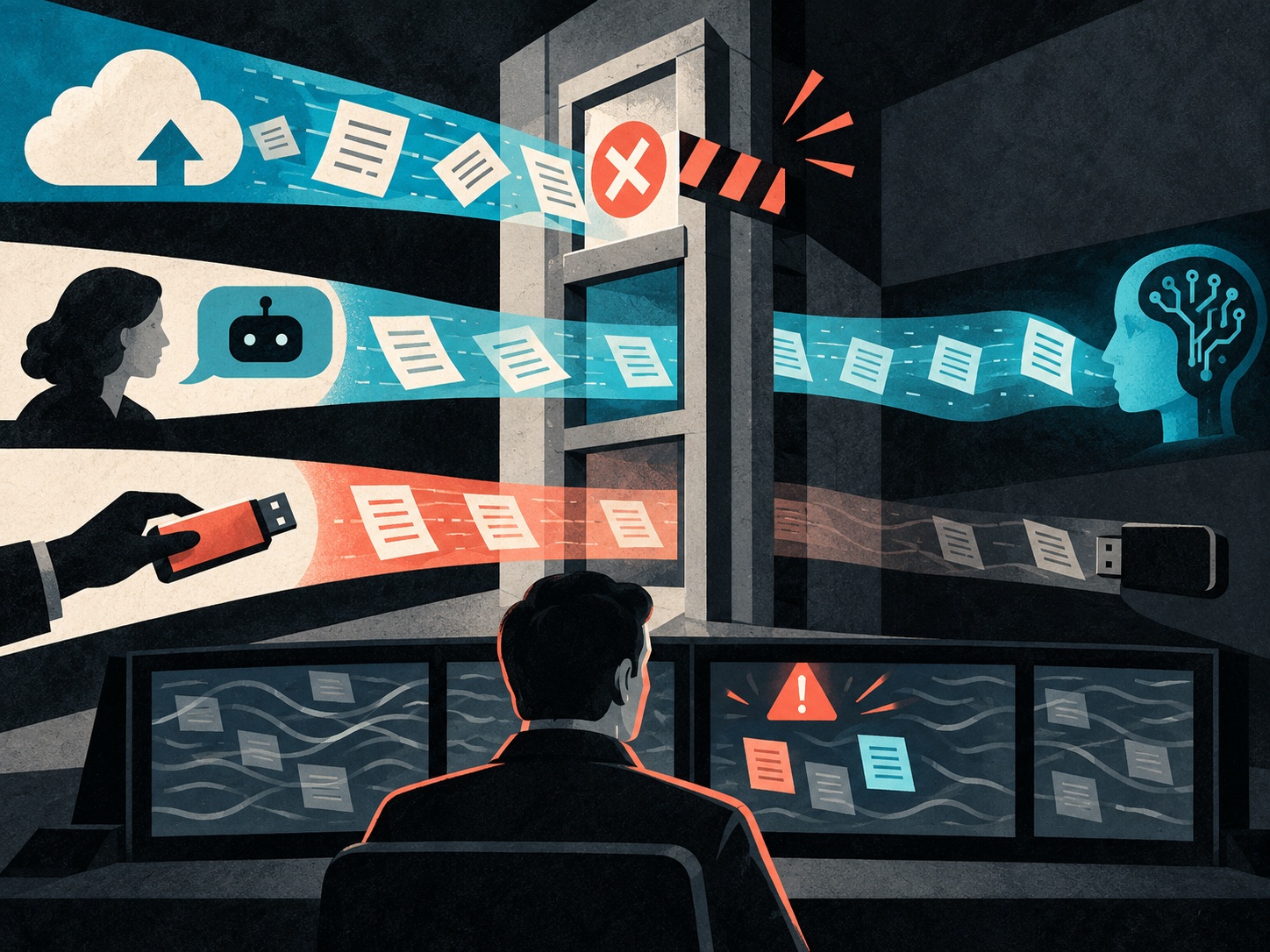
“DLP” describes a family of controls, not one switch
NIST defines data loss prevention in terms of preventing sensitive data from being shared, transferred or used in an unauthorized way. In practice, a program may inspect data at rest, in motion or in use and apply different responses depending on the channel and classification. A browser upload, email attachment, endpoint copy, SaaS sync and prompt sent to a public AI service are not automatically governed by the same policy. [4]
That makes coverage a matrix rather than a yes/no property. For each important data class, a team should ask: where does the data live; which systems can read it; which egress routes are monitored; which identity and device signals are available; and what happens when a rule matches? A control that logs a cloud upload may be valuable for investigation, but it is not a block. A strict block on email does not protect a copied file uploaded through an unmonitored browser or an unmanaged endpoint.
Enforcement mode also reflects business risk. Strict blocking can stop a leak but disrupt legitimate work when classification is noisy. A warning can educate and gather context but relies on the user’s decision. Audit-only mode gives visibility with no immediate prevention. The important question is not whether a policy is “on”; it is whether its chosen action matches the data’s sensitivity and the business’s tolerance for interruption.
A practical audit after reading the headline
Map actual flows. Start with a small set of high-impact data types—customer records, source code, regulated research or credentials—and trace a legitimate workflow from storage to collaboration. Include managed and unmanaged devices, browser uploads, email, sync clients and AI tools. Record the control at each boundary and the evidence it emits.
Separate detection from enforcement. Export policy settings and group them by channel: monitor, warn, require justification, quarantine or block. Compare the configured mode with the claim made to executives. If a policy only alerts, call it visibility or detection in the control description. Do not report it as prevention.
Measure alert quality and human overrides. Review a representative period of alerts, deduplicate recurring events, identify false positives, and inspect override reasons. High noise can undermine a technically correct control because analysts and users learn to ignore it. Tune against a documented baseline, but track what coverage changes when thresholds move.
Review AI pathways explicitly. The CSA report says GenAI is a leading concern for respondents, while routine reporting remains limited. That does not prove every organization is leaking data through AI. It does suggest a concrete inventory question: which approved and unapproved AI services can receive organizational data, and which identity, endpoint and network controls can see those flows? [1]
Run a safe pilot. NIST’s draft SP 1800-39 practice guide focuses on discovering, identifying and labeling unstructured data. Teams can use that lifecycle to select a bounded data set, test detection first, review false positives with business owners, then pilot stronger actions on a narrow channel. The guide is an initial public draft, not a regulatory mandate. [3]
Survey limitation is part of the story
Jazz’s sponsorship and questionnaire collaboration do not invalidate the findings, but they belong alongside the headline. The report’s sample, geography, self-reporting and definitions constrain what can be inferred. The results should not be used to claim that 73% of all organizations have lost data, nor that DLP blocks only 16% of incidents industry-wide. Those percentages describe respondents and a subset of respondents with a reported loss.
An organization can test the relevant proposition directly. Pick a few sensitive data flows and document what the current controls see, what they do, and how often legitimate work is disrupted. Compare the resulting evidence with the organization’s risk statement. This produces a more actionable answer than counting DLP licenses or repeating an industry survey percentage.
A control is only as strong as its least visible route
Detection after an incident still has value: it can shorten response time and reveal an overlooked channel. But prevention claims demand a higher bar. Teams should know which data is covered, which paths are inspected, and whether the policy actually blocks the risky action. The survey is a useful warning against equating deployment with control effectiveness, as long as its population and sponsor remain visible in the interpretation.
The operational goal is not to block every transfer. It is to make high-risk movement observable and proportionate: strong controls for clearly sensitive data, useful explanations for employees, and an escalation path when a legitimate workflow meets a rule. Without that design, an organization may have DLP everywhere on a slide and a blind spot at the exact boundary that matters. Our credential-exposure analysis shows why protected data types need their own clear inventory.
Frequently asked questions
Does deploying DLP mean an organization can prevent data loss?
No. A DLP tool may discover, alert on or block different data flows. Organizations should verify which channels and data classes are covered and whether each policy detects, warns or strictly blocks.
What did the Cloud Security Alliance DLP survey report?
The 2026 CSA survey included 433 IT and security respondents, mainly in the United States and Canada. Among respondents reporting a confirmed loss, only 16 percent said DLP blocked their most significant incident before data left.
How should security teams use the CSA DLP survey results?
Treat the results as a directional, self-reported survey rather than a universal incident rate. The survey was co-developed with and sponsored by Jazz, so pair it with local channel coverage, alert and incident data.
Sources & further reading
Keep reading

Exchange Symptoms After October Windows Updates: Microsoft's Guidance
Microsoft links Exchange symptoms to October Windows updates, rules out the separate Exchange update, and warns against uninstalling patches.

GitHub Actions Lockfiles Pin the Workflow, Not Its Good Intentions
GitHub's Actions lockfile preview pins workflow dependencies, including nested actions. It improves integrity but cannot tell you whether code is safe.

OpenAI's Rosalind Academic Plan Has a Narrow Lab-Shaped Door
The Rosalind Academic Plan offers up to 30 seats for eligible US university labs for up to a year, but excludes API access and requires trusted-access review.
/* Comments */
Comments are offline right now — we reconnect automatically, nothing is lost.