
The Company That Sells You Cybersecurity Just Got Hacked — Hacker Claims Its Cloud Keys Too
A hacker calling itself 888 claims 35GB of stolen Accenture source code and Azure keys. Accenture confirms a breach, disputes the scope.
On this page
Accenture spent 2025 telling every enterprise client on earth to modernize its cloud security posture. In July 2026, someone selling stolen Azure keys on a crime forum made the case that Accenture should have taken its own advice first.
What exactly did the hacker claim?
A poster using the handle “888” put a listing up on the cybercrime forum PwnForums on July 6, 2026, titled “Accenture Data Breach.” The pitch, per BleepingComputer: “Today I am selling the Accenture Data Breach, thanks for reading and enjoy!” The claimed haul was just over 35GB, described across the listing as source code, RSA keys, SSH keys, Azure Personal Access Tokens (PATs), Azure Storage access keys, and configuration files — offered for sale in Monero, the cryptocurrency of choice for people who’d rather not leave a paper trail.
As proof, 888 posted a screenshot appearing to show a clone operation against an Azure DevOps repository named 121123_AtriasTalentAcademy, associated with what looked like an Accenture production hostname. Both BleepingComputer and The Register note they could not independently verify the full scope of the claim from that screenshot alone — a single repo clone is evidence of something, not proof of a 35GB exfiltration.
That gap between “here’s a screenshot” and “here’s a verified breach inventory” is the entire story right now, and it’s worth sitting with before reaching for a verdict either way.
Threat intelligence firm SOCRadar, cited by The Register, says the same 888 handle previously claimed a 2024 incident tied to Accenture — data on more than 32,000 current and former employees, sourced from a third-party compromise rather than Accenture’s own infrastructure. A repeat claimant with a prior partially-substantiated claim carries more weight than a first-time poster, even before independent verification of the new one.
What did Accenture actually confirm — and what did it dodge?
Accenture confirmed there was an intrusion. It did not confirm anything else the hacker claimed. Spokesperson Andy Rowlands gave The Register a statement that both papers ran nearly verbatim: “We are aware of this isolated matter, and we have remediated its source. There is no impact to Accenture operations and service delivery.”
Read that sentence as a lawyer would, not as a headline. It confirms an incident happened and says the source has been fixed. It does not confirm the 35GB figure. It does not confirm which of source code, RSA/SSH keys, Azure PATs, or Storage access keys were actually taken versus merely listed. It does not say how the attacker got in. It does not say whether client data — as opposed to Accenture’s own internal repos and credentials — was ever in scope. The Register asked how the compromise occurred, which systems were affected, and exactly what data was taken; Accenture did not respond.
“Isolated” is doing a lot of work in that quote, and it’s a claim, not a finding — one Accenture has every incentive to make and no independent party has yet confirmed.
- 35GB total, posted July 6, 2026
- Source code + RSA/SSH keys
- Azure PATs + Storage access keys
- Configuration files
- Sale priced in Monero
- An “isolated matter” occurred
- Source has been “remediated”
- No customer/financial impact claimed
- No confirmation of data volume
- No detail on entry vector
Why do leaked Azure keys matter more than a leaked repo?
Because a repo is a confidentiality loss and a live key is an access loss, and those are different classes of emergency. Source code walking out the door is bad for IP and can leak logic attackers use to find further bugs. But Azure Personal Access Tokens and Storage access keys are credentials — if they were live and un-rotated at the moment of exposure, they are a direct line into whatever cloud resources they were scoped to. That’s the difference between “someone read our diary” and “someone has a key to the building,” and it’s why the claimed inclusion of RSA/SSH keys and Azure PATs alongside source code is the detail worth more scrutiny than the 35GB headline number.
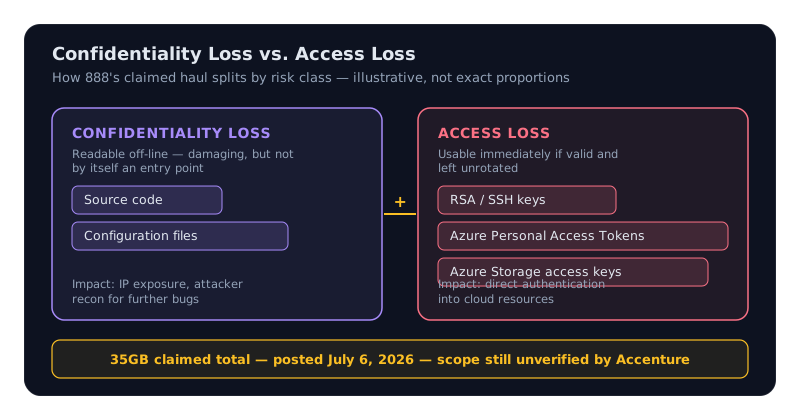
This is also why “we remediated the source” is the load-bearing phrase in Accenture’s statement, not “no impact.” Fixing the source — patching whatever let 888 in — matters, but it’s a separate question from whether every credential visible in that 35GB claim has since been rotated. Accenture hasn’t said either way.
What should engineering teams actually do with this story?
Treat it as a live reminder to audit their own blast radius, not as evidence that Accenture specifically was careless — nobody outside Accenture and 888 currently knows enough to say that. The pattern is familiar regardless of how this particular claim resolves: a PAT or storage key gets committed, embedded in a CI config, or left in a script, and it sits there working fine until someone finds it — the same failure mode behind a recent GitHub Actions supply-chain backdoor that hit AsyncAPI’s build pipeline. Companies with otherwise mature DevOps practices and repo hygiene still leak secrets constantly, because secret scanning is a discipline, not a one-time setup step.
Do
- Rotate any credential the moment it’s suspected exposed, don’t wait for confirmation
- Run automated secret scanning on every commit, not just at CI build time
- Scope Azure PATs and Storage keys as narrowly as the task allows, never org-wide
- Assume a claimed leak is real for response purposes until proven otherwise
Don't
- Wait for a vendor’s PR statement to decide whether to rotate your own exposed keys
- Treat “no financial impact confirmed yet” as “no impact”
- Store long-lived PATs in scripts or config files instead of a secrets manager
- Assume a forum listing is fake just because the seller is anonymous
Where does this leave Accenture — and everyone watching?
It leaves Accenture in the uncomfortable position every large services firm eventually occupies: confirming just enough to avoid a disclosure violation while disputing just enough to protect the brand, with the real scope sitting somewhere in between until forensics — public or private — narrow it down. Accenture’s own advisory business exists to tell clients that “isolated,” “remediated,” and “no impact” need to be backed by evidence, not just asserted. The same standard now applies to Accenture, and it’s arriving in a stretch of 2026 already crowded with major disclosures — including KDDI’s breach affecting 14 million logins across six Japanese ISPs.
For everyone else, the actionable takeaway isn’t schadenfreude. It’s that a 35GB claim built on source code, RSA/SSH keys, and cloud access tokens is exactly the combination that turns a single intrusion into a multi-system incident if the credentials were live — and that the gap between a forum screenshot and a fully verified breach inventory is where most of the real risk assessment work actually happens, whether it’s Accenture doing it internally or the rest of the industry watching from outside.
Until Accenture, or an independent forensics review, closes that gap, the honest summary is the one both outlets landed on: a threat actor claims a lot, a major vendor confirms a little, and the difference between those two accounts is currently unresolved.
Frequently asked questions
What did the hacker actually claim to steal from Accenture?
A threat actor using the handle 888 posted on the cybercrime forum PwnForums on July 6, 2026, claiming to have exfiltrated just over 35GB of data, including source code, RSA and SSH keys, Azure Personal Access Tokens, Azure Storage access keys, and configuration files, which it offered for sale in Monero.
Did Accenture confirm the breach?
Yes. Spokesperson Andy Rowlands said Accenture is "aware of this isolated matter, and we have remediated its source," adding there is "no impact to Accenture operations and service delivery." Accenture did not confirm the 35GB figure, the specific data types claimed, or how the intruder got in.
What evidence did the hacker provide?
A screenshot appearing to show the attacker cloning an Azure DevOps repository named 121123_AtriasTalentAcademy from what looked like an Accenture-linked production hostname. Neither BleepingComputer nor The Register could independently verify the full scope of the claimed 35GB haul from that screenshot alone, leaving the true extent of the intrusion unconfirmed.
Has this threat actor targeted Accenture before?
According to threat intelligence firm SOCRadar, cited by The Register, the same 888 handle previously claimed a 2024 incident tied to Accenture involving data on more than 32,000 current and former employees, obtained through a third-party compromise rather than Accenture's own systems.
Why do leaked cloud keys matter more than leaked source code?
Source code is a confidentiality problem; live Azure Personal Access Tokens and Storage access keys are an access problem. If valid and unrotated, they can let an attacker authenticate directly into cloud resources, which is why incident response for credential leaks prioritizes rotation over disclosure.
/* Comments */
Comments are offline right now — we reconnect automatically, nothing is lost.