
On this page
A quadruped can be made to move by writing a gait into its controller. The harder question is whether the body itself can help organize that movement. A new study of the compliant research robot eBert explores that alternative: identify the body’s natural oscillations, excite them, and let its springs and inertia contribute to the coordination.
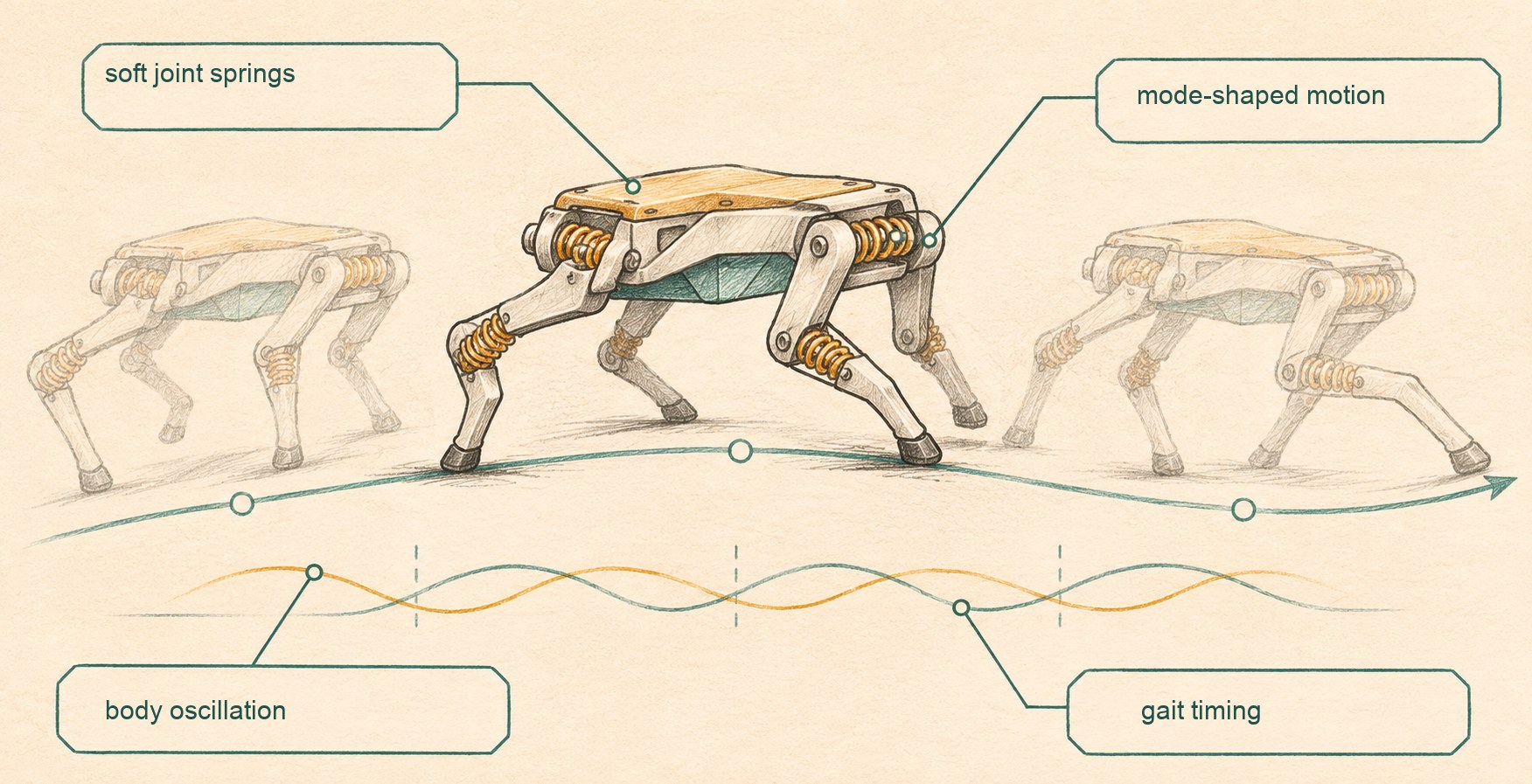
The result is a useful design lesson, not a claim that controllers are obsolete. The authors report six nonlinear normal modes for eBert, validated in simulation and hardware, then use mode-informed foot patterns to produce distinct locomotion behaviors. Their central proposition is that morphology can make some motions easier to elicit. [1]
The body is part of the control problem
Many legged robots rely on relatively stiff actuators and feedback controllers that continuously correct motion. This can work well, but the controller must coordinate a body whose useful dynamics are not necessarily designed into the mechanism. Animals offer another model: elastic tissue, posture and neural control interact, so movement is shaped by both computation and mechanics.
The eBert study asks whether a robot’s own resonances can serve as a useful movement vocabulary. A nonlinear normal mode is a coordinated oscillation of a nonlinear mechanical system. The term does not mean a single motor simply vibrates at one frequency. The motion depends on the robot’s geometry, mass distribution, springs and configuration, and can change as its amplitude grows.
The researchers first characterize these modes around a constrained standing pose. They identify six, then check that the predicted motions are present in the physical robot as well as in simulation. A simple state-switching controller supplies energy to excite a chosen mode and compensates for friction. A further foot-lifting pattern, matched to each mode’s coordination, turns oscillation into a gait. [1]
That sequence matters. The hardware is not walking autonomously from a passive shove. Analysis identifies plausible motions; feedback excites them; foot control helps convert them into steps. “Embodied intelligence” here describes a division of labor between a mechanism that makes some motions natural and a controller that selects and sustains them.
Why this could change robot design
If engineers can anticipate a robot’s useful modes during mechanical design, they may reduce the amount of detailed gait choreography needed for every task. A body could be built to favor a family of motions, with control choosing among them. The paper reports that each identified mode can lead to a distinct gait and speed in simulation, with much of that behavior transferred to eBert hardware. [1]
The approach is especially relevant when a robot’s task changes. A trot, bound or pace is not just a different animation: footfall timing affects stability, contact forces and energy. A morphology that supports several coordinated patterns could give a controller a smaller, more interpretable set of choices than a large collection of hand-tuned trajectories.
But this is not evidence that resonance automatically yields efficient or robust field locomotion. The experiments are a proof of concept on one highly compliant quadruped. The paper describes mode-informed movement on hardware, not a broad terrain benchmark, long-duration reliability study, or comparison of energy use against production robots. Contact changes also mean the standing-pose modes are proxies for movement tendencies, not an exact model of every phase of walking. [1]
What robotics teams should take from it
For teams designing legged platforms, the practical question is whether mechanical dynamics are being treated as a resource or only as a disturbance to cancel. A useful early design loop could measure or model modes, determine which tasks they might support, and evaluate whether the controller can excite them predictably under changing loads and contact.
That loop still needs the familiar engineering checks: stability margins, actuator limits, repeatability, terrain variation, payload changes, battery draw, and safe recovery when the expected mode is not available. A body tuned for one rhythm may become harder to control elsewhere. The study motivates co-design, where hardware and control are developed together, rather than simply replacing one with the other.
The broader idea has roots in biorobotics, which uses robotic systems to study how physical structure and control interact in animal-like movement. [3] eBert adds a concrete engineering demonstration: nonlinear dynamics can be analyzed on a full quadruped and deliberately used to produce motion on hardware. The next test is whether that design knowledge generalizes beyond a carefully engineered research platform.
A useful follow-up experiment would separate the value of the mode analysis from the value of the added foot pattern. For each mode, a team could compare the same controller with and without mode-informed timing, then report speed, stability, energy and recovery under matched conditions. That would show whether the body dynamics reduce control effort, improve repeatability, or simply produce a different motion. The paper motivates these tests; it does not yet settle them.
This distinction matters for deployment. Elastic joints can store and return energy, but they can also introduce sensitivity to payload, wear and contact conditions. A controller that excites a resonance safely in a constrained lab may behave differently on a slope or under a changing load. The right engineering target is not “let physics handle it,” but “measure which physical behaviors are useful, and define when the controller should use or avoid them.”
For now, the strongest claim is modest and valuable: springs can do more than absorb shock. With the right analysis and a controller that knows how to excite them, a robot’s body can help write its gait.
Frequently asked questions
Does the eBert robot walk without a controller?
No. The researchers use a deliberately simple feedback controller to excite the robot's identified modes and compensate for friction, then coordinate foot lifting. Its mechanics shape the gait, but control remains part of the system.
Was the work tested on a physical robot?
Yes. The paper reports identifying six nonlinear normal modes in simulation and hardware and transferring several mode-inspired gaits to the physical eBert platform. It is a proof of concept, not a field deployment.
Sources & further reading
Keep reading
Praxis-1 Predicts What a Robot Will See Next—and the Motion to Get There
Runway’s open robot-action model couples short-horizon video prediction with control. It is a research starting point, not a safety-rated robot brain.

Kodiak’s New Driverless Trucks Expand a Specific Industrial Route
Two Western Star 49X trucks with Kodiak’s Gen7 system entered Atlas’s Permian fleet. The deployment is industrial and route-bound, not a general highway launch.
MIT’s Robot Memory Knows When It Should Look Again
UQ-DAAAM helps a robot revisit uncertain object memories. Its benchmark reduces uncertainty under a view budget, not proving every memory true.
/* Comments */
Comments are offline right now — we reconnect automatically, nothing is lost.