
Kodiak’s New Driverless Trucks Expand a Specific Industrial Route
Two Western Star 49X trucks with Kodiak’s Gen7 system entered Atlas’s Permian fleet. The deployment is industrial and route-bound, not a general highway launch.
On this page
Autonomous trucks are easiest to understand when the route and job are specific. Kodiak’s latest delivery is not a generic promise to replace long-haul drivers: it is two heavy vocational trucks joining Atlas Energy Solutions’ Permian Basin operation, where trucks move proppant between load-out points and oilfield sites. The deployment has a defined customer, cargo and operating region—useful boundaries for judging what the technology has demonstrated. [1] [2]
A new chassis, a new hardware generation
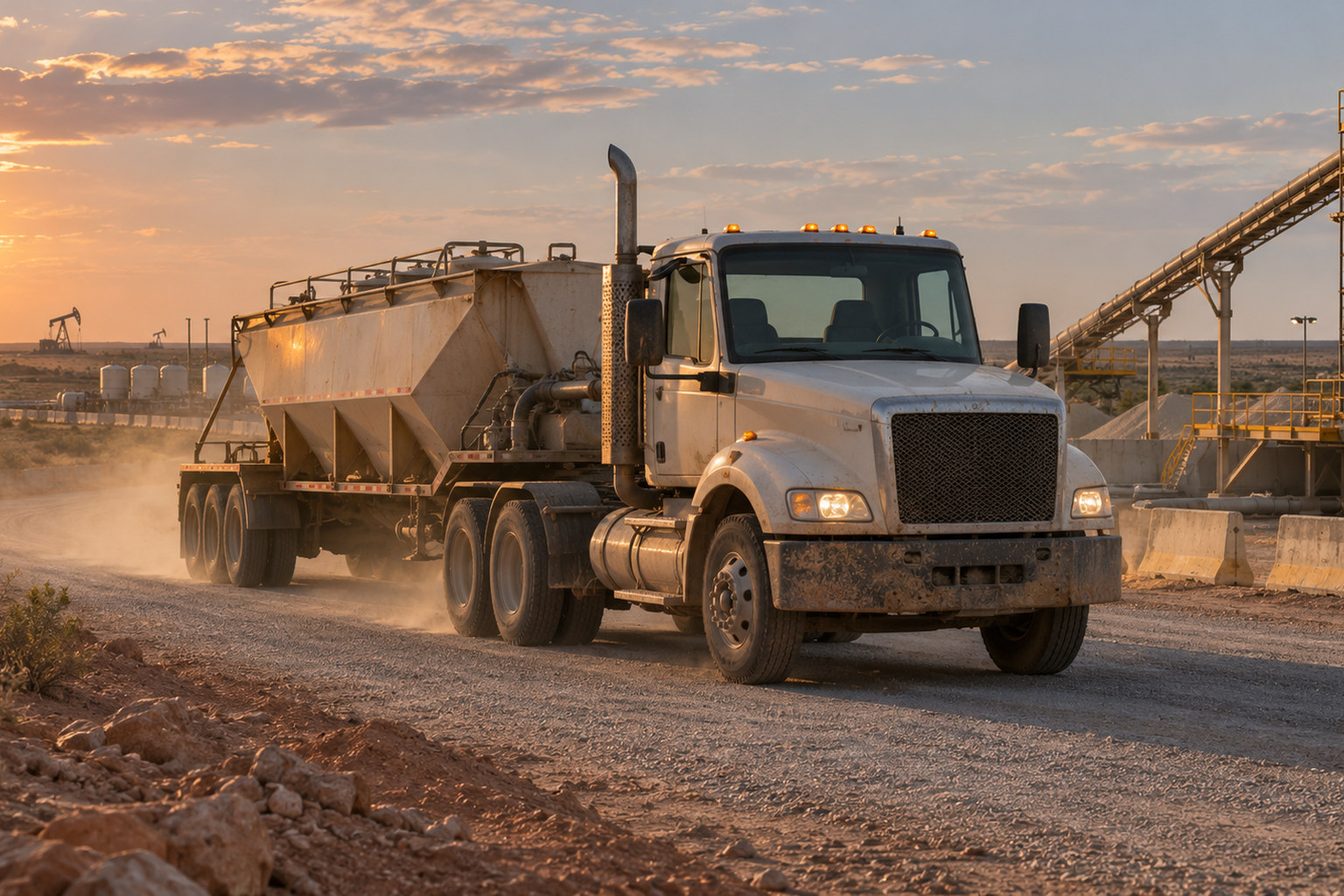
Kodiak announced on November 3 that it had delivered the first two Western Star 49X trucks equipped with its Kodiak Driver system to Atlas in September. They are the first of 65 Western Star units that Kodiak plans to deliver as part of Atlas’s initial order for 100 Kodiak-equipped driverless trucks. The company says Atlas’s owned-and-operated fleet reached 37 vehicles after the addition. [1]
The 49X is a heavy-duty vocational platform manufactured by Daimler Truck North America, designed for demanding work sites. Kodiak says the new trucks are the first in its commercial service to use its Gen7 hardware and the first day-cab autonomous trucks in that service. Gen7 has a more compact design intended to simplify integration across vehicle configurations. Kodiak reports nearly 50% more compute power than its Gen6 platform, while stress tests suggest its sensor pods and compute enclosures may last longer. Those are company-reported hardware comparisons; the release does not provide an independent evaluation or a longitudinal fleet comparison. [1] [3]
Atlas’s use case is a logistics loop. The trucks haul proppant, a material used in oil and gas well completion, in a region where the company already operates mines, load-out points and a sand-conveyor system. Atlas previously described expanding the driverless operation across a second load-out point and said its fleet had completed thousands of loads and tens of thousands of driverless hours by March 2026. Those figures describe the company’s own operational reporting, not independently audited safety performance. [2]
An industrial route is not an open highway
Kodiak says these trucks operate with no person in the cab. The announcement also says the companies began limited service over public county roads in the Permian Basin in cooperation with regional highway transportation authorities. It expects broader public-road use around mid-2027 after safety requirements are met. These conditions are important: this announcement describes a bounded service expansion with specific partners, not unrestricted autonomous trucking across the United States. [1]
Driverless work on industrial routes can be more controlled than a general long-haul route, but it still needs a complete operating system. Fleet operators must handle vehicle maintenance, remote support, weather, route changes, loading and unloading, incident response and the handoff between automated and human-run operations. A truck can perform reliably on one repeated route while the system remains unproven on another road, in another vehicle configuration or under different operating conditions.
The broader autonomous vehicle field is also full of distinct deployments. For example, a drone’s multi-sensor inspection workflow is a different form of automation with its own human review and operational limits. The useful comparison is not which technology is “more autonomous,” but how each one constrains its operating domain and handles exceptions.
Measure the service, not only the hardware
The next evidence to watch is whether the fleet grows on schedule, whether the new 49X platform maintains uptime under actual Permian conditions, how often a human intervenes and how the companies report incidents or route restrictions. Kodiak says the initial 100-truck order is on track for completion in the first half of 2027. It also cites an earlier 64-day uptime record from a Gen6-equipped truck, which should not be confused with a Gen7 result. [1]
For a buyer, “driverless” does not answer every procurement question. A useful evaluation asks what routes are covered, what cargo is moved, which conditions trigger a stop, how remote assistance is staffed and what evidence supports the expected maintenance interval. Truck count and compute power are relevant indicators of scale and hardware design, but neither alone proves lower cost, safer operations or transfer to public highways. Kodiak and Atlas have described a real commercial deployment; their next task is to show that the system expands while preserving the operating boundaries and service reliability that make it useful.
Frequently asked questions
What did Kodiak deliver to Atlas Energy Solutions?
Kodiak says it delivered two Western Star 49X trucks equipped with its Gen7 autonomous hardware to Atlas in September. They are the first of 65 Western Star trucks planned within Atlas’s initial order of 100 Kodiak-equipped driverless trucks.
Are these trucks operating as driverless long-haul highway trucks?
No. The announcement concerns Atlas’s industrial proppant-logistics operation in the Permian Basin. Kodiak says the companies began limited service on public county roads in cooperation with local transportation authorities, with broader use expected only after additional safety requirements.
What is new about the Gen7 hardware?
Kodiak says Gen7 has a more compact design and nearly 50 percent more compute power than Gen6. The company also says stress testing indicates longer expected lifetimes for its SensorPods and compute enclosures; those are company-reported comparisons, not independent fleet results.
Sources & further reading
Keep reading

MIT’s Robot Memory Knows When It Should Look Again
UQ-DAAAM helps a robot revisit uncertain object memories. Its benchmark reduces uncertainty under a view budget, not proving every memory true.
T-Rex Gives Robot Hands a Faster Sense of Touch
Panasonic's tactile robot policy separates slower visual planning from faster touch corrections. Its benchmark results are promising, with clear limits.
Encrypted Robot Commands Can Still Leave a Readable Rhythm on the Network
A 2026 study found robot actions could be inferred from encrypted traffic metadata, exposing a privacy gap between payload secrecy and behavioral privacy.
/* Comments */
Comments are offline right now — we reconnect automatically, nothing is lost.