
On this page
Imagine asking a household robot where the first-aid kit is. It glimpsed a red cabinet from across a corridor, but a cart blocked half the view. A useful robot should not turn that partial glance into a confident instruction. It should be able to say, in effect, “I may have this wrong. Let me check.”
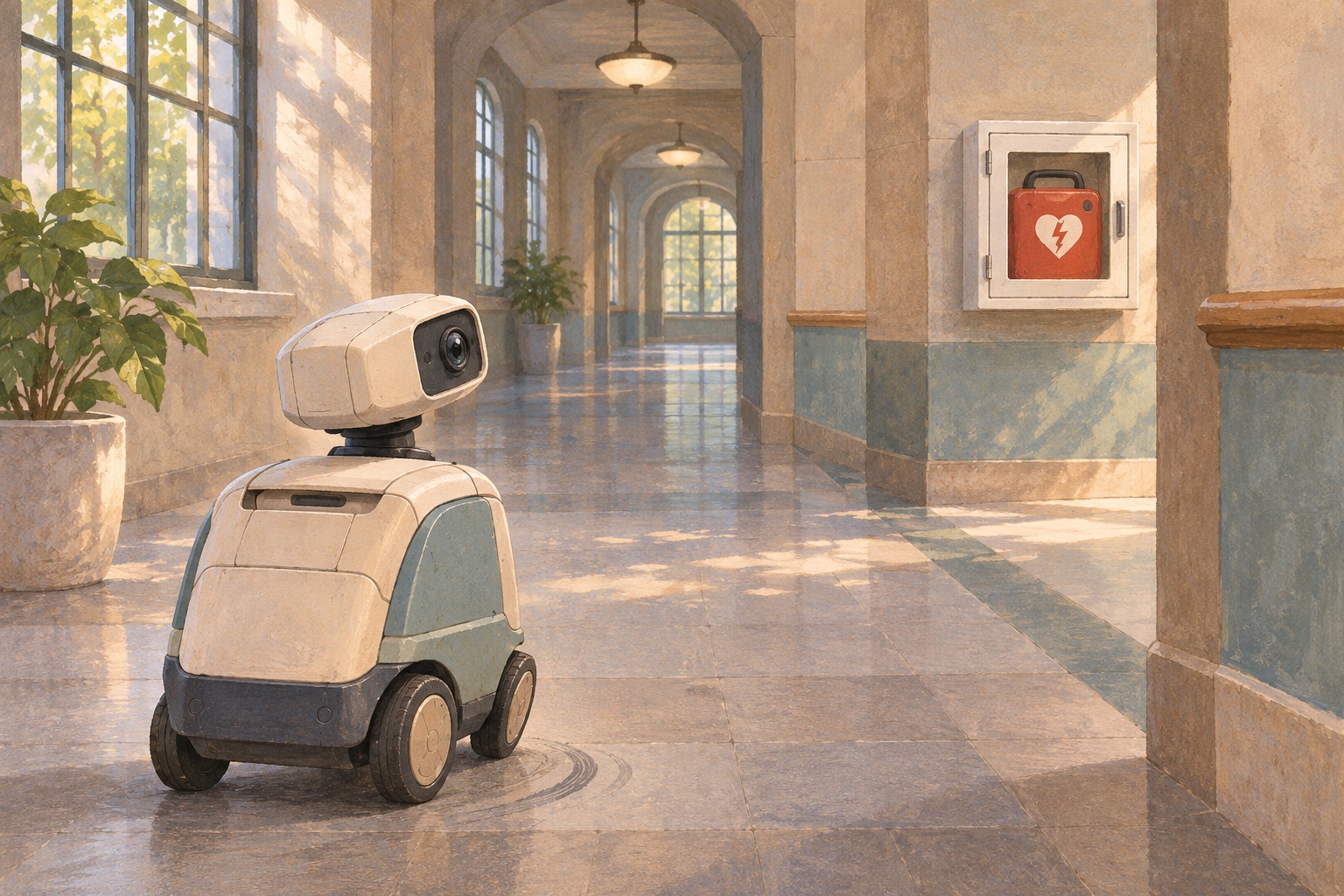
MIT News describes a new method called UQ-DAAAM for estimating uncertainty in a robot’s spatial memory and deciding whether it should collect additional views. The work extends the group’s earlier DAAAM approach, which helps a robot answer questions about objects it has encountered. The newer method asks a crucial second question: how much should the robot trust the description it stored? [1] [3]
The paper, “Remember with Confidence,” models uncertainty using two signals: how much captions for the same object vary across views, and how coherent each view’s description appears. When a later query depends on a fuzzy object, the system can spend a limited view budget to collect more evidence and update its memory. [2]
A confidence score is a reason to investigate
The work is less like adding a permanent “confidence: 0.87” label to every object and more like deciding where the robot’s limited attention is most valuable. If the stored description changes drastically as the camera angle changes, or a single caption appears internally inconsistent, that object is a candidate for another look. The robot can prioritize that evidence rather than revisiting everything equally.
In the paper’s reported experiment with a budget of two additional views, UQ-DAAAM achieved a 92.3 percent uncertainty reduction rate, compared with 34.2 percent for a quality-based baseline and 5.6 percent for random view selection. The measure describes reduction in uncertainty under that setup. It does not mean 92.3 percent of all object labels were correct, nor that the method will achieve the same result in every building, robot or vision model. [2]
That wording matters because “confidence” sounds like truth to a person reading an answer. But a robot can become consistently wrong. Several views may share the same obstruction. A vision model can repeat one mistaken label. A question can contain a false premise. The system’s uncertainty estimate is a signal about its own evidence, not an external certificate that the world matches its memory.
The right next step can be another view
A robot that can revisit an object changes how memory works. Instead of treating a stored scene as a static map, it can treat it as a set of claims with uneven evidence. When a user asks a low-stakes question, a tentative answer may be enough. When the answer affects navigation, medication, safety equipment or a person’s belongings, the system should seek a clearer view or hand the decision to a person.
A practical design would make the uncertainty visible in the interaction. “I saw a red cabinet near the north hallway, but the label was partly blocked. I can return and check” is more useful than a polished guess. It also gives the person a chance to correct the task before the robot acts.
There are limits to the evidence. The paper evaluates on indoor robot question-answering settings and describes assumptions behind its uncertainty guarantees. Its authors note limitations related to model calibration and hallucinated captions. The evaluation demonstrates a research technique for choosing views; it does not establish that a deployed robot can safely identify emergency equipment in a real building. [2]
That gap is where the next engineering work lives: test across different homes and facilities, measure how often the system’s uncertainty predicts an actual error, check what it does when new views remain ambiguous, and define when a human must confirm. The most trustworthy robot memory may not be the one that never hesitates. It may be the one that knows when its first impression deserves a second look.
Frequently asked questions
What is UQ-DAAAM designed to do?
It estimates uncertainty in a mobile robot's object-level spatial memory and can select additional camera views when a later question requires more evidence. It is a research method, not a deployed emergency-response product.
Does the reported 92.3 percent mean the robot is 92.3 percent accurate?
No. In the paper's fixed two-view-budget experiment, 92.3 percent is the uncertainty reduction rate. It is not object recognition accuracy or a universal measure of factual correctness.
Can repeated views prove that a memory is correct?
No. The system can reduce uncertainty by comparing captions across selected views, but repeated observations may share the same blind spot, model error, or incorrect premise. High-stakes tasks need independent checks.
Sources & further reading
Keep reading
Kodiak’s New Driverless Trucks Expand a Specific Industrial Route
Two Western Star 49X trucks with Kodiak’s Gen7 system entered Atlas’s Permian fleet. The deployment is industrial and route-bound, not a general highway launch.
T-Rex Gives Robot Hands a Faster Sense of Touch
Panasonic's tactile robot policy separates slower visual planning from faster touch corrections. Its benchmark results are promising, with clear limits.
Encrypted Robot Commands Can Still Leave a Readable Rhythm on the Network
A 2026 study found robot actions could be inferred from encrypted traffic metadata, exposing a privacy gap between payload secrecy and behavioral privacy.
/* Comments */
Comments are offline right now — we reconnect automatically, nothing is lost.