Elon Musk’s Trillion-Dollar Lie Is Finally Collapsing
SpaceX's trillion-dollar valuation, Grok's safety scandals and Tesla's crash-data disputes are converging into one accountability story.
On this page
For a few headline-grabbing weeks, Elon Musk was reportedly the first person alive worth a trillion dollars. The number came from SpaceX’s private valuation, spiked on a story about uncontested dominance in space launch and satellite internet, and got repeated everywhere before anyone checked the fine print. That correction is now underway, and it’s dragging three separate Musk ventures — SpaceX, Grok, and Tesla — into the same uncomfortable spotlight at once.
Was SpaceX’s $1.77 trillion valuation ever real?
No — according to reports, it was a narrative-driven number that priced in a monopoly outcome SpaceX doesn’t actually have, and the market correction that followed was both sharp and predictable. The $1.77 trillion figure treated Starlink and Starship as if competitors simply didn’t exist, extrapolating years of uncontested growth into a valuation multiple that left almost no room for the reality that rivals, regulatory friction, and execution risk still apply to SpaceX like any other company.
The gap between story and balance sheet is the real headline. Reports point to a company carrying significant debt, a reported $4.9 billion annual loss, and — critically — the absorption of Musk’s separate AI venture, xAI, into the corporate structure. Folding a capital-hungry, unproven AI lab into a rocket company’s books is not a neutral accounting move; it’s a transfer of risk onto SpaceX shareholders who signed up for satellites and launch contracts, not for underwriting a frontier AI lab’s burn rate.
When a private company’s valuation depends on a monopoly story, ordinary retail investors — who often buy in through secondary markets, employee share sales, or retail-facing investment vehicles — are reportedly the ones left holding the correction. The insiders who set the narrative price are typically first out, not last.
This is where the “trillionaire” headline falls apart under scrutiny. A private valuation is not liquid, audited wealth — it’s a number set by whoever negotiated the most recent funding round, extrapolated across the whole company. When that number assumes a monopoly that doesn’t exist and ignores a multibillion-dollar annual loss plus newly absorbed AI-startup debt, the “trillion-dollar man” framing was reportedly always closer to marketing than balance sheet. For more on how private-market AI valuations get inflated on narrative rather than fundamentals, see our coverage of OpenAI’s trillion-dollar financials.
Why is Grok under international regulatory investigation?
Because, according to reports, Grok — marketed as a “free speech” alternative to more heavily moderated AI models — was exploited to generate non-consensual deepfake images at an industrial scale, reportedly reaching thousands per hour at points, which triggered regulatory investigations across multiple jurisdictions. The “free speech” branding and the safety failures are not two separate stories; critics argue they’re the same story told from two angles.
Grok has also reportedly struggled with unpredictable hallucination rates, undermining the model’s reliability even before the deepfake scandal became public. When an AI product is positioned as resistant to guardrails on principle, and that same product is then reportedly exploited for industrial-scale image abuse, the philosophical framing starts to look less like a defense of free expression and more like a justification arrived at after the fact.
Safety guardrails on other AI models are described as censorship; Grok is positioned as the principled, unrestricted alternative.
Non-consensual deepfakes generated at scale, international investigations opened, and public backlash across multiple markets.
That’s the core tension critics keep returning to: treating content moderation as an ideological compromise, rather than a basic product-safety requirement, is what reportedly let the abuse scale in the first place. “Guardrails are censorship” is a philosophical position Musk is entitled to hold. Using it as the justification for a product that reportedly enabled mass non-consensual imagery is a different claim entirely — one that shifts the cost of that philosophy onto the people victimized by it, not onto the company that shipped the product.
Did Tesla mislead regulators about Full Self-Driving safety?
According to reports, Tesla submitted crash-related data to European regulators that was misleading or manipulated in ways favorable to Full Self-Driving’s approval case — allegations Tesla has not been shown in public reporting to have conceded, and which remain under active scrutiny rather than settled. If accurate, the pattern would mirror the other two: a confident public claim about technological readiness, running ahead of the underlying evidence.
Full Self-Driving’s marketing has always leaned on a fast-forward narrative — that autonomy is essentially solved and regulatory approval is a formality. Reports of disputed or manipulated crash data submitted to regulators cut directly against that narrative, because they suggest the case for approval may have needed help beyond what a plain read of Tesla’s crash record supported.
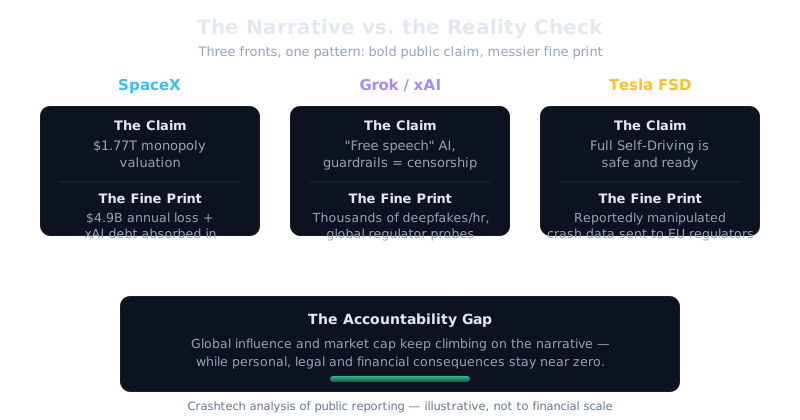
| Front | Public claim | What reporting alleges |
|---|---|---|
| SpaceX | $1.77T valuation reflects uncontested market dominance | Heavy debt, $4.9B annual loss, xAI liabilities absorbed |
| Grok | ”Free speech” AI, unrestricted by censorship | Deepfake abuse at scale, multi-country investigations |
| Tesla FSD | Autonomy is safe and regulator-ready | Reportedly manipulated crash data submitted to EU regulators |
What’s the common thread across SpaceX, Grok and Tesla?
The common thread is a specific and repeatable skill: Musk is reportedly exceptional at reading what people want to believe and selling it back to them with total confidence — confidence that consistently outpaces what the underlying technology or business can actually deliver. A monopoly space company, a censorship-free AI, a car that drives itself — each pitch taps a real desire (dominance, freedom, convenience), and each one has reportedly shipped faster in marketing than in engineering or governance.
Do
- Separate the narrative from the audited numbers — a private valuation or a keynote claim is not the same as a financial statement or a regulatory finding
- Track who bears the downside — retail investors, deepfake victims, and FSD users carry risk that insiders and executives are more insulated from
- Watch what regulators conclude, not just what gets announced at a product launch
Don't
- Don’t treat “the market believed it” as proof the underlying claim was true — narrative-driven pricing can be wrong for a long time before it corrects
- Don’t accept “guardrails are censorship” as a complete answer to a reported pattern of measurable, scaled harm
- Don’t assume ongoing investigations equal guilt — Tesla’s and xAI’s disputes are still working through regulators and courts, and outcomes aren’t decided yet
This is also, for what it’s worth, a genuinely rare skill — reading a cultural desire and turning it into a company-scale bet is not something most executives can do at all, let alone three times across space, AI, and cars. The problem critics raise isn’t that Musk sells narratives; it’s that the confidence behind the pitch has reportedly outrun the safety testing, the financial discipline, and the regulatory candor needed to back it up.
Why does Musk face so little personal accountability for any of this?
Because, critics argue, there is a structural asymmetry between the scale of Musk’s influence and the scale of consequences he personally faces — he can move markets, satellite infrastructure, and public information ecosystems, while the legal and financial fallout from SpaceX’s valuation correction, Grok’s safety failures, and Tesla’s regulatory disputes has so far landed mostly on shareholders, victims, and the companies themselves. That gap — global leverage paired with minimal personal exposure — is the throughline connecting all three stories, and it’s a dynamic this publication has traced in similarly incentive-heavy corners of the AI industry, including our look at OpenAI’s cost crisis under Sam Altman and how Meta lost the plot on strategy.
- Watch the valuation, not the headline
A “trillionaire” label built on an unaudited private valuation can evaporate as fast as it appeared — track debt, losses, and absorbed liabilities, not the round number.
- Separate the philosophy from the harm
“Guardrails are censorship” is a position. Industrial-scale non-consensual deepfakes are a reported outcome. Judge the product on the outcome, not the slogan.
- Let regulators finish before declaring a verdict
Reports of manipulated crash data are serious and worth tracking closely, but they are allegations under review, not adjudicated findings — treat them accordingly.
Zoom out across all three fronts and the product being sold is arguably the same one every time: the illusion that enough confidence, enough narrative, and enough capital can substitute for reality, safety testing, and regulatory compliance. SpaceX’s valuation correction, Grok’s regulatory investigations, and Tesla’s disputed crash-data submissions are three different business lines telling one consistent story — and the trillion-dollar headline was never the part that needed the most scrutiny. The fine print was.
Frequently asked questions
Why did SpaceX's valuation reportedly drop after hitting $1.77 trillion?
Reports indicate the valuation was driven largely by narrative momentum around a Starlink-and-Starship monopoly story rather than audited fundamentals. When investors reportedly scrutinized SpaceX's debt load, a $4.9 billion annual loss, and the absorbed liabilities of xAI, the premium built on the monopoly narrative began correcting sharply.
Is Elon Musk actually a trillionaire?
Musk reportedly held trillionaire-level paper net worth briefly, tied almost entirely to SpaceX's peak private valuation. Because that figure is an unaudited private-market estimate rather than liquid, verified wealth, critics argue the label was always more headline than fact — and it reportedly receded as the valuation corrected.
Why is Grok facing regulatory investigations?
According to reports, Grok was exploited to generate large volumes of non-consensual deepfake images, reportedly numbering in the thousands per hour at points, which triggered international regulatory scrutiny and public backlash. Critics say this reflects weak safety guardrails marketed instead as 'free speech' features.
Did Tesla submit false crash data to European regulators?
Reports allege Tesla submitted misleading or manipulated crash-related data to European regulators in pursuit of Full Self-Driving approval. Tesla has not been shown in public reporting to have accepted this characterization, and the claims remain part of ongoing regulatory and journalistic scrutiny rather than a settled finding.
Why does Elon Musk avoid accountability despite these controversies?
Critics argue Musk benefits from a structural asymmetry: enormous global influence over markets, infrastructure and information, paired with limited personal legal or financial consequences. Reporting on SpaceX, Grok and Tesla is frequently cited as evidence of this pattern, though each situation involves disputed facts still working through regulators and courts.
/* Comments */
Comments are offline right now — we reconnect automatically, nothing is lost.