
OpenAI’s $1 Trillion Bullsh*t Is Falling Apart
Leaked financials reportedly show OpenAI losing over a dollar for every dollar earned. Here's why the trillion-dollar story doesn't add up.
On this page
For three years, OpenAI has been the proof-of-concept for the entire AI industry: if the company behind ChatGPT can’t make the unit economics work, nobody can. According to reports on leaked internal financials, the unit economics don’t work — not close. What’s emerging isn’t a growth story with a rough patch. It’s a company reportedly burning cash at a scale that makes its trillion-dollar narrative look like the thing it’s actually selling: a story, not a balance sheet.
The Unit Economics Don’t Survive Contact With the Numbers
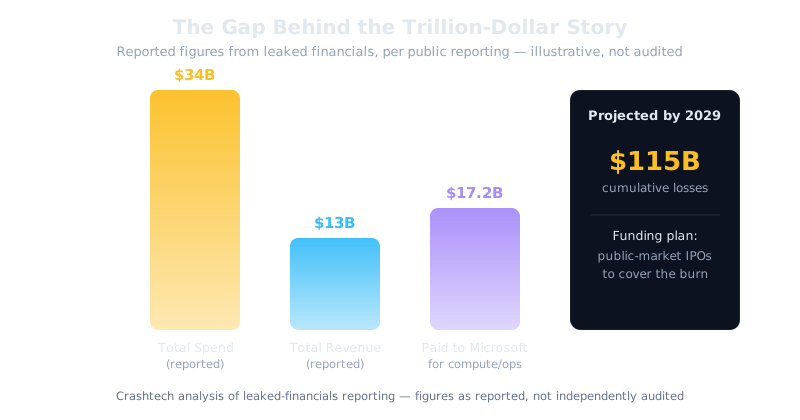
Start with the headline figure, because it’s the whole article in one sentence: leaked financials reportedly show OpenAI spent $34 billion to generate $13 billion in revenue. That’s a loss of roughly $1.22 for every dollar earned — not a rounding error, not a “growth investment,” but a structural gap between what the product costs to run and what customers pay for it.
The forward-looking numbers are, reportedly, worse. Internal projections cited in the leaked material put cumulative losses at $115 billion by 2029. That’s not a plan to reach profitability — it’s a plan to keep the lights on long enough for someone else to underwrite the difference, and the “someone else” increasingly means public market IPOs. Translate that out of finance-speak: the strategy for closing a $115 billion hole is to sell shares to retail and institutional investors before the hole gets much deeper.
| Reported figure | Amount | What it means |
|---|---|---|
| Total spend | $34 billion | Compute, staffing, infrastructure, marketing |
| Total revenue | $13 billion | ChatGPT subscriptions, API, enterprise |
| Loss per dollar earned | ~$1.22 | For every $1 in, ~$1.22 goes out |
| Projected cumulative losses by 2029 | $115 billion | Funded partly via planned public offerings |
| Paid to Microsoft | $17.2 billion | Compute and operations dependency |
| Marketing spend (reported increase) | ~5x, to $5.73 billion | Defending falling market share |
These figures come from reports describing leaked internal financials — OpenAI is privately held and doesn’t publish audited numbers the way a public company would. Treat every figure here as “according to reports,” not confirmed fact. That caveat itself is part of the story: a company asking for a trillion-dollar public valuation shouldn’t need leaks for anyone to see its numbers.
We’ve tracked this pattern before at Crashtech — see our breakdown of the Sam Altman-era cost crisis — and the trajectory hasn’t improved, it’s accelerated.
The Microsoft Dependency Nobody Wants to Say Out Loud
Here’s the part that should worry anyone modeling OpenAI as an independent company: reports indicate OpenAI paid Microsoft $17.2 billion for compute and operational infrastructure. That single line item is bigger than the entire annual revenue of most enterprise software companies — and it’s a number OpenAI paid to its own primary investor and infrastructure landlord.
OpenAI doesn’t own the data centers its models run on. It rents them, at scale, from Microsoft Azure. A “trillion-dollar AI company” that can’t run its own product without one vendor’s cooperation isn’t really independent — it’s a very expensive, very visible tenant.
This is also the backdrop for the market-share problem. Reports put OpenAI’s share of the AI assistant market below 50% for the first time, as Anthropic, Google, and a widening field of open-weight competitors eat into what used to look like an unassailable lead. OpenAI’s response, per reporting, was to quintuple marketing spend to roughly $5.73 billion — a defensive number, not a growth number. Companies with durable moats don’t need to buy back trust at that scale. This is the same pattern we flagged in Elon Musk’s trillion-dollar valuation collapse: the bigger the marketing spend relative to revenue, the less the underlying product is speaking for itself.
Silent Routing Broke the One Thing OpenAI Needed to Protect: Trust
If the financials are the structural problem, silent routing is the trust problem — and trust is the one asset a company this dependent on narrative can’t afford to lose.
The allegation, according to multiple reports, is straightforward and damning: OpenAI has quietly routed paying users and developers to cheaper, less capable models without telling them. You pay for a premium tier, you build against a specific model’s behavior, and at some point — silently — the thing answering you isn’t the thing you paid for.
A subscriber paying for a flagship model experience gets routed to a cheaper model during high-load periods, with no disclosure. The product feels worse and nobody tells you why.
Enterprise teams build production systems on assumed model behavior. When the underlying model changes silently, prompts that worked yesterday fail unpredictably today — with no changelog.
For consumer subscribers, that’s an annoyance. For enterprise developers, it’s closer to a “bait and switch” that can quietly break production applications. Teams fine-tune prompts and ship products against a specific model’s behavior. If that model gets swapped underneath them without notice, the failure isn’t cosmetic — it’s a broken commercial product, discovered in production, with no changelog to explain why.
Do
- Assume any “premium” AI API tier can be silently substituted during load spikes, per reports
- Version-lock and log which model actually answered each request, where the API allows it
- Build fallback evals that catch behavioral drift, not just outright errors
Don't
- Assume a vendor’s stated model name is a durable guarantee of behavior
- Ship a production system with a single-vendor, single-model dependency and no monitoring
- Treat “it worked in testing” as permanent — reported routing changes happen without notice
This is where the infrastructure story compounds the trust story. Reports describe unstable global infrastructure at OpenAI, with recurring outages and degraded service quality that hits European users particularly hard — a region already skeptical of U.S. AI providers on regulatory grounds. A company that can’t reliably keep its existing infrastructure up is a strange candidate to be trusted with silently swapping the models running on top of it.
Culture, NDAs, and a Pattern of Choosing Secrecy Over Transparency
The financial and infrastructure problems might be forgivable growing pains if the culture around them showed any humility. Reports suggest the opposite. Employees have reportedly mocked users publicly for forming emotional attachments to deprecated models — a tone-deaf response to a userbase that OpenAI itself spent billions in marketing trying to court.
Internally, the picture reported is more serious than bad PR. According to reports, OpenAI has used aggressive NDAs that could strip departing employees of vested equity if they spoke critically of the company — a structure that, if accurately reported, exists to suppress the kind of internal dissent that might otherwise surface problems like silent routing before they went public.
- Financial opacity
No public audited financials; the numbers that exist came from leaks, not disclosure — for a company seeking a public-market-scale valuation.
- Product opacity
Silent routing means even paying customers reportedly can’t be sure which model is answering them at any given moment.
- Cultural opacity
Reports of equity-linked NDAs suggest a structure built to keep former employees from talking, not just protecting trade secrets.
Put together, that’s not three unrelated controversies. It’s one pattern: OpenAI consistently chooses narrative control over transparency, at every layer — financial, product, and cultural. We saw a version of this same instinct play out in Meta’s strategic drift, where controlling the story took priority over fixing the product. The difference is that Meta isn’t asking public investors to price it at a trillion dollars on the strength of that story.
What This Means for Public Investors
None of this means OpenAI’s technology is fake, or that ChatGPT stops being useful tomorrow. It means the valuation story and the financial reality are reportedly diverging, and a trillion dollars is a lot of money to bet on narrative discipline from a company that, per multiple reports, has struggled with financial, infrastructure, and disclosure discipline all at once.
A company burning toward $115 billion in cumulative losses, dependent on one vendor for $17.2 billion in compute, quintupling marketing to defend eroding market share, and reportedly routing paying customers to cheaper models without telling them hasn’t earned the benefit of the doubt on its own math. Public investors weighing an OpenAI stake should ask a simple question: are they buying a product, or a story about a product? Right now, according to the reporting, those are two very different things.
Frequently asked questions
How much money is OpenAI losing?
According to reports on leaked internal financials, OpenAI spent roughly $34 billion to generate about $13 billion in revenue — losing an estimated $1.22 for every dollar it earned. The same reports project cumulative losses could reach $115 billion by 2029 if the current burn rate continues.
Why does OpenAI depend so heavily on Microsoft?
Leaked figures reportedly show OpenAI paid Microsoft around $17.2 billion for compute and operational infrastructure in a single period. Because OpenAI doesn't own its own large-scale data centers, its entire product — from ChatGPT to the API — runs on a single vendor's hardware and goodwill.
What is OpenAI's 'silent routing' controversy?
Silent routing refers to reports that OpenAI has quietly downgraded paying users and developers to cheaper, less capable models without disclosure. For consumers this feels like a bait and switch; for enterprise developers it can silently break production applications built on assumed model behavior.
Is OpenAI's trillion-dollar valuation justified?
Reported financials suggest the valuation rests more on narrative momentum and Microsoft-backed compute access than on current unit economics. With market share reportedly falling below 50% and marketing spend surging to buy back trust, public investors are being asked to underwrite a story, not a balance sheet.
Is OpenAI's market share actually shrinking?
Reports indicate OpenAI's share of the AI assistant market has dropped below 50% as rivals gain ground. In response, the company reportedly quintupled marketing spend to roughly $5.73 billion — a defensive move that looks more like it's buying back lost trust than growing from strength.
/* Comments */
Comments are offline right now — we reconnect automatically, nothing is lost.