
Meta Didn’t Lose the Future. It Lost the Plot
Meta burned $80B on the metaverse, pirated books for AI, and hid debt in Enron-style deals. Here's the strategic collapse, reportedly, in order.
On this page
Mark Zuckerberg doesn’t lack conviction. He has poured more capital into more consecutive sci-fi bets than almost any executive in corporate history. The problem isn’t the size of the swings — it’s that each one arrives after the last one visibly failed, and each one requires a new set of shortcuts to sustain. What follows is not a story about a company missing the future. It’s a story about a company that keeps sprinting toward it while walking away from the one advantage it already had.
How much did Meta actually lose on the metaverse, and why did it pivot straight into a $115B AI race?
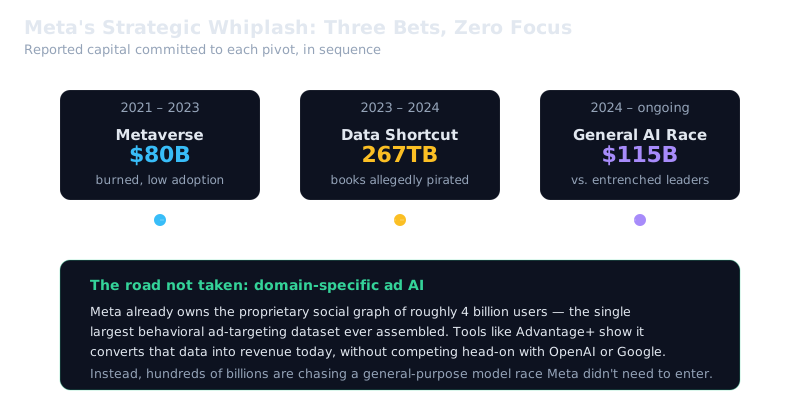
Meta’s Reality Labs division has reportedly burned through roughly $80 billion since 2021, according to the company’s own quarterly disclosures — spent chasing a fully immersive “metaverse” that, by nearly every public adoption metric, solved a problem almost nobody had. Headsets stacked up in closets. Horizon Worlds, the flagship social app, reportedly struggled to hold even a fraction of its early user base past the first few months. The company rebranded itself entirely — Facebook became Meta — around a product category that never found a mainstream audience.
That’s not a rounding error. It’s a multi-year bet, backed by the full weight of the company’s name change, that produced one of the more visible strategic write-offs in recent tech history.
Every pivot in this piece follows the same shape: a massive capital commitment, announced with total conviction, followed by a quiet scramble to make the numbers work once reality sets in. The metaverse was act one.
Rather than pause and diagnose why the metaverse flopped, Meta reportedly pivoted almost immediately into building general-purpose frontier AI models, committing an estimated $115 billion to compete directly with OpenAI, Google, and Anthropic — companies with years of research head start and, in OpenAI’s case, a valuation built almost entirely around being first. That race is already brutally expensive; Crashtech has covered how even OpenAI’s own trillion-dollar financials show a company losing more than a dollar for every dollar of revenue it earns. Meta is now voluntarily entering that same burn-rate arena, late, against entrenched leaders, in a category where it has no obvious structural edge.
Here’s the part that makes it look less like strategy and more like whiplash: Meta already sits on the single most valuable, most defensible asset in the entire AI economy — a proprietary behavioral graph of roughly 4 billion users. Instead of turning that graph into increasingly dominant, hard-to-replicate domain-specific ad AI, the company is spending hundreds of billions chasing a general-purpose model market where it’s competing on someone else’s terms.
A behavioral and social graph no competitor can replicate. Tools like Advantage+ already show this data converts into ad revenue at high efficiency, today, without a single new frontier model.
A general-purpose LLM race against labs that started earlier, raised specifically for this fight, and don’t have to defend a legacy ad business at the same time.
Did Meta really pirate 267 terabytes of books to train its AI?
Facing the enormous data requirements of frontier model training, Meta allegedly chose a shortcut: court filings in ongoing litigation allege the company downloaded approximately 267 terabytes of copyrighted books from known shadow-library repositories, reportedly to avoid the cost and friction of licensing that material legitimately — leaning instead on a “fair use” legal defense to justify the scale of the ingestion.
More damaging than the volume is the intent behind it. Internal memos reported in the press reportedly show Zuckerberg personally intervened to kill a $200 million licensing deal that would have let Meta legitimately acquire training data. Taken together, the filings and reporting suggest this wasn’t an accidental legal gray area — it was, allegedly, a calculated, industrial-scale decision to prioritize speed and margin over compensating the people who created the underlying material.
Do
- License training data proactively, even at a premium, to avoid years of litigation risk
- Treat a $200M deal as cheap insurance against reputational and legal exposure
- Build data pipelines that survive discovery in federal court
Don't
- Allegedly pull terabytes of copyrighted work from shadow libraries to hit a deadline
- Kill a completed licensing deal and hope “fair use” covers the gap
- Assume court filings full of internal memos won’t become public record
Is Meta really surveilling employees to train AI that replaces them?
The piracy allegations aren’t the only place Meta has reportedly cut corners to feed its AI ambitions. According to reports on internal company practices, Meta began monitoring the keystrokes and day-to-day workflows of roughly 72,000 American employees, reportedly to harvest behavioral and task data used to train AI agents — agents explicitly designed to eventually automate similar work.
If accurate, that’s a genuinely uncomfortable loop: employees generating the training data for their own potential replacements, while under active surveillance, at a company simultaneously running large-scale layoffs. Crashtech has previously covered how that dynamic fits into a broader morale crisis inside Meta, where internal comparisons to past scandals have reportedly circulated among staff.
How is Meta hiding the true cost of its AI buildout?
The infrastructure bill for a $115 billion AI race doesn’t disappear — it has to be financed somewhere. Reporting on Meta’s capital structure describes the company using highly complex, off-balance-sheet financing vehicles — compared by analysts to Enron-era accounting structures — to keep an estimated $27 billion in AI data-center debt from showing up directly on its balance sheet.
That structuring matters beyond accounting optics. It reportedly shifts real financial risk onto local communities: massive new data centers are being built in small towns that could be left holding stranded infrastructure and utility costs if Meta scales back or abandons individual projects once the AI spending cycle turns. It’s a pattern worth watching across the industry — Crashtech has also tracked how aggressive, debt-fueled valuation bets played out in Elon Musk’s trillion-dollar valuation collapse, where the gap between paper value and financial reality eventually came due.
| Strategic move | Reported figure | Who absorbs the risk |
|---|---|---|
| Metaverse buildout | ~$80B spent | Shareholders, via years of Reality Labs losses |
| Alleged book piracy | 267TB ingested | Authors and publishers, via unpaid licensing |
| General AI race | ~$115B committed | Shareholders, competing without a data moat edge |
| Off-balance-sheet debt | ~$27B hidden | Local communities hosting data centers |
What would a coherent Meta strategy actually look like?
None of this happens in a vacuum of declining relevance — that’s what makes it land as strategic incoherence rather than survival instinct. Meta’s core advertising business is, by most public reporting, still enormous and still growing, and the company continues to lean on engagement-optimized, attention-maximizing content to extract revenue from that core business even as it funds increasingly detached, expensive side bets. The money to chase the metaverse, then general AI, then whatever comes next, has to come from somewhere — and it’s coming from a core product that keeps getting more aggressive about holding attention, not less.
- Stop competing where you have no moat
General-purpose LLMs are a scale-and-compute war against labs built for exactly that fight. Meta’s advantage was never going to be “better base model.”
- Double down on the proprietary graph
Domain-specific ad AI, trained on behavioral data no competitor can access, is already reportedly outperforming — that’s the moat worth reinforcing.
- Fund data legitimately
A $200M licensing deal is a rounding error against a $115B AI budget. Litigation risk and reputational damage cost more than the deal ever would have.
- Bring financing on-balance-sheet
Complex financing structures that draw Enron comparisons invite exactly the kind of scrutiny that erodes investor and regulator trust long-term.
The through-line across the metaverse, the alleged piracy, the employee surveillance, and the off-balance-sheet debt isn’t a company that’s lost sight of the future. It’s a company that keeps finding new, expensive ways to avoid building on the advantage it already has. Meta didn’t lose the future. It had the best hand at the table and folded it, repeatedly, to chase someone else’s game.
Frequently asked questions
How much money has Meta lost on the metaverse?
Meta has reportedly spent roughly $80 billion on its Reality Labs metaverse division since 2021, according to its own earnings disclosures, with user adoption widely described as abysmal relative to the spend. The division continues to post multibillion-dollar quarterly losses.
Did Meta really pirate books to train its AI?
Court filings in ongoing litigation allege Meta downloaded roughly 267 terabytes of copyrighted books from shadow libraries to train its Llama models, reportedly to avoid licensing costs while leaning on a fair-use legal defense. Meta has not conceded wrongdoing and the cases remain in litigation.
Why did Meta pivot from the metaverse to AI?
After the metaverse failed to attract mainstream users despite tens of billions in spend, Zuckerberg reportedly redirected Meta toward building general-purpose AI models, committing roughly $115 billion to compete with OpenAI and Google rather than doubling down on Meta's own ad-targeting advantage.
Is Meta monitoring its employees for AI training data?
According to reports on internal Meta practices, the company began tracking the keystrokes and workflows of roughly 72,000 U.S. employees, reportedly to generate behavioral data for AI agents designed to automate similar work. Meta has described such data collection as tied to productivity tools.
How is Meta hiding its AI infrastructure debt?
Reporting on Meta's financial structuring describes the company using complex off-balance-sheet financing vehicles, compared by analysts to Enron-era accounting, to keep an estimated $27 billion of AI data-center debt from appearing directly on its balance sheet, shifting risk onto lenders and host communities instead.
/* Comments */
Comments are offline right now — we reconnect automatically, nothing is lost.