
Gemini Omni 1.2 Makes Video Editing Conversational—and Raises a Consent Test
Google’s video model adds 15-second clips and conversational edits; its model card says speech-changing capability remains restricted.
On this page
A video editor asks for a tighter crop, a new background or a product detail to remain consistent across a few seconds of footage. Conversational editing can reduce the cost of those revisions. It can also make changes to a real person’s image or voice feel routine. Google’s November 5 Gemini Omni 1.2 Flash release puts those two sides into the same product story: longer clips and more iterative editing, alongside an explicit model-card note that changing speech is a capability the company is restricting for now. [1] [2]
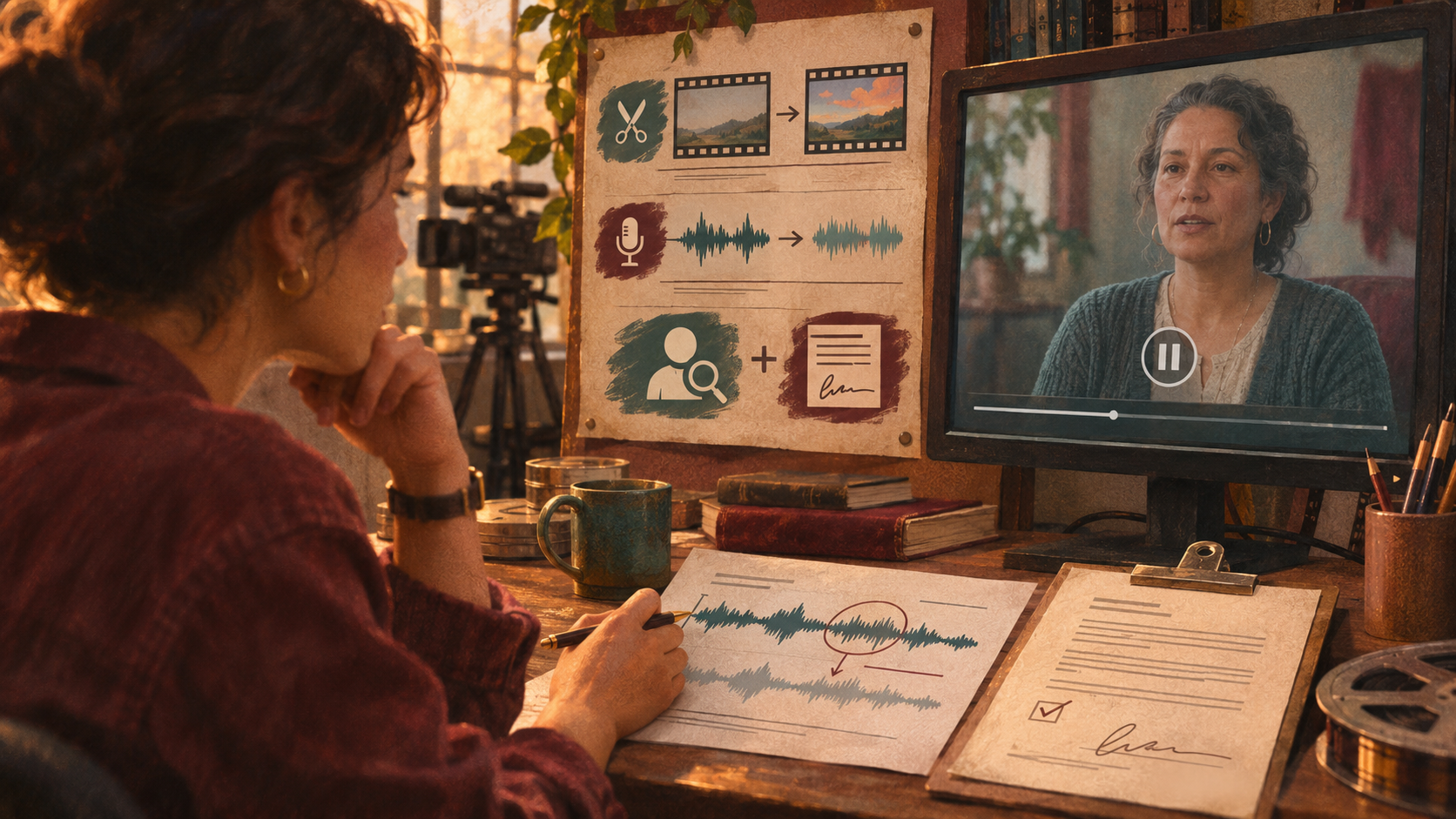
From a short clip to a sequence of edits
Google says Omni 1.2 Flash can generate and edit video up to 15 seconds, compared with 10 seconds for version 1.1. The company’s product announcement lists a 720p price of $0.07 per second, 30% below Omni 1.1, and describes reference inputs that can include images, short motion clips and audio cues. Google says the model is generally available through the Gemini API and Gemini for business, with availability also appearing in Google products such as Vids. These are launch details from Google and may vary by surface, region or account. [1] [3]
The workflow is designed around revision rather than a single prompt. A creator can start with a quick low-resolution draft, request an adjustment, and upscale a selected result. Reference following is particularly relevant to product or character work: a team may want the same package, garment or face to remain recognizable while the camera or scene changes. Google describes stronger consistency across these references, but that is a vendor claim, not an independent test across every type of footage. [1]
A longer maximum clip does not eliminate editing. A 15-second generation may help with a short scene or ad concept, but it still needs checks for temporal continuity, physical details, sound, product accuracy, framing, accessibility and whether the final result communicates what its creator intends. A model can preserve a logo’s colors while altering its shape, or generate a plausible movement that is wrong for the object being shown.
Speech editing changes the stakes
Video editing already changes context through cuts, crops, pacing and sound design. Generative tools add the ability to alter a frame or regenerate a sequence from instructions. The boundary becomes sharper when an edit can change what a person appears to say. Google’s model card states that Omni 1.2 has this capability, while saying it is currently restricted as the company works on responsible deployment. That is a meaningful product limitation, not a claim that every possible use is technically impossible. [2]
Teams making content with real people should treat permission as part of the production record. Consent to appear in a recording does not automatically establish consent to synthesize or alter someone’s speech. A responsible workflow should keep the source footage, log edits, review the final audio with the person or authorized representative when appropriate, and clearly disclose material alterations to viewers. For journalism, training, legal evidence or public-interest material, the requirements are even stricter: generated edits should not be passed off as an unchanged recording.
Google points to SynthID watermarking for generated content. Content credentials standards such as C2PA can package signed information about an asset’s origin and editing history, depending on how a tool implements them and whether the metadata survives export. These mechanisms are useful provenance signals, but they have limits. A missing credential does not prove a file is genuine, and a valid credential does not establish the truth of the content or the trustworthiness of every signer. [2] [4]
Crashtech has covered the limits of AI-video pricing and usage caps in Google Vids and how competition shapes short-form AI video tools. Omni 1.2 adds another practical dimension: lower generation cost can make more iterations possible, so editorial policy needs to travel with the editing capability.
How to evaluate it without trusting the demo
Creators and developers can test a model with a small, documented set of source assets. Include a real person only with appropriate permission. Track which details must remain stable, which edits are requested, and whether the output changes anything outside the requested scope. Evaluate failures across audio, motion, identity, text on packaging and temporal transitions—not only the first frame or a showcase clip.
For API buyers, calculate cost per approved final clip rather than cost per second generated. Include drafts that are discarded, review time, upscaling, storage and the work required to record consent and provenance. A price reduction matters only if the whole path from request to publishable asset becomes less costly without lowering review quality.
For any generated or revised video, preserve the original and identify the edited version clearly. Keep a human reviewer responsible for determining whether the edit is accurate and permitted. Use watermarks or content credentials as supporting context, not as a substitute for the underlying source and an editorial decision.
More iteration means more responsibility at the handoff
Omni 1.2 Flash is a short-video tool with new length, cost and editing controls. Google’s model card also acknowledges that speech alteration sits inside the system’s capability space and remains restricted. That combination suggests the right way to assess the release: test how reliably it follows references and preserves intended details, then decide what approval and disclosure rules must accompany its outputs.
The improvement to watch is not simply whether a model can produce a longer clip. It is whether people can make useful edits while preserving context, consent and a reviewable path back to the source. [1] [2] [4]
Frequently asked questions
What changed in Gemini Omni 1.2 Flash?
Google says the model supports video creation and conversational editing up to 15 seconds, with stronger reference following and a lower listed 720p generation price than Omni 1.1 Flash. The company’s launch claims should be checked against the current product and API terms.
Can Gemini Omni 1.2 change a person's speech?
Google’s model card says the model has a capability to change speech in videos, but that capability is currently restricted while the company studies safe and responsible deployment.
Does a SynthID watermark prove that a video is truthful?
No. A watermark or content credential can help identify provenance or AI-generated media under supported conditions; it does not verify that a video’s claims are accurate, fair or contextually complete.
Sources & further reading
Keep reading

Apple Opens Siri AI Actions to Developers
Apple’s developer preview lets apps expose actions to Siri through App Intents. Shipping, policy, age and regional limits still shape what teams can build.

Google Dreambeans Turns Connected Apps Into a Morning Story Feed
Dreambeans is an experimental Google Labs app that turns selected Google app data into daily stories. Its usefulness depends on what people connect.

A Bigger AI Cache Can Save GPU Time—If the Network and Reuse Rate Cooperate
Supermicro, IBM and NVIDIA proposed persistent KV-cache storage for long prompts. Their headline speedup is a vendor test, not a universal inference result.
/* Comments */
Comments are offline right now — we reconnect automatically, nothing is lost.