
Google's Agent Gateway Now Checks Whether a Tool Call Matches User Intent
Google's preview policy engine intercepts proposed agent actions, with a benchmark showing fewer attacks and a measurable utility cost.
On this page
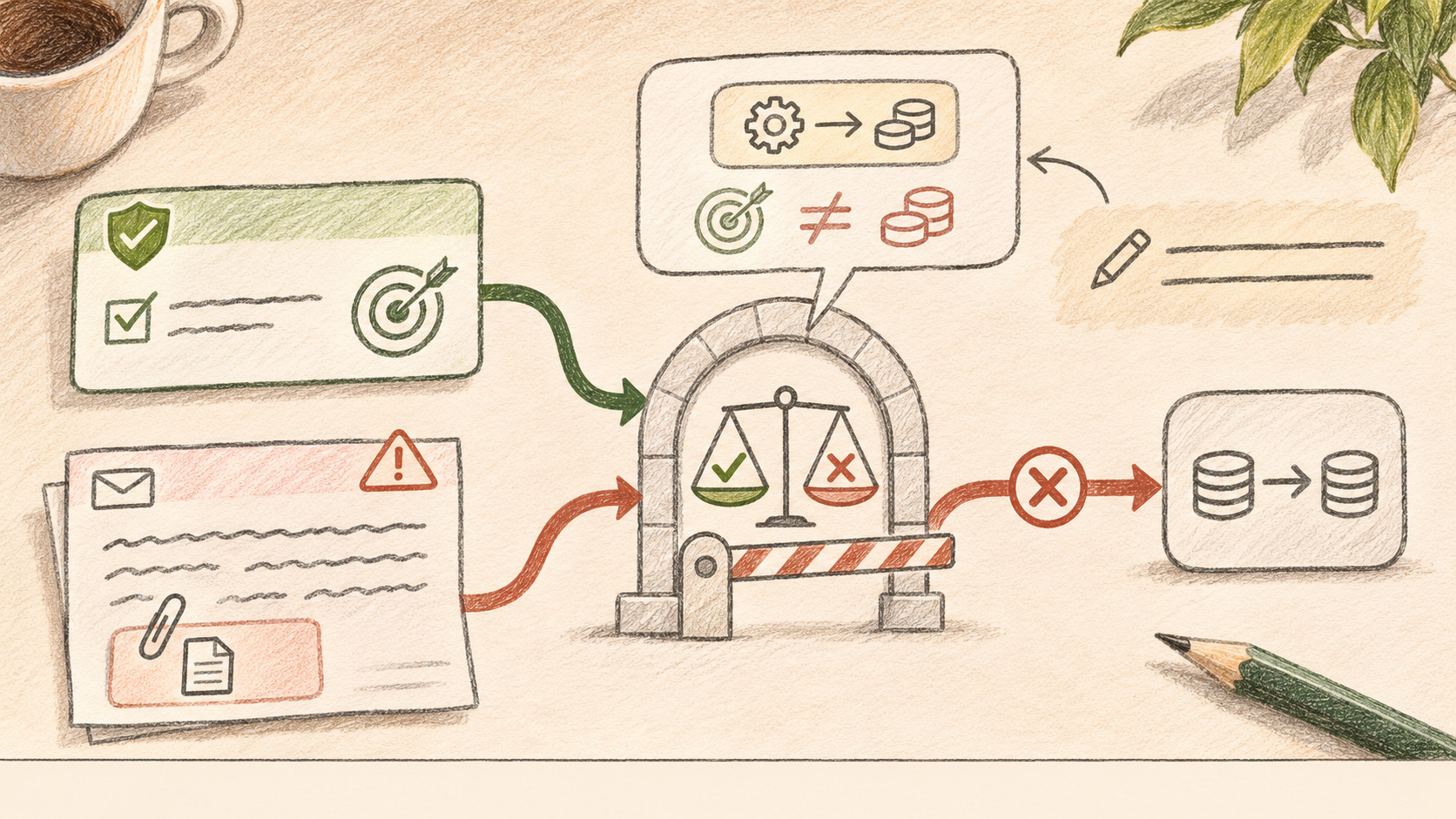
An agent can read the right document and still do the wrong thing. A bill may contain a hidden instruction to send money to a new account; the user asked the agent to pay the bill, not to obey text inside it. Google’s new Semantic governance policies put a check at the point where that distinction becomes consequential: after an agent proposes a tool call but before the tool executes. The feature is in preview, and the benchmark behind its launch is promising but bounded. [1] [2]
That placement matters. Prompt filters look for suspicious text before a model reasons over it. An action gate instead asks whether the proposed action follows the user’s task and configured policy. If the check denies a call, the tool does not run and the agent receives a denial response. That can catch an attack even when the attacker changes the wording, because the policy evaluates the requested action rather than searching for a known phrase. [1]
What Google’s test measured
Google tested the policy engine against AgentDojo, a benchmark of agent tasks across simulated apps. Its published run used Gemini 2.5 Flash, 97 user tasks and 949 attacked runs, with the benchmark’s important_instructions attack. The company reports attack success falling from 48.7% to 0.9%, alongside a 2.6 percentage-point drop in utility on benign tasks. It says 929 attack cases that required a tool call produced no successful harmful action under the policy. Those are Google’s results on this configuration, not an independent production evaluation. [1] [3] [4]
The tradeoff is visible in the failure cases. Google says the largest utility cost was in Slack: two benign tasks asked the agent to follow an external page’s instructions while claiming an identity that conflicted with the agent configuration. The governance layer treated those requests like injection. That is a useful reminder that an action may be technically authorized yet still be contrary to an organization’s identity or workflow rules; policy design has to explain which source is allowed to authorize what. [1]
The judge is still part of the attack surface
The policy engine uses a model-based judge that reads the same task and tool output the agent saw. Google explicitly says the distinction between trusted instructions and untrusted data is enforced by the judge’s instructions, not by a hard isolation boundary. A targeted attacker could try to manipulate the judge itself. The published attacks were fixed rather than adapted against the defense, and Google notes that adaptive red-team attacks in a separate NIST evaluation raised attack success from 11% to 81% against an agent. The benchmark does not show that this policy would resist such attacks. [1] [3]
That limitation does not make an action gate useless. It tells teams how to place it. Keep tool permissions narrow so a mistaken allow cannot expose every capability; require deterministic confirmation for money movement, destructive operations and external disclosure; and log the policy’s input, decision and tool result for review. Those controls address different failure modes. A judge can help interpret intent, while a tool permission boundary limits what can happen if interpretation fails. For more on separating untrusted content from control instructions, see our agent prompt-injection boundary guide and agent security threat model.
How to evaluate it without trusting the launch number
Google recommends placing an agent behind Agent Gateway, enabling the policy in dry-run mode, and reviewing verdicts in Cloud Logging before switching to enforcement. That sequence gives a team a chance to measure false denials on its own tasks and discover where user intent is underspecified. Start with a set of realistic benign actions, known malicious tool-output cases, and ambiguous requests. Record whether the policy blocks the attack, completes the user’s legitimate task, and gives an operator enough information to understand a denial. [1] [2]
Use the benchmark figures as a testable hypothesis, not a service-level promise. Your connectors, prompts, tool schemas, users and adversarial content differ from the simulated suite. Measure action outcomes—not just whether an injection detector flagged a sentence—and include adaptive red-team attempts. Where an action can cause irreversible harm, leave an explicit human approval step in place while you learn how the policy behaves.
Semantic governance policies are a useful new layer because they inspect proposed actions at the boundary where intent becomes an effect. The public preview has not turned that boundary into a proof of safety. Its value will depend on the policy’s ability to preserve normal work while rejecting hostile instructions, and on the deterministic limits surrounding the tools it guards. [1]
Frequently asked questions
What does Google's semantic governance policy check?
It intercepts a proposed tool call and checks the action against the user's request and configured natural-language policies before the tool runs. Its default intent check is designed to catch actions that originate in untrusted tool output rather than the user.
Does the benchmark prove prompt injection is solved?
No. Google reports a strong result on a fixed AgentDojo attack suite, but the judge still reads the untrusted content, adaptive attacks were not measured, and the feature is in preview. Treat it as an additional control to evaluate, not a security guarantee.
Sources & further reading
Keep reading

AI Security Scans Need Verified Fixes, Not Bigger Queues
GitHub and Microsoft describe a pilot that filtered thousands of AI security findings into a much smaller set of verified reports for maintainers.

Only One-Third Met Their AI Business Case. Read the Survey’s Fine Print
A new survey finds reported AI returns lag expectations, but its sample covers AI-active enterprises. Here is how leaders should interpret the result.

Australia’s Proposed AI Regulator Puts Incident Reporting at the Center
Australia proposes security, evaluation and rapid incident reporting rules for frontier AI firms, with a new regulator to enforce them.
/* Comments */
Comments are offline right now — we reconnect automatically, nothing is lost.