
Google’s Chemistry Agent Is Fast at Finding Candidates; the Lab Still Decides
Google Antigravity links literature search, molecular datasets and chemistry tools in a drug-design workflow, but every proposed molecule remains a hypothesis.
On this page
A molecule can be one atom away from being a different molecule. That makes drug-discovery assistance a demanding test for AI: it must read papers, map names and diagrams to structures, keep measurements attached to the right compound, run calculations, and leave enough evidence for a chemist to inspect the chain. Google DeepMind’s Antigravity demonstration attempts that whole path for a family of lung-cancer kinase inhibitors. Its most useful lesson is about workflow design, not machine-made medicine. [1]
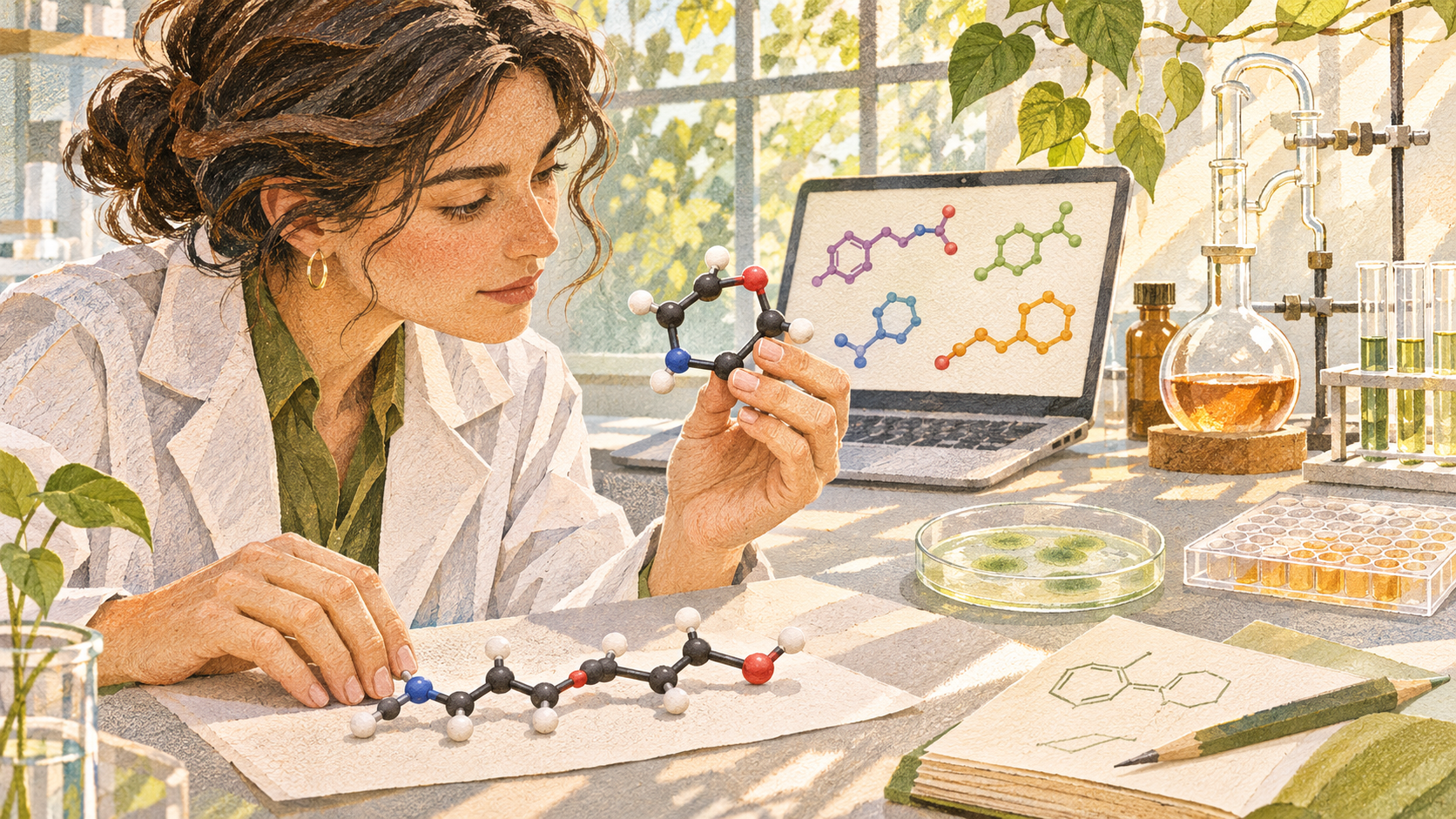
The tedious part is joining the evidence
In a typical literature-driven project, the same chemical structure may appear as a systematic name in a paper, a two-dimensional drawing in a figure, a shorthand label in a table, and a machine-readable record in a catalog. Each representation can contain different context: a potency value, cell line, assay conditions, or an experimental variant. Joining these records incorrectly can produce a convincing analysis of the wrong compound.
DeepMind says its Cheminformatics Skills connect a language model’s planning and literature work to RDKit for molecular computation and to ChEMBL and PubChem as structured resources. RDKit provides established open-source cheminformatics functions; ChEMBL curates bioactivity information; PubChem aggregates chemical information and identifiers. This division of labor matters. A language model can decide which operation to request and summarize what it found, while specialized code performs structure-aware transformations and calculations. [1] [2] [3] [4]
The team’s example begins with crizotinib and lorlatinib, drugs with a related kinase-inhibitor scaffold. It describes rigidification: adding a bond that constrains molecular rotation can reduce the number of shapes a molecule adopts. In the specific comparison, DeepMind notes that lorlatinib’s cyclized structure has fewer rotatable bonds than crizotinib. This is a medicinal-chemistry hypothesis about molecular shape and binding, not a guarantee that any newly constrained analogue will bind better. [1]
What the agent actually did
DeepMind reports that the agent searched papers and patents for analogues, extracted thousands of compound records, filtered irrelevant entries, and attached sources to its collection. It built an interactive viewer so a scientist could inspect compounds and plot measurements such as potency against rotatable bonds. The team then describes matched molecular pair analysis, which compares compounds that differ by a specific change, alongside predictive models evaluated on held-out data. Finally, the agent proposed candidate macrocycles and possible synthesis routes. [1]
That sequence resembles a research assistant with access to a domain workbench. Its value depends on preserving the links between the paper, the structure, the measured result, and the calculation. A chart is only useful if the records behind it refer to the intended compounds and comparable experiments. A model score is only informative if the held-out split reflects the kind of new compounds scientists actually want to predict.
DeepMind says its guidance favors chronological splits when suitable dates exist and scaffold splits as a way to estimate performance on structurally different compounds. That is a better question than asking whether a model can fit random examples from a familiar chemical family. But the company’s post is a demonstration, not an independent, blinded benchmark of time saved or predictive accuracy across drug programs. The reported workflow should be treated as a concrete case study, not a generalized performance claim. [1]
Faster hypotheses do not remove experimental work
There are several gates between a generated design and a medicine. A proposed structure must be chemically plausible; the suggested route must be practical; a laboratory must synthesize the compound; assays must measure its behavior; and researchers must test whether the result replicates under appropriate conditions. Clinical safety and efficacy require still more evidence. A molecule that appears potent in a computational model can fail because of solubility, toxicity, metabolism, delivery, or assay context.
DeepMind explicitly warns that sparse data, inter-lab assay noise, and narrow measurement ranges limit prediction precision. It calls the designs testable hypotheses and says they need experimental synthesis and validation. That qualification is central: an agent may compress searching, cleaning, plotting and routine modeling, but it cannot turn correlated records into proof of a biological effect. [1]
For researchers considering such systems, the useful evaluation is not a polished demo. Start with a fixed collection of papers and compounds. Check whether every extracted structure resolves to the intended identity, whether every measurement retains its assay conditions and citation, whether the model split avoids leakage, and whether another scientist can rerun the analysis. Then measure how much expert time the workflow saves and how often its suggested next experiments survive review.
That approach connects to broader questions about AI and scientific reproducibility. Crashtech has covered AI agents in drug-development workflows and how AlphaFold supports drug-design work; both show why a useful computational step is one component of a longer evidence chain.
The practical change is a shorter route to a reviewable idea
Antigravity’s chemistry workflow is interesting because it presents data discovery, analysis and candidate generation as connected work rather than a sequence of isolated prompts. A chemist can inspect the source compounds, challenge the model assumptions, ask for a different comparison, and decide whether a proposed design deserves synthesis. The interface may make iteration faster, while the decision to trust a candidate remains with scientists and experiments.
That is a narrower claim than “AI discovers a drug,” but it is the one the demonstration supports. If these tools help researchers move from scattered records to a well-documented, testable design sooner, they can improve the pace of hypothesis formation. The next proof will come from reproducible experimental work, not from the speed of a generated answer. [1]
Frequently asked questions
What did Google Antigravity demonstrate for chemistry?
Google DeepMind describes a workflow that searches literature and chemical databases, curates compounds, runs analysis with chemistry software, builds potency models, and proposes macrocycles with candidate synthesis routes. The demonstration is a research workflow, not an approved drug or clinical result.
Does the agent prove that a proposed molecule will work as a medicine?
No. A prediction or suggested synthesis route is a testable hypothesis. The compound still has to be synthesized and evaluated experimentally, and its safety, efficacy, manufacturability, and clinical value are separate questions.
Sources & further reading
Keep reading

PAPERBENCHX Tests Whether AI Can Rebuild Evidence, Not Just Explain a Paper
A 93-task benchmark across scientific fields finds a large gap between AI agents running parts of an experiment and reproducing its evidence.
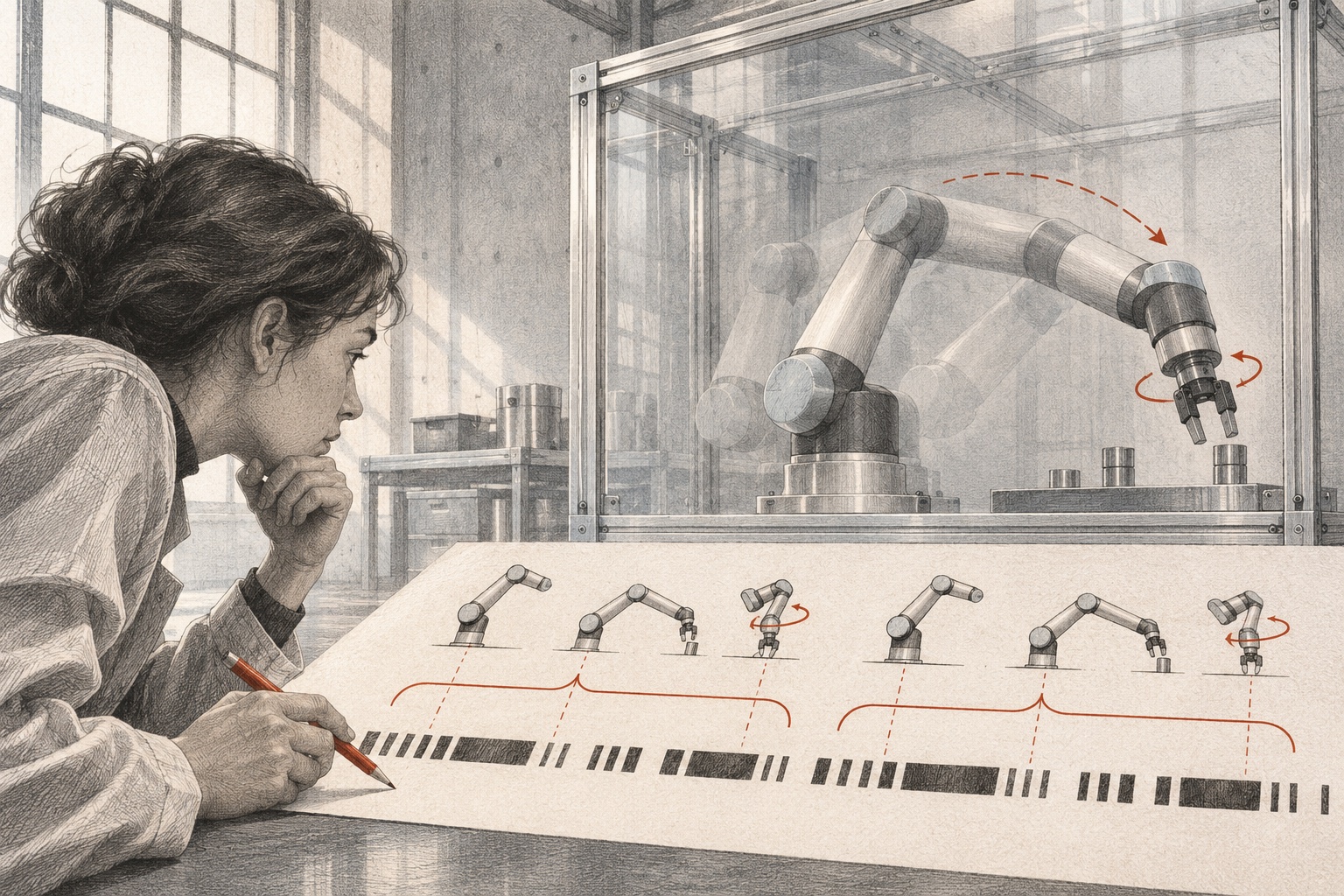
Encrypted Robot Commands Can Still Leave a Readable Rhythm on the Network
A 2026 study found robot actions could be inferred from encrypted traffic metadata, exposing a privacy gap between payload secrecy and behavioral privacy.

NTT and Safran Want Satellite Laser Links to Behave More Like a Network
A November 6 memorandum explores connecting Safran optical ground stations to NTT's network control and All-Photonics Network technologies.
/* Comments */
Comments are offline right now — we reconnect automatically, nothing is lost.