
IBM's Quantum System Two Is Now in Chicago. The Hard Part Is Building Around It
IBM has installed a Quantum System Two at the University of Chicago. Its research value depends on algorithms, access, and links to classical computing.
On this page
The most consequential part of IBM’s November 6 Chicago announcement may be its address. A quantum processor is not useful to a research community simply because it exists; scientists also need access, collaboration, classical computing, and time to turn hardware capability into testable algorithms. IBM’s new System Two brings that work to Hyde Park Labs now, with a later move planned to a larger Illinois quantum campus.
What arrived in Chicago
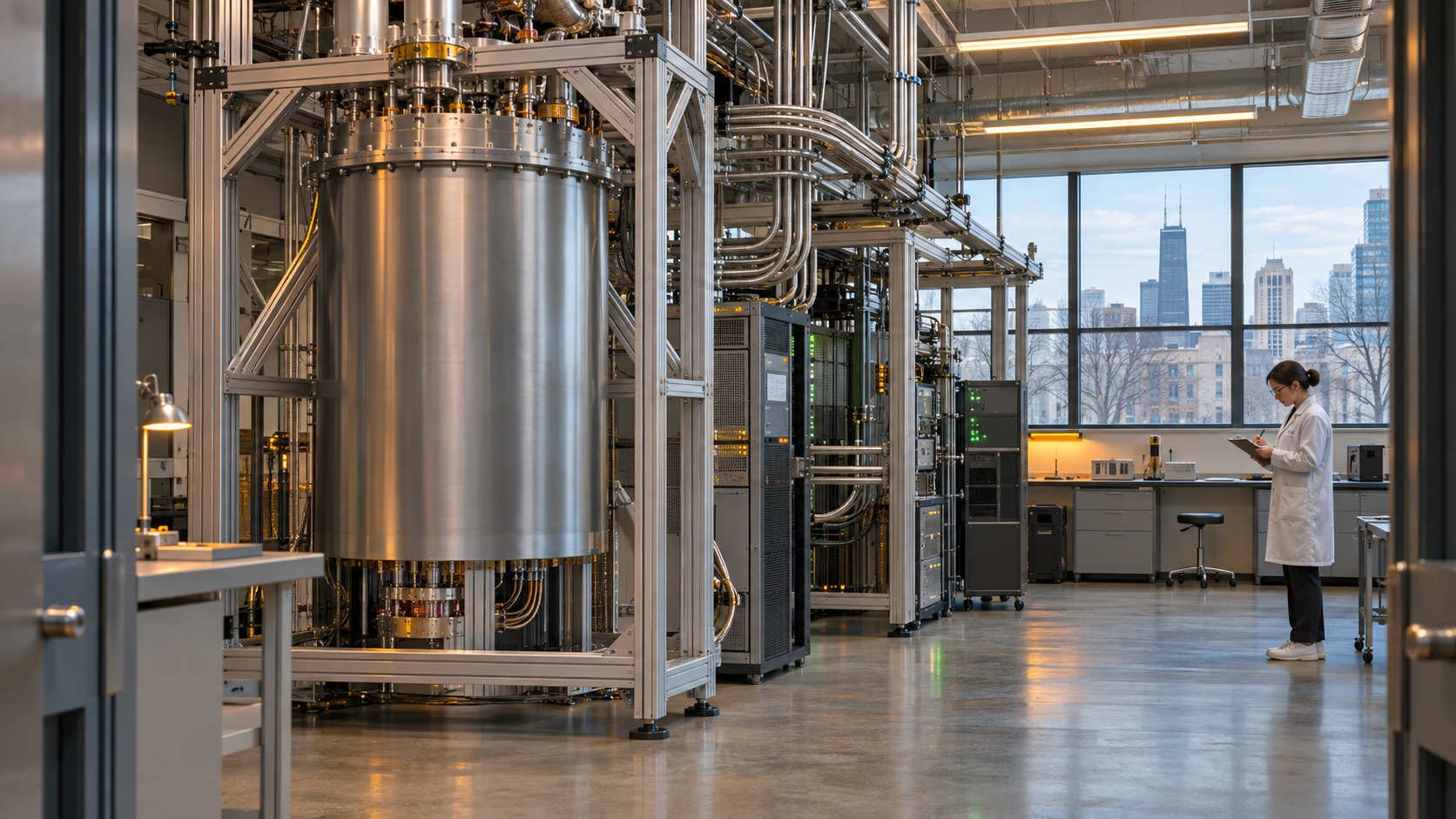
IBM announced that its Quantum System Two is operational at Hyde Park Labs, where it is hosted by the University of Chicago. The company describes it as its first quantum computer in Illinois and says it is powered by its Nighthawk processor. IBM intends the machine to anchor the National Quantum Algorithm Center while the Illinois Quantum and Microelectronics Park is built. [1]
The initial location matters because it gives university, laboratory, startup, and industry collaborators a place to work together before the larger park is complete. IBM identifies projects involving molecular simulation, power-grid optimization, high-energy physics, and distributed quantum computing as areas of work in the state. Those are research directions and collaborations, not demonstrations that the machine has already solved these problems better than classical computers. [1] [3]
A system is only one layer of the work
Quantum System Two is designed as a modular architecture. IBM’s system materials describe cryogenic infrastructure and a framework intended to connect multiple quantum processors as the technology scales. That architecture is important for engineering, but scaling hardware alone does not establish fault-tolerant computation or an economic advantage on a useful workload. [2]
A complete research path has several linked steps: hardware must produce stable operations; error rates must be controlled; an algorithm must map a real problem to the device; and results must be compared with strong classical methods. Researchers also need to understand which part of a result came from the quantum processor and which came from classical pre- or post-processing. The National Quantum Algorithm Center’s stated purpose is to concentrate some of that algorithm and application work alongside the hardware. [3]
The distinction is easy to lose in milestone announcements. “Operational” means the installation is working as a facility; “scientifically useful” is a claim about the research it can support; and “quantum advantage” requires evidence against a classical baseline on a defined task. Those are separate milestones.
What should readers watch next?
For scientists, the relevant signal will be papers and technical materials that specify the device, calibration conditions, error treatment, algorithm, and classical comparison. For businesses considering a quantum program, an installed machine is an invitation to explore collaborations—not a reason to move production workloads away from conventional computing.
For Illinois, the system is also part of an ecosystem strategy: connect universities, national laboratories, startups, employers, and training programs around shared infrastructure. IBM and state partners describe a future move to the Illinois Quantum and Microelectronics Park, where the system is meant to become a centerpiece when construction is complete. That future location should not be confused with the system’s current Hyde Park Labs deployment. [1]
The practical significance of the announcement is therefore local and cumulative. A quantum system, research center, and campus can make it easier to assemble teams and test algorithms. Whether those pieces produce durable applications will depend on the evidence that follows—not the ribbon-cutting alone.
Frequently asked questions
Is IBM Quantum System Two in Chicago operational?
IBM said the system was operational at Hyde Park Labs and hosted by the University of Chicago when it announced it on November 6, 2026. IBM says it will later move to the Illinois Quantum and Microelectronics Park when that campus is completed.
Does a new quantum computer mean useful quantum advantage is available to businesses?
Not by itself. A deployed machine creates research capacity, but useful applications still depend on hardware performance, error correction, algorithms, classical-computing integration, and reproducible evidence that a quantum method outperforms the best classical approach for a defined task.
What is the National Quantum Algorithm Center?
The National Quantum Algorithm Center is a Chicago research collaboration established in 2024. IBM describes it as bringing companies and researchers together to develop algorithms and applications that can advance alongside quantum hardware.
Sources & further reading
Keep reading

Wolfpine Makes Tenstorrent Kernels Easier to Inspect. It Does Not Predict Their Speed
Wolfpine is a community Python simulator for Tensix accelerators that can run tt-metal programs and expose traces, with an explicit limit on timing accuracy.
Marvell’s Lumentum Deal Targets the Optical Links Inside AI Data Centers
The proposed $115 billion all-stock deal combines Marvell’s connectivity chips with Lumentum’s lasers and optics. Approval and integration remain years away.

Anthropic’s Message Threads Shrink Agent Requests, but Add State to Own
Anthropic’s beta API threads send only new turns, but expire quickly, require replay logic, and are not eligible for zero data retention.
/* Comments */
Comments are offline right now — we reconnect automatically, nothing is lost.