
Marvell’s Lumentum Deal Targets the Optical Links Inside AI Data Centers
The proposed $115 billion all-stock deal combines Marvell’s connectivity chips with Lumentum’s lasers and optics. Approval and integration remain years away.
On this page
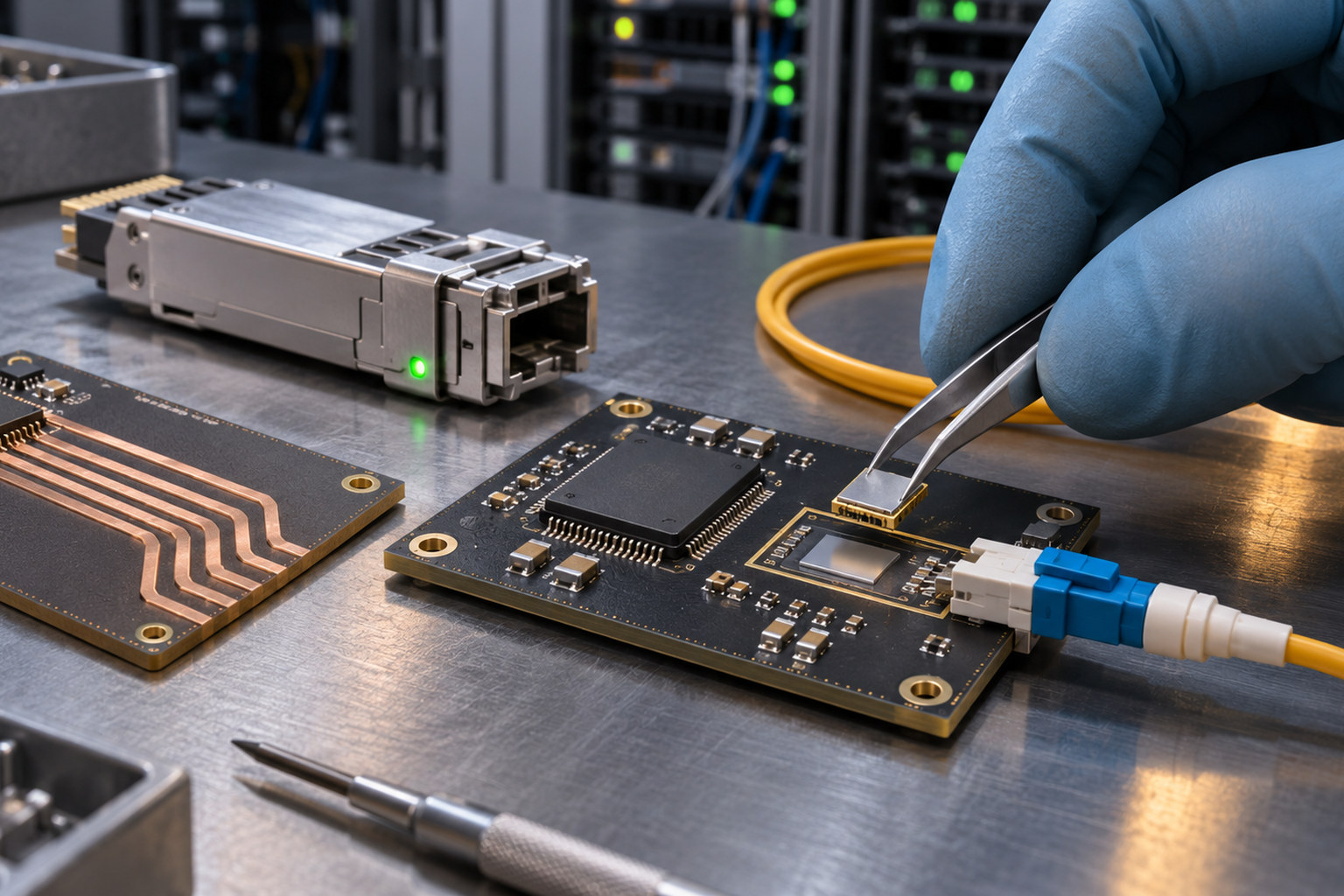
A modern AI cluster moves data across more than one kind of link. Copper still connects many components, while fiber carries information over longer distances. As bandwidth demand grows, vendors are trying to bring optical connections closer to processors and package boundaries. Marvell’s agreement to acquire Lumentum is a bet that owning more of that electrical-to-optical chain could help it design those systems together. [1]
From separate components to a co-designed link
Marvell’s portfolio includes electrical and optical interconnect, network switching, custom silicon and semiconductor technologies. Lumentum makes high-performance lasers, optical transceivers and optical circuit switches, and operates specialized compound-semiconductor manufacturing for materials such as indium phosphide. The companies say a combined portfolio could support more integrated designs across distances that range from links between data centers to connections inside advanced semiconductor packages. [1]
Why connect those businesses? Electrical signals are effective across many short paths, but longer or higher-bandwidth links create tradeoffs in reach, power and signal integrity. Optical fiber can move data over distance with different loss characteristics, while the optical engine, lasers, packaging and electronic switching must still fit into a reliable system. As more links move toward the compute, designers have to coordinate the electrical and optical pieces earlier instead of treating them as interchangeable modules.
That is the technical logic behind the deal. Combining component road maps might let one supplier coordinate the silicon that handles signals with the optical hardware that sends them. It might also simplify qualification and manufacturing planning for customers. Those are potential benefits the companies describe, not outcomes already delivered. The deal does not mean every new AI server will use the combined company’s parts or that integration automatically lowers power or cost.
The financial headline is conditional
Marvell announced a fixed exchange ratio of 4.5 Marvell shares for each Lumentum common share and an implied Lumentum enterprise value of about $115 billion. The companies said existing Marvell shareholders would own roughly 67% of the combined company after closing, with Lumentum shareholders owning about 33%. These are transaction terms and management projections, not a valuation of realized synergies or future product sales. [1] [2]
The agreement requires approvals from both companies’ shareholders, antitrust and other regulatory approvals, an effective Form S-4 registration statement and other customary closing conditions. The companies currently expect a close in the first half of 2028. Until then, Marvell and Lumentum say they will remain separate businesses. A long timeline matters because customer road maps, supply agreements and product qualifications do not change simply because an acquisition is announced. [2]
This is part of a broader infrastructure story. New data-center construction faces power and supply constraints, as described in the debate over a proposed wave of AI data centers. Faster interconnect is one piece of system capacity; it does not create additional grid power, cooling, chips or trained operators by itself.
What to watch after the announcement
The next useful evidence is specific: whether the deal clears regulators and shareholder votes; how the companies handle manufacturing capacity and customer commitments while operating separately; and whether they announce validated products that actually integrate electronics and photonics. Claims about a $550 billion addressable market or more than $1 billion in expected annual run-rate cost synergies come from the companies’ own transaction materials and depend on assumptions that have not yet been realized. [1]
Customers should also watch for engineering details, not just portfolio breadth. A tightly co-designed link still needs to meet latency, power, reliability, repairability and thermal requirements in a real system. Optical components add their own manufacturing and packaging constraints. If the merged business can make these tradeoffs easier for customers to manage at volume, the deal will have a practical technical impact. Until integration plans and products exist, the agreement is best understood as a strategic position in a changing connectivity stack, not an immediate upgrade to AI infrastructure.
Frequently asked questions
What did Marvell agree to buy from Lumentum?
Marvell announced an all-stock agreement to acquire Lumentum. The companies say their portfolios include electrical interconnect, switching and custom silicon on Marvell’s side, and lasers, transceivers, optical circuit switching and specialized photonics manufacturing on Lumentum’s side.
Does the deal mean the companies’ products are integrated now?
No. The agreement is subject to shareholder, regulatory and other closing conditions. The companies expect to remain independent until a projected first-half 2028 close, and any combined products or manufacturing plans would come later.
Why are optical connections becoming more important in AI systems?
As systems move more data between accelerators, racks and data-center sites, electrical links face reach, bandwidth and power tradeoffs. Optical components can move data over fiber, but designing, packaging and manufacturing them alongside electronics remains a complex engineering task.
Sources & further reading
Keep reading

Anthropic’s Message Threads Shrink Agent Requests, but Add State to Own
Anthropic’s beta API threads send only new turns, but expire quickly, require replay logic, and are not eligible for zero data retention.
Together Compiler Turns GPU Tuning Into a Continuous Inference Loop
Together’s compiler keeps an optimization engine running across inference experiments, trading setup time and throughput against fidelity and workload fit.

A Light-Based AI Experiment Shows What Optical Computing Still Needs
A Tokyo team trained a physical learning system with optical dynamics. The result is promising, but it has not run today’s largest language models.
/* Comments */
Comments are offline right now — we reconnect automatically, nothing is lost.