
On this page
IPVS was adopted to solve real scaling problems in kube-proxy’s older iptables implementation. The Kubernetes project now says it plans to remove the IPVS backend because its kernel API does not map cleanly to the Kubernetes Services API, important edge cases were missing, and maintaining a separate implementation became difficult. The schedule is not fully consistent across Kubernetes sources. The November 16 blog summary says removal is planned for 1.40, while the current virtual-IP documentation and KEP-5495 specify that 1.40 makes IPVS opt-in and 1.43 removes the backend. Operators should use the current release documentation for each upgrade and treat 1.43 as the documented removal milestone. [1] [2]
For operators, this creates a useful window. You can test another backend while IPVS still exists, compare behavior on the cluster’s real kernel and distribution, and document any vendor-managed constraints before version 1.40 changes the default. The project recommends nftables for Kubernetes 1.36 or newer on Linux kernel 5.13 or newer. If that combination is unavailable, iptables may remain the practical option; its implementation has received substantial optimization work since the old performance concerns that motivated IPVS. [1]

Why a faster backend became harder to keep
The original attraction of IPVS was its data-plane lookup behavior: IPVS used kernel hash tables instead of the long sequential rule matching used by an older iptables path. It also avoided rewriting an entire ruleset after every service or endpoint change. Kubernetes says those design choices helped address real scaling limits. The problem was that kube-proxy’s full service model is more complicated than selecting a destination from a list. [1]
Some Kubernetes service features require behaviors that the IPVS API does not directly provide, so kube-proxy had to fall back to iptables and ipset for parts of the implementation. That made the backend more complex and brought some of the maintenance and scaling concerns back into the path. The project also says the IPVS backend never achieved full functional compatibility with the iptables backend. It is therefore not useful to reduce the change to “the new backend is faster.” The maintainability and correctness trade-off is central to the deprecation rationale. [1]
Another common reason operators chose IPVS was its menu of schedulers. Kubernetes explains that kube-proxy runs on every node, but its IPVS scheduler state is not shared across nodes. Several schedulers that make sense in other load-balancer architectures do not provide the expected benefit in this distributed arrangement. The project’s claim is architecture-specific; it does not mean IPVS schedulers are useless in every deployment. [1]
The migration schedule has intermediate stages
The published Kubernetes Enhancement Proposal (KEP-5495) defines these milestones:
- 1.35: IPVS is deprecated and kube-proxy warns when it is used.
- 1.37: the
KubeProxyIPVSfeature gate is added and remains on by default. - 1.40: the feature gate is planned to default off, making IPVS opt-in.
- 1.43: the feature gate is planned to lock to its default and the IPVS backend code is planned to be removed.
The KEP describes cleanup of the feature gate in 1.46. Its stages distinguish default-off in 1.40 from backend removal in 1.43. Because the November blog summary conflicts with that schedule, platform teams should verify the current release documentation before each upgrade. The practical deadline for a cluster owner is earlier than the final removal if a supported Kubernetes distribution, kernel, or managed service drops needed support first. [2]
The Kubernetes virtual-IP documentation reflects the staged plan and identifies the KubeProxyIPVS gate. That makes it a useful operational check when reviewing an upgrade, but not a substitute for inspecting the actual kube-proxy configuration and vendor support matrix in a managed cluster. [3]
Choosing between nftables and iptables
For Kubernetes 1.36 or later and Linux kernel 5.13 or later, the project recommends nftables. The nftables backend reached general availability in Kubernetes 1.33; later performance and scaling improvements make 1.36 the recommended starting point for the migration described in the November 2026 post. The post reports only a slight performance advantage over IPVS in its tests and explicitly cautions against interpreting its graph as a claim of a noticeable speedup. It is safer to treat nftables primarily as the supported, feature-complete direction than as a guaranteed performance upgrade. [1] [4]
Where nftables requirements cannot be met, Kubernetes says the iptables backend may be a reasonable fallback. Since IPVS was introduced, kube-proxy’s iptables code has been optimized to reduce redundant rules, avoid repeat computation and update only changed portions where possible. The article’s operator guidance differs by backend: switching to nftables is described as updating kube-proxy’s configuration and restarting its pods, while switching to iptables warrants rebooting each node for technical reasons. A production cluster needs an incremental plan that fits its availability and node-replacement model. [1]
A safe migration starts with inventory
First locate every place that selects IPVS: kube-proxy ConfigMaps, Helm or cluster API configuration, bootstrap templates, and infrastructure code. Then record Kubernetes versions, kernel versions, Linux distributions, and whether the service is self-managed or owned by a cloud provider. Confirm that the intended replacement is supported by the provider and that no distribution-specific agent manipulates the same ruleset.
In a representative test cluster, compare service routing, source IP behavior, session affinity, NodePort access, health checks, external traffic policy, dual-stack paths, and any customized IPVS options. Measure failure behavior and node transitions, not only steady-state request latency. Rehearse the exact configuration change and rollback steps. For each backend, follow the project’s migration procedure and the provider’s guidance; avoid mixing a proxy backend change with unrelated CNI or kernel upgrades in the same rollout.
Our Kubernetes control-plane and nodes explainer provides background on how service routing fits into the cluster control plane. For IPVS users, the key decision is now a scheduled one: determine which supported backend satisfies the cluster’s real operating constraints, then move while the old path is still available for comparison.
Frequently asked questions
Is kube-proxy IPVS mode removed now?
No. Kubernetes deprecated IPVS mode in 1.35. The project says it plans to make it opt-in in 1.40 and fully remove it in 1.43, subject to the project release process.
Which kube-proxy backend should IPVS users move to?
Kubernetes recommends nftables for clusters on Kubernetes 1.36 or later with Linux kernel 5.13 or later. Iptables remains a fallback for older supported environments. Validate against the node OS, kernel, distribution, and actual service behavior.
Will switching kube-proxy mode be a harmless restart?
The Kubernetes guidance describes changing the mode and restarting kube-proxy for nftables; for an iptables switch it recommends rebooting each node. Operators should test the procedure and workload impact in their own cluster before rollout.
Sources & further reading
Keep reading
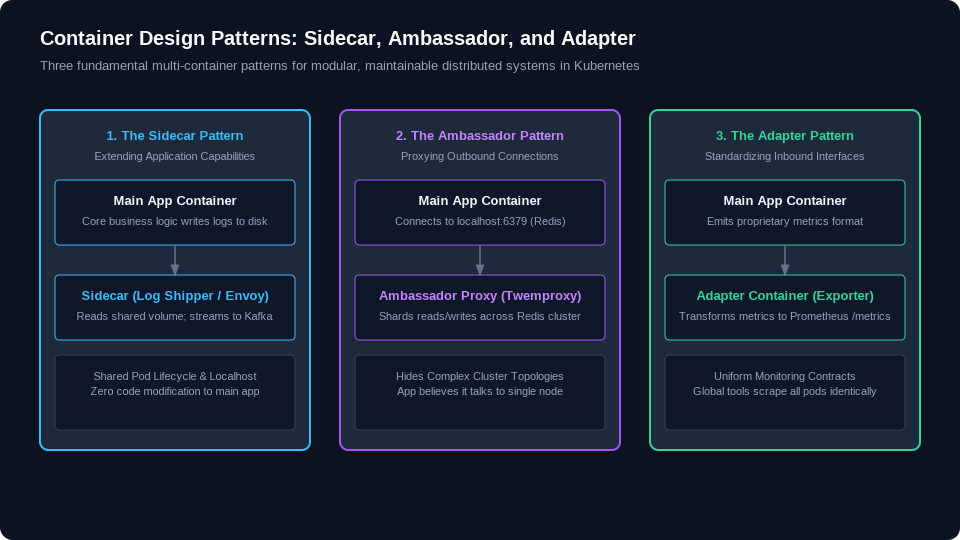
Container Design Patterns for Distributed Systems: Sidecar, Ambassador, and Adapter
Master the three essential multi-container design patterns in Kubernetes: Sidecar, Ambassador, and Adapter architectures for modular cloud systems.
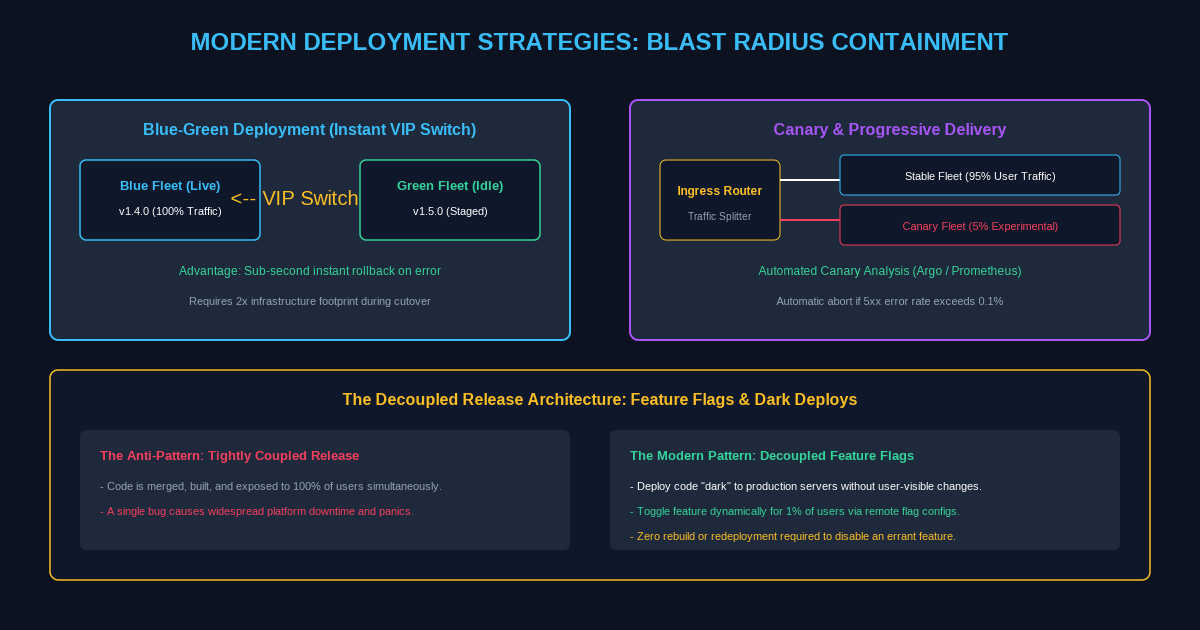
Modern Deployment Strategies: Blue-Green, Canary, and Progressive Delivery
Compare Big-Bang, Rolling, Blue-Green, Canary, and Progressive Delivery. Learn how modern platforms decouple deployment from release to eliminate downtime.
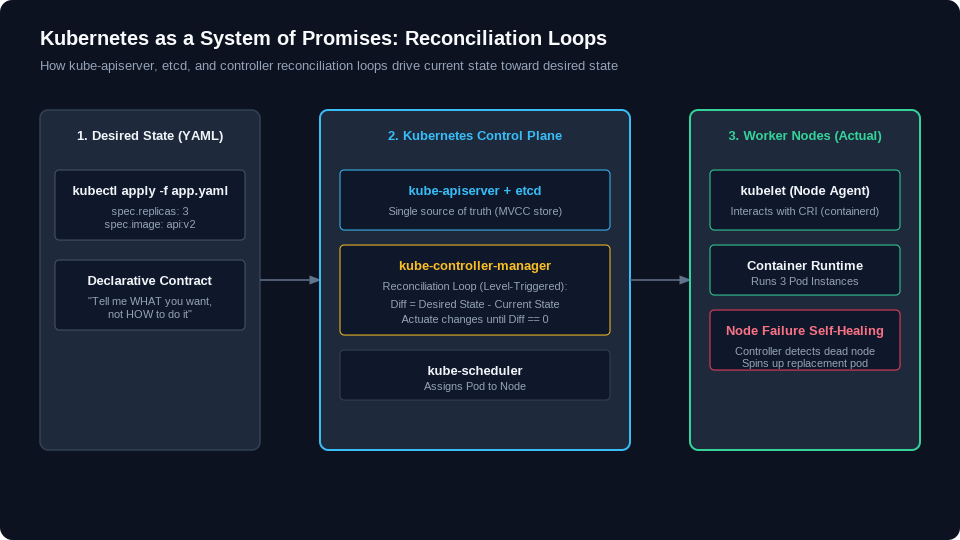
Kubernetes as a System of Promises: Reconciliation Loops and Desired State
Understand Kubernetes control plane architecture: declarative desired state, etcd, kube-apiserver, and controller reconciliation loops.
/* Comments */
Comments are offline right now — we reconnect automatically, nothing is lost.