
topic: systems-architecture
author: Crashtech Editorial
published: Nov 15, 2026 · read: 6 min
---
Linear’s Multi-Region Architecture: Regional Data, Global Identity, One Routing Layer
Linear describes replicating its full production deployment by region, then routing shared-domain requests through a global authentication service and proxy.
On this page
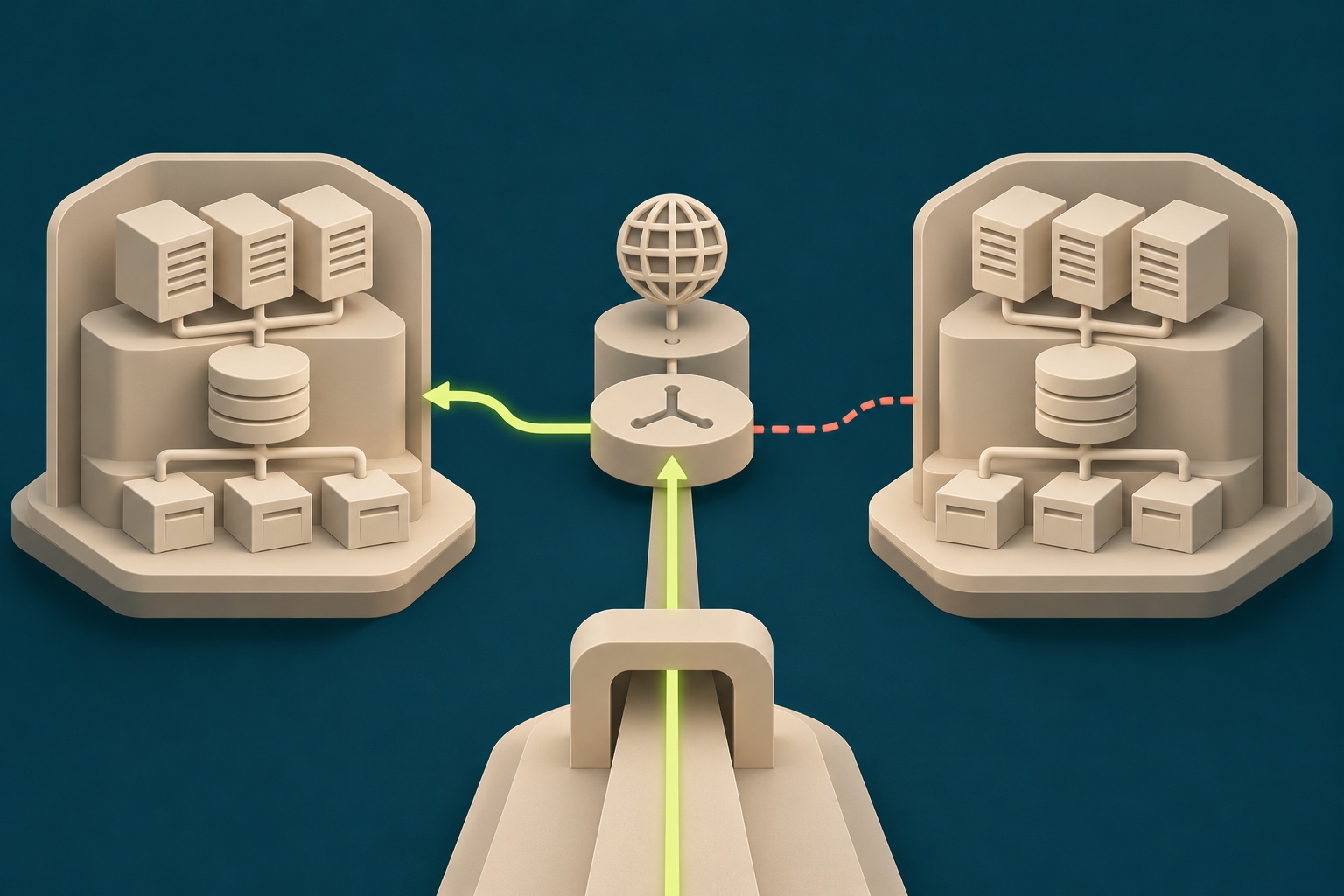
Multi-region hosting is often explained as a database placement problem. Linear’s account describes a different first decision: replicate a complete production deployment in each region, then route every workspace request to the deployment that owns its data.
The company’s engineering post, published in May 2024, says its original infrastructure was concentrated in Google Cloud’s us-east1. Two goals prompted the move: leave room to scale beyond a single primary database and host European workspace data in Europe for customers concerned about data location. Linear presents this as the architecture it built at that time, not a claim about every detail of its current platform. [1]
Replicate deployments instead of splitting one database
Linear chose to replicate the full production deployment rather than shard the database across regions. Each deployment has its own application servers, database and ancillary stores. The team says this made operations simpler because a region could continue to execute against one database instance, and regional data stores remained local by default. It also created more isolation: a problem in one deployment would not automatically affect every other region. [1]
This choice trades a simpler regional application boundary for duplication. Teams need to deploy compatible application versions, manage regional infrastructure and credentials, and decide which services are global versus regional. It also makes request placement a correctness requirement: the routing layer must send a user’s workspace traffic to the deployment that owns it.
Linear says workspace region selection was meant to be invisible after workspace creation. Users continue using the same linear.app and api.linear.app domains, while integrations and internal tooling are expected to work across regions without custom region handling. That property narrows the complexity exposed to clients, but it concentrates routing responsibility in shared infrastructure. [1]
Put regional complexity behind a proxy
The post describes a proxy in front of traffic that authenticates a request, identifies the user and workspace, then routes to the correct region. Linear used a Cloudflare Worker for this role. The worker extracts request authentication information, calls a global authentication service for a signed JWT and target region, and forwards the request to that regional deployment. [1]
The authentication service stores the global association between users, workspaces and regions. Linear describes a one-way call pattern: regional services can call the global service directly, while global-to-region actions are scheduled through Google Pub/Sub for execution across regions. The proxy caches authentication signatures so frequent requests do not need a new round trip to the global service every time. [1]
That design separates two paths. User requests need low-latency routing based on identity and workspace ownership; global maintenance actions need a way to reach regional deployments without creating a central worker that directly controls every region. It also introduces explicit failure questions: what happens if global authentication is unavailable, how long can a cached signature remain valid, and how are region moves coordinated?
Infrastructure as code reduced the cost of a second region
Linear says its infrastructure had been managed manually in Google Cloud before the project. The team used Terraform export tooling to capture existing resources, removed global or unnecessary resources from the regional deployment, and refactored the remainder into modules that accept a region parameter. It also built a staging environment to exercise infrastructure changes and routing behavior. [1]
This is an important sequence. A second region is not just a second set of servers; it has to be reproducible. If the first deployment is a collection of manual changes, rebuilding it elsewhere creates drift and makes later updates harder to reason about.
The post says authentication was extracted to a global service before the proxy routing work was completed. During that period, the original API kept fallback authentication for requests that had not yet been pre-signed. The team then worked through integrations and internal tools that needed to read or write in both regions. These transitional paths show why “multi-region ready” is a product behavior, not just an infrastructure diagram. [1]
When this pattern fits
Full regional replicas are attractive when strong data isolation and operational independence matter more than minimizing duplicated infrastructure. They can make a region’s database boundary easier to understand, but they require a reliable global identity-to-workspace mapping and disciplined deployment automation.
For teams evaluating the pattern, start with the ownership model: which region is authoritative for each customer or workspace, how that mapping is authenticated, and which operational actions must fan out globally. Then test region failure and failback, not only normal routing. The DoorDash service-mesh migration offers a complementary lesson: traffic layers make behavior consistent, but their own capacity, configuration and failure modes must be operated deliberately.
Preserve the same front door for real-time traffic
Linear wanted users, integrations and internal tools to keep using the same domains regardless of workspace location. That constraint includes more than ordinary HTTP requests: the post notes that Linear uses WebSockets for real-time synchronization, making the proxy’s ability to forward a request without modifying its response important. [1]
The proxy design therefore had to accommodate existing client behavior while adding region selection. Linear describes using a Cloudflare Worker that obtains a signed authentication result and forwards the request to the selected deployment. Caching those signatures reduces repeated trips to global authentication, but it also creates an expiration and revocation policy that operators need to reason about. [1]
This is a tradeoff between central visibility and availability. A global identity service gives the routing layer one place to resolve workspace ownership. It also becomes part of the request path, so its latency, failure behavior and regional reach matter. Caches help with the common case; teams still need to test what happens when a signature expires or the global service is unreachable.
Keep the data boundary explicit
Linear’s post says it chose complete deployment replication so ancillary data stores would be regional by default. This reduces the number of per-query decisions about where data lives, compared with a shared multi-region database. The boundary is easier to explain: a workspace belongs to a deployment, and its application and database operations stay together. [1]
The article does not claim that placing data in Europe automatically satisfies every GDPR obligation. Region selection can address a customer’s data-location concern, but compliance also depends on data categories, access, subprocessors, retention and operational practices. The engineering post is evidence of Linear’s hosting architecture, not a legal certification.
For a platform considering the same route, quantify both sides: duplicated regional capacity and operational work versus the complexity of cross-region sharding and data movement. Then test cross-region dependencies—identity, integrations, administration and background tasks—because those global paths can become the less obvious source of coupling.
Frequently asked questions
How did Linear choose to implement multi-region hosting?
Linear’s May 2024 engineering post says it replicated the full production deployment for each region rather than sharding one database across regions. Each deployment keeps its own database and ancillary stores.
How does Linear route requests to a workspace’s region?
The post describes a global authentication service that associates users with workspaces and regions, plus a Cloudflare Worker proxy that authenticates a request and forwards it to the correct regional deployment.
Does hosting workspace data in Europe by itself guarantee GDPR compliance?
No. Linear says European data hosting helps address customer concerns, but the article does not claim that region selection alone establishes regulatory compliance.
Sources & further reading
Keep reading
How Reddit Migrated Its Comments Backend from Python to Go Without Switching Blind
Reddit’s engineering team used tap-compare reads and isolated sister datastores to validate a high-write Go migration while Python remained the production path.

Shopify’s BFCM 2025 Readiness: Testing Beyond Forecast Load Before the Holiday
Shopify’s 2025 engineering account details full-journey load tests, regional failovers, chaos exercises, and fixes to analytics systems before BFCM.
DoorDash’s 80M-RPS Mesh: Lessons from a Thousand-Service Migration
DoorDash’s 2025 engineering account explains how a canary rollout of Envoy sidecars addressed fragmented service routing and retry-driven failure risk.
/* Comments */
Comments are offline right now — we reconnect automatically, nothing is lost.