
topic: database-engineering
author: Crashtech Editorial
published: Sep 18, 2026 · read: 4 min
---
Migrations at Scale: Replacing a Production Database at 30,000 Feet Without Downtime
Upgrading high-throughput databases live: change data capture, dual-writing, shadow traffic validation, and zero-downtime cutover protocols.
On this page
There is an old engineering proverb: Anyone can build a bridge, but it takes an engineer to build a bridge that barely stands.
In distributed data infrastructure, the ultimate trial of engineering mastery is replacing a live production database at 30,000 feet: swapping out an aging monolithic database (e.g., migrating 40 terabytes of active transactional data from Oracle or self-hosted MySQL to distributed PostgreSQL) while processing 25,000 queries per second without dropping a single write or taking scheduled downtime.
In hobby projects, migrations are simple: schedule a maintenance window at 2:00 AM on Sunday, display a “Down for Scheduled Maintenance” banner, run a dump-and-restore script, update the connection string, and reboot.
In enterprise global SaaS, financial networks, and healthcare systems, there is no such thing as a maintenance window. An hour of downtime costs millions of dollars and violates contractual SLAs.
Achieving zero-downtime database replacement requires executing a five-stage synchronization protocol combining Change Data Capture (CDC), Shadow Traffic Validation, and Asymmetric Traffic Cutover.
+--------------------------------------------------------------------------+
|                  THE ZERO-DOWNTIME MIGRATION TIMELINE                    |
|                                                                          |
|  Phase 1: Historical Snapshot Backfill (Reads baseline data)             |
|  Phase 2: Change Data Capture (CDC Streams real-time WAL delta)          |
|  Phase 3: Dual-Writing & Shadow Traffic Replay (Quality verification)    |
|  Phase 4: Read Traffic Cutover (Switch readers to New Database)          |
|  Phase 5: Write Traffic Cutover & Reverse Replication (Final switch)     |
+--------------------------------------------------------------------------+
Phase 1 & 2: Change Data Capture (The Bridge Across Time)
You cannot migrate 40 terabytes of data over a network in five minutes. Copying raw database blocks across networks takes 36 to 72 hours.
During those 72 hours, live production traffic continues modifying thousands of rows every minute. If you take a simple snapshot on Monday, by Thursday that snapshot is hopelessly obsolete.
The solution is Change Data Capture (CDC) anchored to the database engine’s Write-Ahead Log (WAL) (using tools like Debezium and Apache Kafka):
[Live App Writes] ---> [Legacy Database Primary]
                              |
                              +---> (Local Disk Commit)
                              |
                              v
                  [Write-Ahead Log (WAL Engine)]
                              |
                              v (Debezium CDC Connector)
                  [Kafka Streaming Event Topic]
                              |
                              v (Consumer Sink Service)
[New Modern Database Target]- Start the CDC Stream First: Before copying a single historical row, attach a CDC connector to the legacy database’s replication stream. Every subsequent
INSERT,UPDATE, andDELETEemits an immutable change event into a Kafka topic. - Backfill Historical Snapshots: A background worker reads historical data in throttled primary-key chunks (e.g., 5,000 rows at a time) and loads them into the new database.
- Replay the CDC Log: Once the historical backfill finishes, the streaming sink consumes the buffered Kafka change events and applies them to the new database. Within a few hours, replication lag drops to under 50 milliseconds. The new database is now a near-real-time replica of the legacy engine.
Phase 3: Shadow Traffic Validation (Proving Correctness)
Never switch production traffic to a new database engine simply because the row counts match.
Different database engines (e.g., MySQL vs. PostgreSQL) implement subtle behavioral differences:
- Collation and case-sensitivity rules in string comparisons.
- Timestamp precision (microsecond truncation vs. milliseconds).
- Transaction isolation semantics under high write contention.
To detect bugs before cutover, deploy a Shadow Traffic Proxy:
[Live Client Query] ---> [API Gateway Proxy]
                                |
             +------------------+------------------+
             | (Synchronous Master Path)           | (Asynchronous Shadow Path)
             v                                     v
   [Legacy Database]                     [New Modern Database]
   - Executes query                      - Executes shadow query
   - Returns data to user (200 OK)       - Discards result
             |                                     |
             +------------------+------------------+
                                |
                                v
               [Automated Diff Comparison Engine]
               (Alerts on mismatched rows, nulls, or slow queries!)
The gateway duplicates 100% of live production read queries. It sends one copy to the legacy database (returning the result to the user) and an asynchronous copy to the new database.
A diff engine compares the two responses:
- Did both queries return the exact same rows?
- Did the new database execute the query in 5 ms or did an un-indexed column cause a 4-second table scan? Shadow traffic runs for at least one full business cycle (typically 7 days) until zero diff anomalies remain.
Phase 4: Atomic Read Cutover
Once shadow validation proves 100% parity:
- Reconfigure the API gateway connection pool to route Read Queries (SELECT) to the new database.
- The legacy database continues handling all state-changing writes (INSERT/UPDATE/DELETE).
- The CDC pipeline streams writes to the new database in sub-50 milliseconds.
- If an unexpected read performance regression appears, the gateway instantly flips reads back to the legacy database with zero customer disruption.
Phase 5: The Final Write Cutover (Reverse Replication Safety Net)
The final step is cutting over write traffic. To execute this safely without risk of data loss, you must configure Reverse CDC Replication:
                  [Live Production Cutover Moment]
                                   |
         +-------------------------+-------------------------+
         |                                                   |
Step 1: Pause Gateway Writes (1-second drain)       Step 3: Enable Reverse CDC
Step 2: Verify CDC Lag == 0 milliseconds                    New DB ---> Legacy DB
(Rollback safety net!)- The Sub-Second Connection Drain: The API gateway briefly pauses incoming write requests for 800 milliseconds (buffering requests in memory).
- Verify Zero Lag: The migration harness confirms that the forward CDC pipeline has processed 100% of pending events (Replication Lag = 0 ms).
- Flip Authoritative Master: The gateway switches its primary write connection string to point to the new database.
- Activate Reverse CDC: Immediately spin up a reverse CDC pipeline that streams changes from the New Database back to the Legacy Database.
Why Reverse Replication Is Mandatory
If an unforeseen disaster strikes six hours after cutover (e.g., an exotic deadlock crashes the new database under peak evening traffic), you cannot simply switch back to the legacy database if it stopped receiving writes six hours ago.
Because the reverse CDC pipeline kept the legacy database continuously synchronized with every write made to the new database, you retain a zero-data-loss rollback option for days post-cutover. If anything fails, you flip traffic back to the legacy engine seamlessly.
Zero-downtime migrations are not acts of bravery; they are exercises in defensive distributed systems discipline. Build the bridge, verify the shadows, and always maintain an active reverse escape hatch.
Keep reading
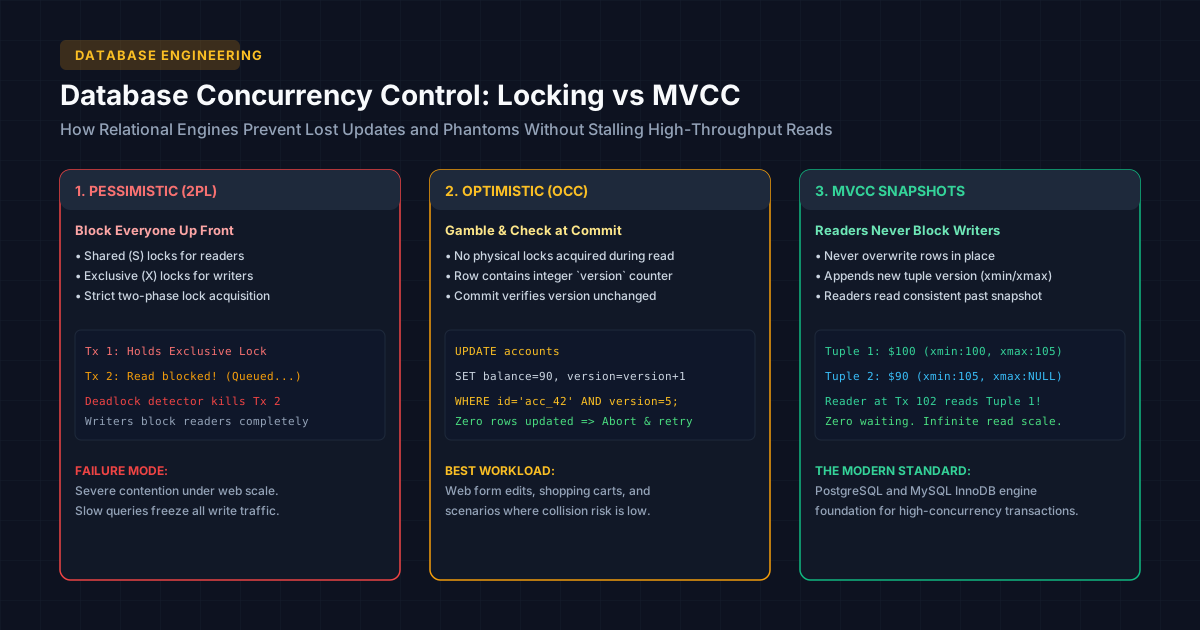
Concurrency Control in Databases: Lost Updates, Locking, and Isolation Levels Explained
How concurrent transactions corrupt state: dirty reads, non-repeatable reads, phantom reads, pessimistic locks, and MVCC snapshot isolation.
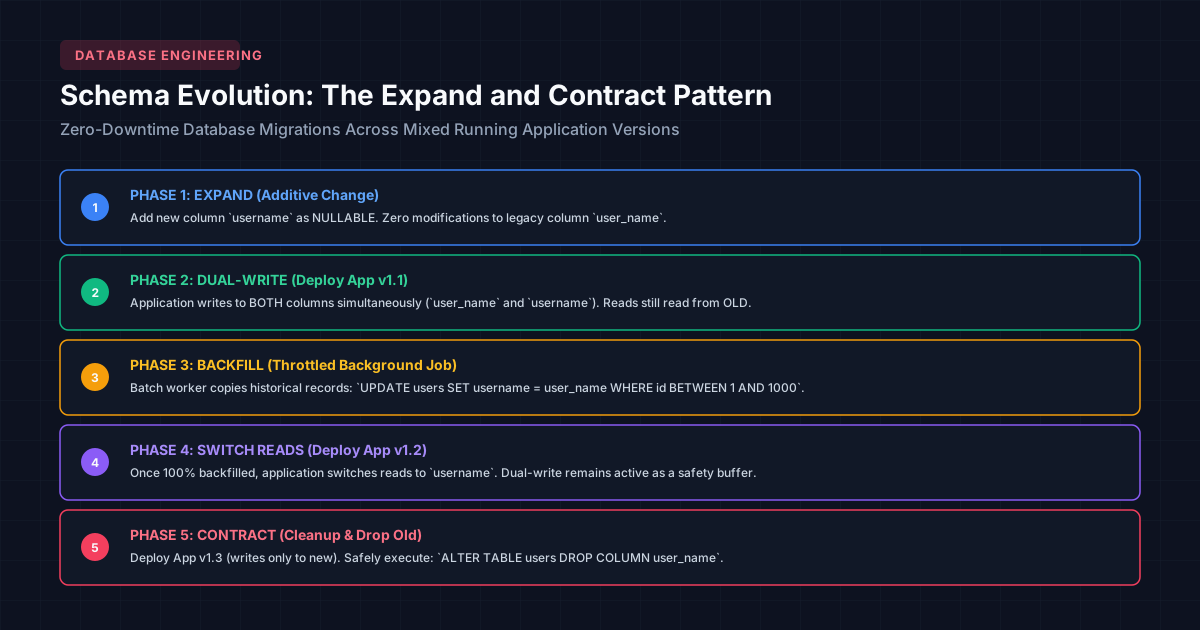
Schema Evolution Without Outages: Expand and Contract Migrations for Systems Running Mixed Versions
Why multiple schema versions run concurrently in production, and how five-phase expand-contract migrations prevent downtime.
Cloud Armor’s CDN Edge Rules Can Filter Before Cached Content Is Served
A November Preview adds ASN, threat-intelligence and HTTP filtering to Cloud Armor edge policies for Cloud CDN. The cache boundary changes where policy applies.
/* Comments */
Comments are offline right now — we reconnect automatically, nothing is lost.