
A CubeSat Instrument May Give a Lunar Mission a Faster Start
NASA says a flight-proven CubeSat detector is being adapted for a planned lunar instrument, with new environmental demands still to solve.
On this page
Space hardware often becomes useful beyond the mission that first carried it. NASA’s Heliophysics Engineering and Technology Office describes a recent example: MeDDEA, a hard-X-ray instrument that flew on the PADRE CubeSat, is being adapted for AWSEM, a planned lunar payload. The payoff is not simply saving parts; it is carrying flight experience into a new design while making the remaining environmental and integration work explicit. [1]
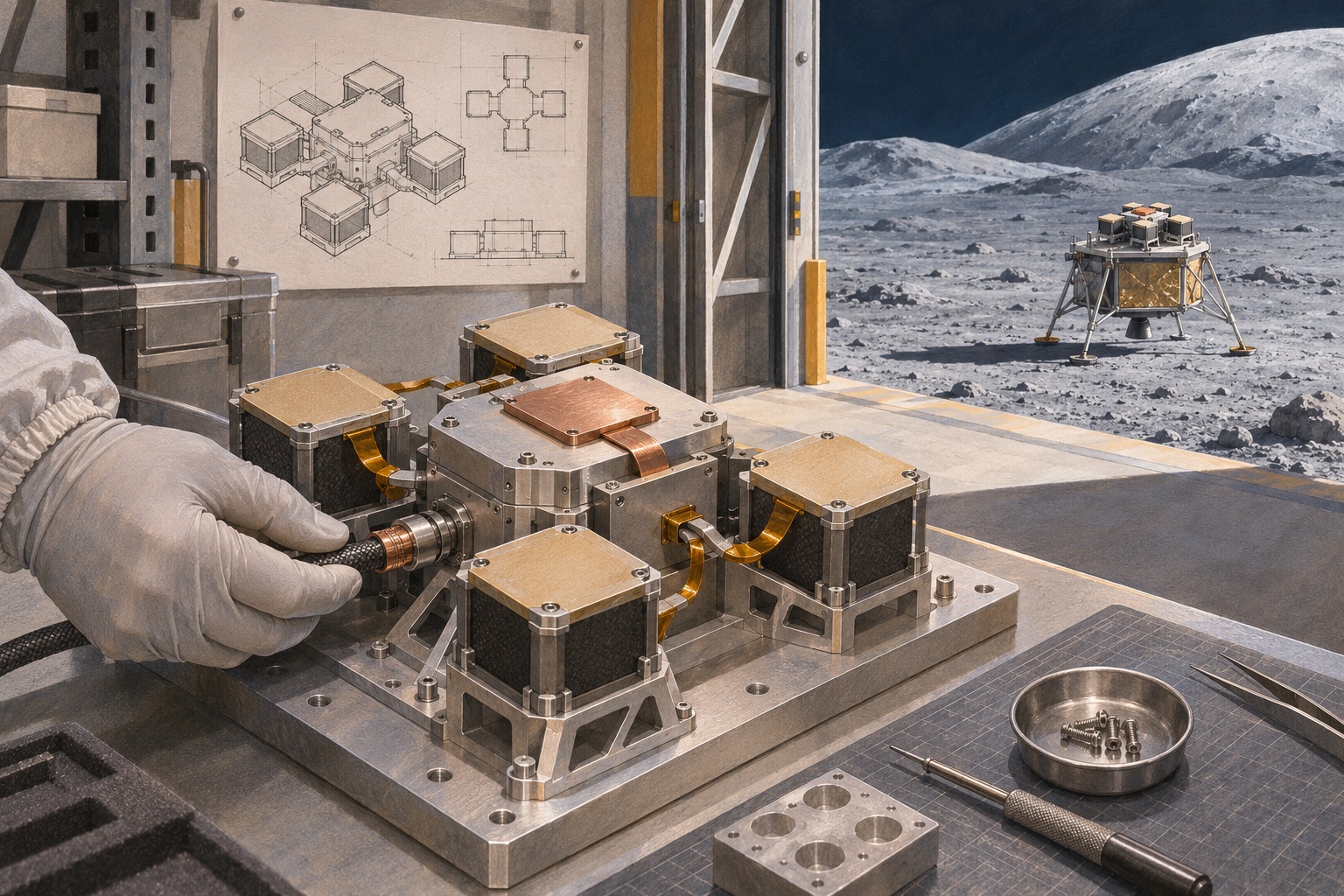
A flight test changes the maturity question
PADRE, the Polarization And Directivity X-Ray Experiment, launched on June 23, 2025, as a 12U-XL CubeSat. NASA says its MeDDEA instrument uses four flight-spare detectors from the Solar Orbiter/STIX instrument and measures the directionality of solar energetic electrons through hard X-rays. The instrument does not create a conventional image with grids; it is designed to infer how electrons are distributed and accelerated from detector measurements. [1] [2]
NASA reports that MeDDEA entered development at Technology Readiness Level 5 and reached TRL 9 through development, environmental testing, integration and on-orbit operation. It also says all four detectors are operating and producing science data. Those claims describe the agency’s own maturity assessment; the arXiv paper gives the technical context for the PADRE observations and should be read for the instrument’s demonstrated measurement scope. [1] [2]
AWSEM—Advanced Warning for Solar Energetic particles on the Moon—was selected in September 2026. NASA says it is planned to fly on Northrop Grumman’s Lunar Infrastructure Demo 1, with flight readiness targeted for the end of 2027. Its purpose includes observing solar flares and warning of solar energetic particle events that can affect lunar explorers and infrastructure. The NASA post presents this as a development plan, not as a confirmed launch date or a completed warning capability. [1]
That is why the mission transfer is interesting to engineers beyond heliophysics. Small spacecraft can provide a comparatively fast opportunity to test sensors, interfaces and operational procedures in orbit. A later mission can reuse the evidence, while still requiring changes for a new thermal envelope, power supply and deployment mechanism. Reuse is most valuable when a team knows precisely which risks have been retired and which are new. NASA’s reported TRL progression applies to the MeDDEA design and its PADRE flight experience; it should not be read as a certification that the AWSEM payload is already qualified for the Moon.
Lunar reuse is more than a parts swap
PADRE operated in low Earth orbit. A lunar surface payload faces much wider temperature variation and long stretches of darkness. NASA says the AWSEM design must harden MeDDEA to survive the lunar night. Engineers also need to account for lander interfaces, thermal behavior, power budgets, contamination, vibration and the operational schedule. Prior flight data reduces uncertainty about some components, but the new environment still requires qualification and testing.
That distinction is central to technology transfer. A mature sensor can shorten one part of a development path, while the larger mission remains in design and integration. The same principle appears in other lunar infrastructure: NASA’s separate 5G and Wi-Fi contract is funding a network-in-a-box demonstration and later surface testing, rather than claiming that a lunar communications network is already operational. [3]
What to watch next
The PADRE results matter because solar-flare hard X-rays encode information about energetic electrons. MeDDEA’s measurement approach focuses on directional signals rather than a conventional image, so translating the data into a picture of particle acceleration requires instrument calibration and physical modeling. The paper provides a more specific technical basis than the agency’s program summary; it does not establish that the planned lunar payload will deliver operational warnings on a schedule. [2]
The next evidence will be concrete: published design updates, thermal-vacuum and radiation testing, lander integration, a stable flight-readiness milestone and, eventually, data returned from the lunar environment. NASA also says AWSEM could investigate lunar fluorescence, including calcium and iron lines, but that remains a project estimate dependent on instrument performance and the mission environment. [1]
For space-science readers, the wider lesson is that small missions can test hardware in real operating conditions and create a path to larger or more ambitious science. The value is strongest when the transfer record clearly separates what has flown, what has been adapted and what is still planned. PADRE offers the first kind of evidence; AWSEM has yet to prove the rest.
Frequently asked questions
What is moving from PADRE to AWSEM?
NASA says AWSEM will build on the MeDDEA hard-X-ray instrument architecture and flight experience from the PADRE CubeSat. The lunar instrument is planned to adapt the design for a different environment and mission.
Has AWSEM launched to the Moon?
No. NASA says AWSEM was selected in September 2026 and is planned for a future lunar mission. The article describes a planned payload and development timeline, not a completed lunar deployment.
Why reuse hardware from a CubeSat?
Flight data can reduce uncertainty about components and instrument behavior, but reuse does not eliminate redesign. Lunar temperature swings, long periods of darkness, integration needs and mission schedules create new verification work.
Sources & further reading
Keep reading
NTT and Safran Want Satellite Laser Links to Behave More Like a Network
A November 6 memorandum explores connecting Safran optical ground stations to NTT's network control and All-Photonics Network technologies.
Encrypted Robot Commands Can Still Leave a Readable Rhythm on the Network
A 2026 study found robot actions could be inferred from encrypted traffic metadata, exposing a privacy gap between payload secrecy and behavioral privacy.
AutoDNA Turns a Wet Lab Into a Workflow Engine, With Humans Still on the Bench
Nature's AutoDNA study links AI agents to more than 20 lab instruments; its real advance is coordinated, traceable execution, not a scientist-free lab.
/* Comments */
Comments are offline right now — we reconnect automatically, nothing is lost.