
RTX Spark Could Bring AI Development to Your Desk—With New Tradeoffs
NVIDIA’s compact GB10 system promises local coding and model work, but shared memory, ARM software support and workload fit still decide its value.
On this page
The appeal of a local AI workstation is easy to understand: keep a model and its development loop close to the code, avoid sending every experiment to a remote endpoint and iterate on one machine. NVIDIA’s RTX Spark announcement aims at that workflow. Whether it is a good fit depends less on the product category than on the model, tools and operating boundary a team actually needs.

NVIDIA’s 16 October 2026 developer announcement describes RTX Spark systems based on its GB10 Grace Blackwell superchip, with up to 128 GB of unified memory. The company says laptops were available at announcement and compact desktop systems were expected in November. These are vendor availability statements; check the current regional listing and configuration before making a purchasing decision. [1]
The announcement also promotes results such as a 4.6-times coding-agent improvement. NVIDIA identifies the coding benchmark as AA-AgentPerf-local using Qwen3.8-27B, and gives separate workloads for fine-tuning and Linux kernel compilation. Those results show how a specific setup performed under the company’s test conditions. They do not predict the speedup for another model, codebase, toolchain or comparison machine. [1]
Shared memory changes the fit calculation
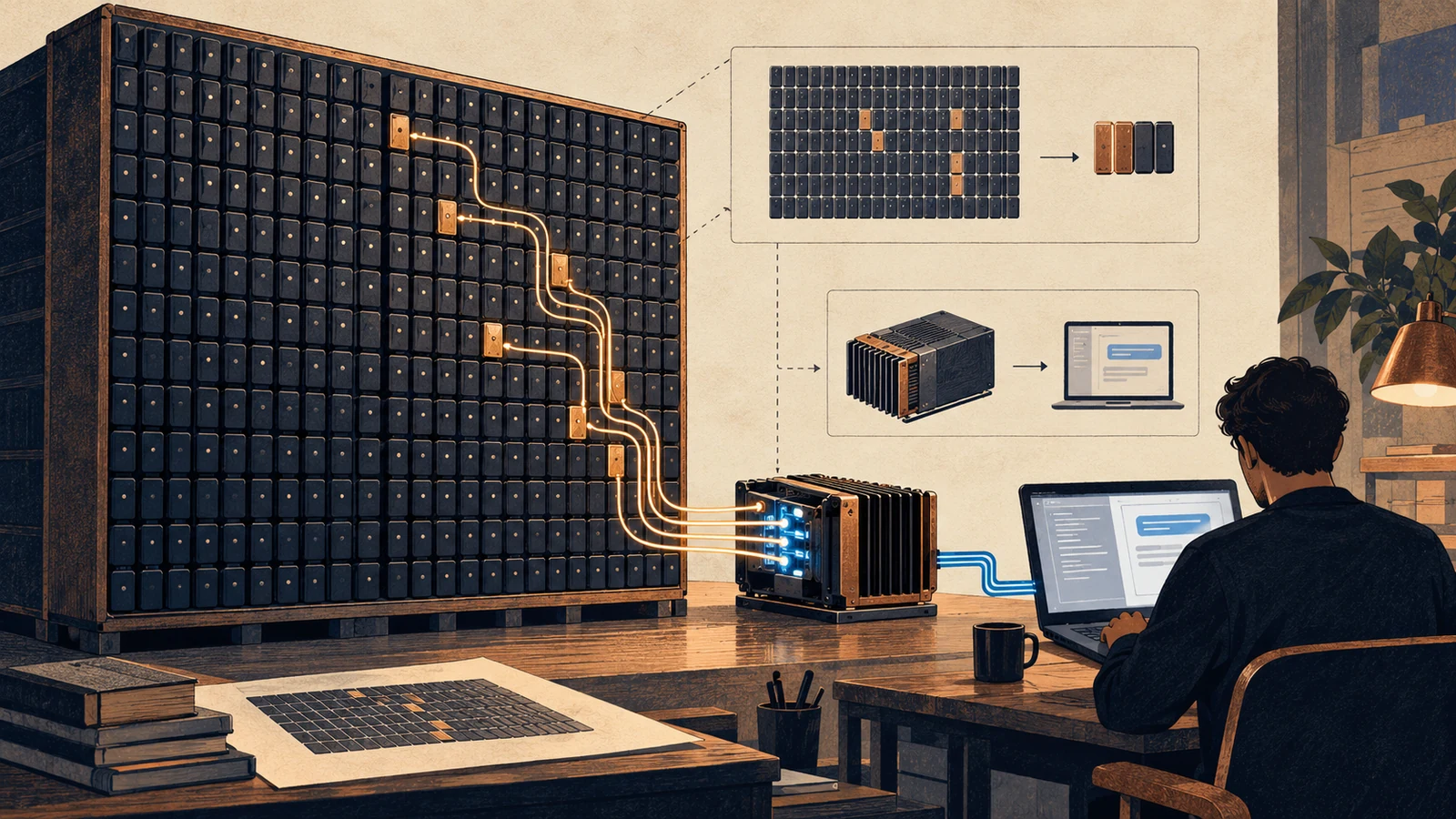
The RTX Spark porting guide describes an ARM-based SoC and up to 128 GB of LPDDR5 shared between CPU and GPU, with 300 GB/s memory bandwidth. Unified memory can simplify access to one pool for system and accelerator work. It does not mean every byte is available to a model: the operating system, applications, runtime, context cache and other workloads also need space. [2]
For a local model, the relevant question is the complete memory footprint at the intended precision and context length. A sparse model may activate only a fraction of its parameters for each token, while still requiring the serving system to store or access a larger set of weights. Our open-weight Beam analysis explains why active parameter counts and total storage are separate. A 128 GB ceiling can make some larger workloads plausible, but it is not a universal guarantee that a particular checkpoint will fit or run at useful speed.
Memory bandwidth, quantization support, batch size and the selected inference engine all affect latency. A one-user coding assistant and a concurrent service for a team have different capacity needs. Before choosing hardware, estimate weight, cache and runtime requirements for the actual model; then test cold start, sustained latency and memory pressure with the agent harness you expect to use.
ARM compatibility is part of the project plan
The GB10 platform is ARM-based, which changes the software checklist. Microsoft’s documentation explains that Windows on Arm can run many x86 and x64 applications through emulation, while native ARM64 applications are generally the direct path for performance. The docs also describe ARM64EC as a way for developers to transition parts of an application, and they call out native support for low-level components such as drivers. [3]
For a development workflow, list every dependency: editor, containers or virtual machines, GPU libraries, database, debugger, package manager, device drivers and proprietary extensions. Check which parts are native, which are emulated and which are unavailable. A tool that starts under emulation may still perform poorly when compiling or handling large files. A driver or kernel module may require an ARM64 build regardless of whether the user-facing app can be emulated. [4]
This is not unique to NVIDIA. Every shift in hardware architecture moves work into the ecosystem: libraries need ports, maintainers need test machines and teams need fallback paths. A local workstation is valuable when the software stack is ready for the workload, not simply because the silicon is capable.
Local compute does not equal a local data boundary
If model inference happens on the device, prompts may stay local for that step. But an agent can still access a hosted API, fetch dependencies, send telemetry, retrieve remote context or open a browser. A coding workflow can transmit source through extensions even when its primary model runs on-device.
Teams with privacy requirements should trace the complete data path. Identify which model weights are installed, which software has network access, where logs are written, whether crash reports include prompt content and how updates are downloaded. Then use OS-level controls or network monitoring to confirm the design, rather than treating “local AI” as a security guarantee.
For an individual developer, a small test can compare a local configuration with a hosted endpoint on the same task set. Measure answer quality, completion time, failure rate, energy and maintenance effort. Include tasks that expose the limits of the workflow, such as large repositories, long context or tool calls that need remote services. The best system may be hybrid: local for sensitive or iterative work, hosted for tasks that exceed the local capacity.
When the desk-sized setup makes sense
RTX Spark is most compelling when a developer has a bounded model workload, values fast iteration or needs to experiment without a shared cloud queue. A buyer should still compare it with a conventional workstation, a hosted GPU and existing developer hardware. Ask how often the workflow uses local inference, which memory sizes are available in the shipping configuration and whether the needed software is supported today.
NVIDIA’s launch benchmarks are a useful description of what it chose to demonstrate. A purchase decision needs a workload-specific trial. Run the same repository tasks, model, precision, context and tools; record completion and latency; and repeat enough times to see variability. Also track the setup effort required to keep dependencies and model runtimes current.
The product’s proposition is not that a compact computer makes every AI workload self-contained. It is that a capable local system may reduce friction for developers whose models and software stack fit. The practical advantage will come from that match: enough memory and bandwidth, compatible ARM software, and a data path the team understands. Measure those constraints before treating a benchmark multiplier as your own expected result.
Frequently asked questions
What is NVIDIA RTX Spark?
NVIDIA describes RTX Spark as a compact personal AI computer built around the GB10 Grace Blackwell superchip, with up to 128 GB of unified memory. The announcement distinguishes developer laptops already available from mini desktops expected later in November 2026.
Does RTX Spark make AI development private by default?
No. Running workloads locally can keep some model processing on the device, but developers still need to inspect telemetry, extensions, package downloads, APIs and data flows in the application they build.
Will all x86 developer tools run on the ARM-based system?
Windows on Arm can emulate many x86 and x64 applications, but emulation does not guarantee equal performance or compatibility. Kernel drivers and low-level components generally need native ARM64 support; check each dependency.
Sources & further reading
Keep reading

Meta’s New Feed Controls Make a Promise. The Ranking System Still Decides.
Facebook’s natural-language feed controls make preference editing easier, but the platform still translates each request into ranking signals.
Reflection Beam Is Open-Weight. Your Deployment Still Has a Memory Problem.
Beam’s Apache-licensed weights widen access, but 501 billion total parameters make hosting, memory and evaluation the real decisions.

The Hard Part of Medical AI Starts After the Accuracy Test
The UK’s AI Airlock Phase 3 puts post-market surveillance and lifecycle evidence in focus as healthcare AI changes after deployment.
/* Comments */
Comments are offline right now — we reconnect automatically, nothing is lost.