
NVIDIA SOMA Retargeter: Turning Human Motion into Robot Trajectories
NVIDIA SOMA Retargeter turns SOMA BVH motion into robot-specific trajectories using scaling, IK, and foot-plant correction—not a validated robot policy.
On this page
A human can walk with a long stride and recover from a stumble using joints and balance strategies a humanoid robot does not share. Copying the human skeleton’s joint angles is therefore the wrong transfer operation. Retargeting must preserve the task-relevant motion while respecting the target robot’s geometry, joint structure and motion limits.
Normalize the source before solving
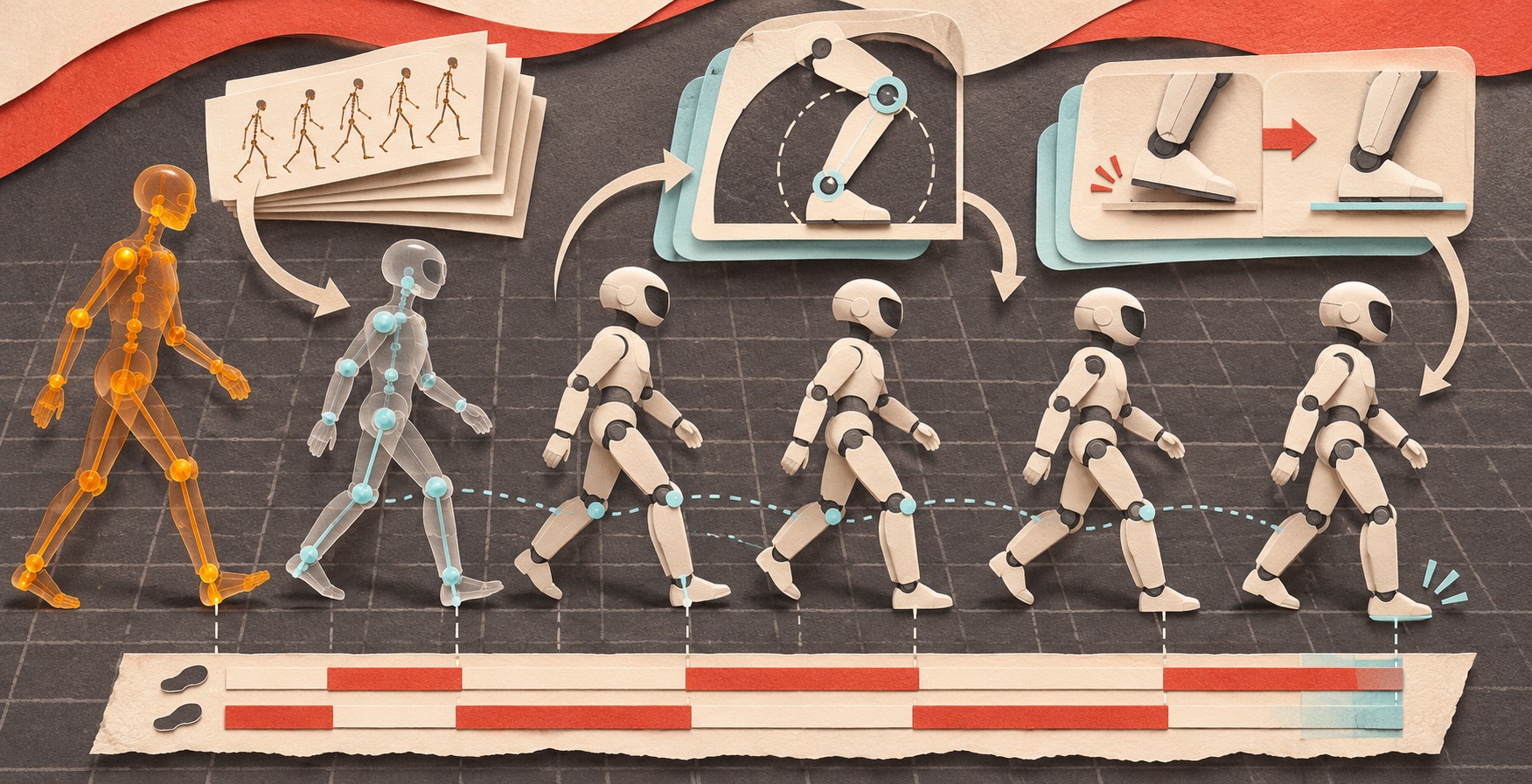
NVIDIA’s November 13 technical post describes an open-source SOMA Retargeter built around the shared SOMA-X body representation. [1] Inputs can originate in motion capture, video reconstruction, online datasets or generated animation, but their skeleton conventions and file formats differ. Mapping motion onto the SOMA base skeleton supplies a common source representation before adapting it to a robot. That normalization does not guarantee that the original motion is accurate; sensor noise, occlusion, timing errors and source-model assumptions remain upstream concerns.
The retargeter consumes BVH motion on the SOMA skeleton. It scales targets to the robot’s proportions, solves for robot poses with configured IK objectives, applies post-processing, and writes a CSV containing root position, orientation and joint angles over time. These are desired states. A policy or controller still has to produce actuator commands that track them under contact, dynamics and sensing constraints.
Body scaling and IK encode priorities
Proportional scaling answers a deceptively difficult question: where should a human hand or foot target lie when the robot’s limbs are shorter or its torso is shaped differently? IK then finds joint configurations that best satisfy multiple objectives. A robot may be unable to match every target simultaneously because of its range of motion, joint limits or differing degrees of freedom. Weights determine which targets matter most, so a configuration tuned for walking may be poor for reaching or manipulation.
NVIDIA describes an experimental IK-weight optimizer that tests configurations over a small representative motion set, comparing target fit and smoothness. Treat this as an aid for configuration search, not an automatic guarantee of a good motion library. Evaluation should use held-out clips from the intended task distribution. Track end-effector and root error, joint-limit proximity, discontinuities, balance-relevant posture and foot contact. Review difficult frames manually; one aggregate score can hide a wrist reaching well while a support foot slides.
Foot contact is a reference-data problem
A motion source may show a foot moving slightly while it should be planted. If a downstream tracking policy is trained against that reference, it receives conflicting signals: maintain contact and also follow the drifting target. SOMA’s foot-plant correction adjusts motion during detected contact intervals. Contact timing and correction strength need tuning, because an incorrect contact interval can freeze a foot during swing or allow drift during stance. Compare corrected and raw trajectories, especially at heel strike, toe-off, turns and changes in support.
Retargeting can also create abrupt changes when the source crosses a robot limit or when IK objectives compete. Inspect joint velocity and acceleration as well as pose error. A trajectory that looks plausible frame by frame may be too discontinuous for a controller to track. Resampling, filtering and task-specific constraints may be needed, and each changes the reference that the policy sees.
Reference motion is not sim-to-real evidence
NVIDIA’s example connects retargeted CSV trajectories to downstream SONIC motion-library preparation and policy training. That pipeline still has several validation boundaries: reference quality, simulated dynamics, policy tracking, robustness to perturbations, and hardware execution. Passing one boundary does not establish the next. Teams should evaluate in simulation with varied mass, friction, delay and sensor conditions, then use controlled hardware trials with safety limits and emergency stop behavior.
A practical evaluation starts with a small, task-specific clip set for configuring IK weights. Retarget those clips, inspect contacts and joint limits, and measure trajectory smoothness. Freeze the configuration, then run a held-out set through the same pipeline. Next measure policy tracking error and failure cases in simulation. Only after those checks should a robot trial be planned, with conservative speed and workspace constraints. Report the robot model, configuration, source motion, correction settings and policy used so the result can be reproduced.
The useful contribution is a more explicit bridge from human motion assets to robot-specific reference trajectories. Its value depends on the quality of that bridge and the discipline of downstream testing—not on treating animation output as autonomous capability.
SOMA Retargeter is best understood as data preparation in a longer robotics workflow. A motion source is normalized, transformed into robot-specific references, checked for contact and kinematic plausibility, then consumed by a controller or learned policy. Our robotics factory-kitting coverage discusses a different robotics stack; the shared lesson is that demonstration, simulation and physical deployment are separate evidence stages.
Frequently asked questions
Does SOMA Retargeter make human motion directly executable by a robot?
No. It produces robot-specific joint and root trajectories from a human motion reference. A downstream controller or learned policy must track those references, and physical execution still requires safety and stability validation.
What does foot-plant correction address?
It adjusts motion during detected contact intervals to reduce sliding-foot artifacts in the reference. It does not prove that the physical robot will maintain contact on every surface or under disturbances.
How should teams evaluate retargeting quality?
Inspect representative clips for joint-limit violations, foot sliding, discontinuities and task-relevant pose error, then measure whether a downstream policy can track them in simulation and on hardware.
Sources & further reading
Keep reading
cuPhoton and Black-Hole Interferometry: Accelerating Correlation Is Not Imaging
NVIDIA's cuPhoton.xBeam targets VLBI data correlation; calibration and image reconstruction remain separate scientific stages.

AlphaGenome 2 Tries to Find the Cell Where a DNA Variant Matters
Google DeepMind's AlphaGenome 2 conditions predictions on cell type and state, aiming to connect genetic variants with the cells where their effects appear.

RIKEN’s AI for Science Plan Starts With the Lab, Not a General Assistant
RIKEN-AXIS links scientific AI, human-led experiments and shared research facilities. Its promise depends on open access and rigorous validation.
/* Comments */
Comments are offline right now — we reconnect automatically, nothing is lost.