
A Wet-Lab Benchmark Tests Whether AI Can Read the Messy Result
BioBasicsBench asks agents to interpret raw lab evidence, spot faulty controls and withhold conclusions. Its score is a start, not proof of lab autonomy.
On this page
A gel image can look persuasive until someone notices that the control lane was loaded incorrectly. In a real laboratory, the next decision may depend on that small detail: repeat the assay, revise the protocol or stop before drawing a conclusion. BioBasicsBench is designed to test whether an AI agent notices those ordinary complications instead of confidently narrating the result.
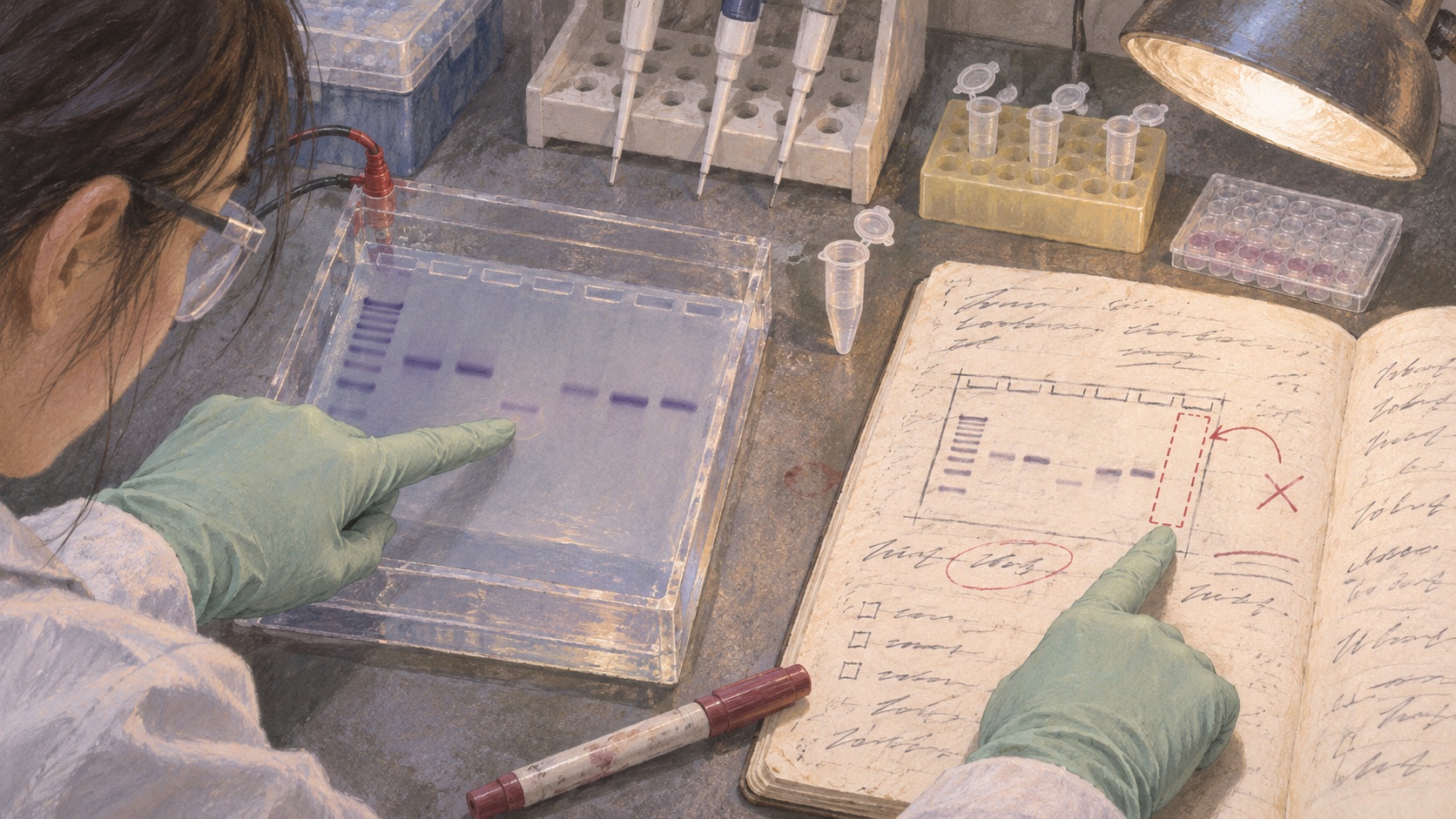
OpenAI introduced the benchmark on November 6, 2026, with biotech company Ligo. Its 100 tasks cover protein methods, imaging and cytometry, assays and quantification, nucleic acid methods, and molecular cloning. The inputs include raw evidence such as gel images, colony plates, microscopy and instrument readouts. Tasks range from reading a sample’s molecular weight to analyzing an assay with several pieces of context. [1]
That focus fills a gap in many scientific evaluations. A paper figure has usually been selected, cleaned and captioned for publication. An experiment in progress can be ambiguous, incomplete or simply wrong. A useful assistant needs to notice the difference between a result and an artifact, check whether the controls support the interpretation and explain when the evidence is insufficient.
The test is about judgment around evidence
OpenAI says scientists built the tasks from their own experiments and paired each with expert-written grading criteria. Each task went through review by another Ligo scientist, an external scientist with wet-lab experience and a final internal review. Answers receive partial credit across rubric criteria, allowing the score to distinguish a conclusion from the reasoning and checks that support it. [1]
At the highest reasoning setting reported in the announcement, GPT-6 Astra earned an average 66.7 percent of available credit; GPT-5.6 Sol earned 43.8 percent. That is evidence of progress on this benchmark as reported by its creator. It also leaves substantial room for error. A score of 66.7 percent is not a probability that the system will be right on any specific experiment, nor does it tell a lab which mistakes carry the greatest risk. [1]
The benchmark’s most important idea may be to reward calibrated uncertainty. If the sample quality is poor or a control is missing, “cannot tell from this evidence” may be more useful than a confident guess. In research settings, an unjustified interpretation can waste reagents, instrument time and researcher attention. The right objective is not simply to produce an answer; it is to produce a defensible next step.
Earlier biology benchmarks such as LAB-Bench evaluate a broader set of research skills, including literature reasoning, figure interpretation and biological sequence work. BenchBench-Protocol focuses on adapting and reasoning about experimental protocols. These evaluations ask different questions, and their scores should not be compared as if they were one league table. Together, they show why scientific AI needs task-specific tests that represent the actual evidence and workflow. [2] [3]
What this does not yet tell a laboratory
A benchmark can help teams identify failure modes, but it does not certify a system for use in a particular lab. BioBasicsBench’s reported results are from OpenAI; the public announcement does not provide an independent replication or a head-to-head evaluation across providers. The task set, full grading rubrics and raw per-task outputs were not linked in the announcement reviewed for this article. That limits outside scrutiny of how representative the tasks are and which errors drive the average score.
The benchmark also tests interpretation, not a complete experimental loop. An autonomous laboratory would need to plan an experiment, check material and instrument constraints, operate equipment safely, maintain sample provenance, notice unexpected behavior, decide when to stop and reproduce the result. Those are distinct capabilities. A model that reads a gel image well may still mishandle a sample label or suggest a protocol that the local instrument cannot perform.
For scientists and managers, the practical way to use a score is as a prompt for local evaluation. Select tasks from the lab’s own routine work. Keep some cases ambiguous or deliberately incomplete. Score whether the system checks controls, separates observation from inference, requests missing information and defers when a decision is consequential. Compare recommendations with expert review, then document the kinds of errors that matter most.
For benchmark builders, the next step is making evaluation reproducible: publish task definitions, permissible tools, grading logic and enough data to independently inspect the results, subject to appropriate handling of sensitive research data. Include negative cases and measure uncertainty calibration. A single mean score can hide whether the model is consistently competent or uneven across task families.
The promise is a better test, not a lab replacement
BioBasicsBench is valuable because it treats mundane experimental interpretation as a real AI capability rather than assuming that scientific knowledge alone is enough. Its initial result is a starting point. The benchmark will become more useful as independent researchers can inspect it, compare systems under shared conditions and test whether performance transfers to new labs and protocols.
Until then, the safe reading is narrow: OpenAI reports improved performance on its 100-task set, while acknowledging persistent weaknesses in image interpretation, control checking and experimental context. That can justify careful pilots with expert oversight. It cannot justify turning an agent loose on a laboratory workflow or presenting a benchmark score as proof that science is ready to run itself.
Related reading
Frequently asked questions
What is BioBasicsBench?
It is a 100-task benchmark developed by OpenAI and Ligo to test how agents interpret routine raw wet-lab evidence, detect mistakes and recognize when the evidence cannot support a conclusion.
Does the benchmark show that an AI can run a laboratory?
No. It tests analysis tasks using experimental evidence. It does not demonstrate that an agent can safely operate instruments, select experiments, manage samples or produce a reproducible scientific result without human oversight.
How should readers interpret the reported score?
OpenAI reports average rubric credit for its models on this benchmark. The result is informative about those tasks, but it is not an independent comparison with other providers or a measure of performance across all laboratory work.
Sources & further reading
Keep reading

When AI Agents Share a Queue, Cooperation Becomes a Safety Question
Anthropic’s multi-agent study measures aid, resource sharing and intervention. It does not answer whether models are conscious or prove agents will collude.

Anthropic Counted 207,000 Science Sessions. What the Count Can’t Prove
Anthropic’s study maps Claude sessions to scientific fields and tasks. It describes product use, not a causal measure of research progress.

A New Benchmark Tests AI on Theoretical Computer Science Research, Not Just Proof Prompts
TCSExam scores theorem proving, solver engineering, constructions, and open conjectures, with Lean or executable checks that make progress more auditable.
/* Comments */
Comments are offline right now — we reconnect automatically, nothing is lost.