
OpenAI’s Hardware Prototype Shows Where AI Engineering Still Needs Review
OpenAI says Astra helped design a talking device, but manufacturing tolerances and assembly details still required human review.
On this page
A model can produce a plausible enclosure, circuit board and firmware in one connected workflow. A factory still needs a design that fits real components, respects tooling limits and can be assembled repeatedly. OpenAI’s new hardware example is notable for including both sides of that gap: rapid design work and the iterations required to make a prototype buildable.
What OpenAI says happened
In a November 3 research post, OpenAI described a side project in which two team members worked with GPT-6 Astra on a device for talking to Codex. The company says Astra helped define functional requirements, design the enclosure and PCB, select components, create software integrations and produce the interface. A contract manufacturer built a small batch of prototypes in under a month after the design work took less than a week. [1]
OpenAI also gives an important qualification: getting the device ready for manufacturing required several rounds of review and iteration. Astra did not consistently account for the manufacturer’s production limits, tolerances or details needed for assembly. That caveat is not a footnote to the story. It identifies the boundary between a coherent design proposal and a design package that can be manufactured reliably. [1]
The post reports internal adoption and company-selected examples, not an independent controlled study. It does not provide a bill of materials, failure rates, engineering hours saved, or a comparison against a human-only design process. The prototype is evidence that a multidisciplinary workflow can be explored quickly; it is not proof that AI can independently deliver production-ready hardware.
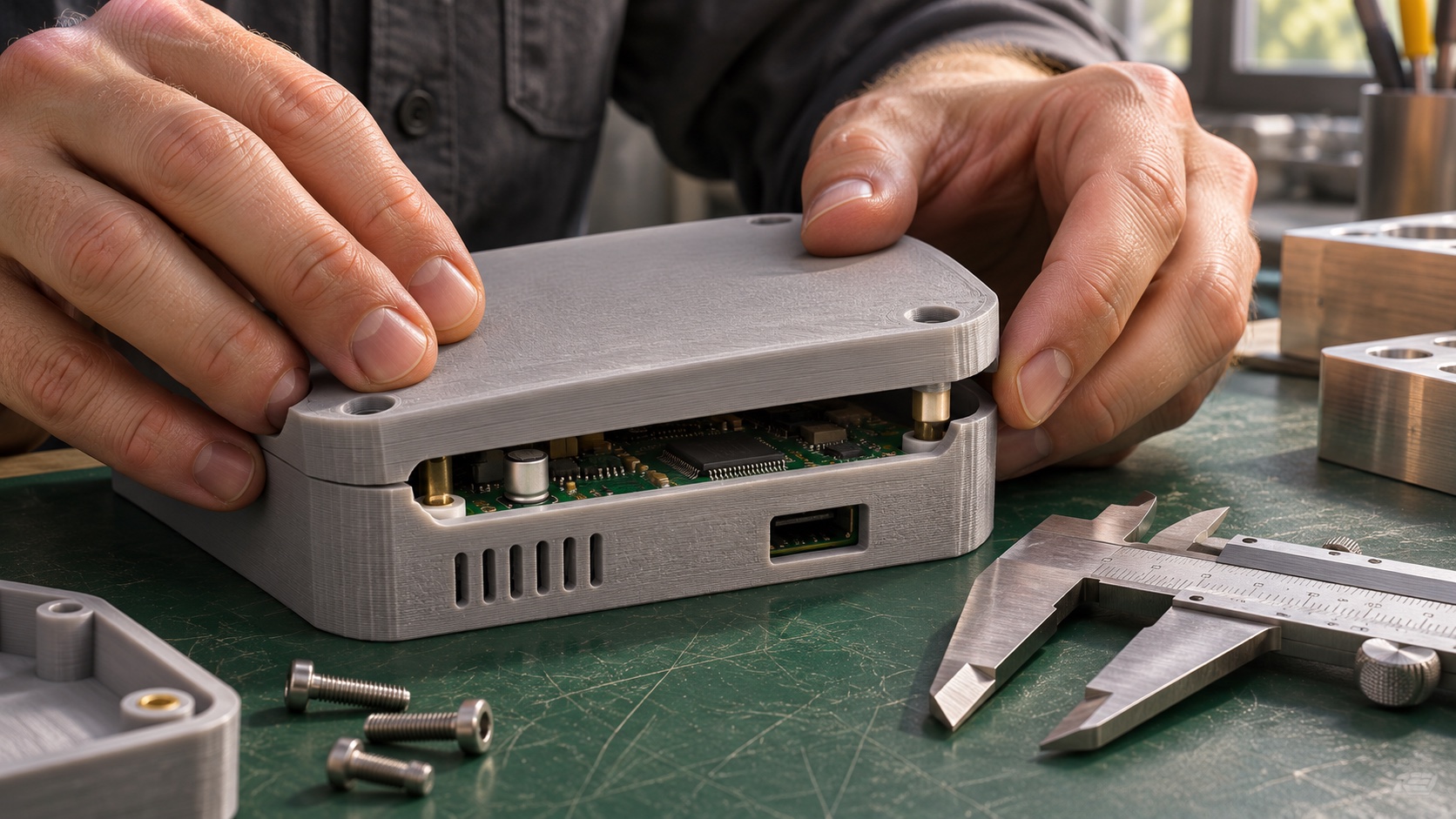
The hidden work between a model and a build
A hardware design is a system of coupled constraints. A connector’s position affects the enclosure; a board’s heat profile affects material and ventilation; screw access affects assembly sequence; material thickness affects both strength and fit. A model can propose changes across these disciplines, but each proposal must satisfy the manufacturing process that will produce the part.
This is why engineering teams rely on review artifacts beyond a rendered shape: dimensioned drawings, tolerances, material specifications, component availability, assembly instructions, simulation assumptions and test plans. Digital-twin and systems-engineering practices likewise depend on linking models to validated requirements and real-world behavior, not merely creating a detailed representation. [2] [3]
The model’s ability to revise a design quickly may reduce the cost of exploring alternatives. But the value depends on how the team captures constraints and validates each iteration. If fit is checked only after a batch is produced, the savings from faster ideation can be consumed by rework. If designers make tolerance, tooling and assembly constraints explicit early, the model can help generate better candidates for review.
A workflow that keeps engineering ownership clear
Teams evaluating AI for mechanical or electrical design can start with bounded tasks: draft a parametric concept, compare layout options, generate a first-pass drawing, or prepare a simulation setup. Require the output to cite dimensions and assumptions, and keep source CAD, version history and reviewer notes together. A qualified engineer should own the release decision and trace each critical requirement to a measurement, analysis or test.
Then test the handoff, not only the model output. Can a manufacturing partner interpret the drawing? Are tolerances achievable with the available process? Can components be sourced? Does the design survive assembly and use? OpenAI’s own report says the manufacturing boundary exposed issues that had not been handled consistently during design. That is precisely where a prototype review should focus.
For teams tracking AI’s move into physical work, our GitHub Git-storage coverage looks at another infrastructure shift: the systems that preserve and coordinate many parallel changes. The underlying principle is similar—faster generation increases the importance of traceable review and dependable handoffs.
Acceleration is not the same as autonomy
OpenAI’s example supports a careful conclusion. A model can contribute across CAD, electronics, software and interface design quickly enough to make a prototype practical. The company also says human review and iteration were necessary to address manufacturing realities. The next measure of progress should be less about whether a model can produce a convincing concept and more about whether it can consistently account for tolerances, assembly, supply constraints and test evidence in the artifacts engineers actually use.
Frequently asked questions
Did OpenAI manufacture a finished product using AI alone?
No. OpenAI describes a small prototype batch designed with Astra and built by a contract manufacturer. It says multiple rounds of review and iteration were still needed before manufacturing because the model missed production limits, tolerances, and assembly details.
What engineering tasks did Astra handle in the reported project?
OpenAI says Astra helped define requirements and design the enclosure, printed circuit board, software integrations, and interface for a device that talks to Codex. The company does not publish independent validation of each design output.
Can teams treat generated CAD as production-ready?
No. The announcement itself highlights manufacturability gaps. Engineers should validate dimensions, materials, tolerances, safety, sourcing, assembly, and simulation results with qualified reviewers before production.
Sources & further reading
Keep reading

Google Pay’s India Shopping Pilot Adds a New Job to a Payments App
Google is testing a personalized fashion feed, visual search and virtual try-on in Google Pay India. The pilot sends purchases to merchant sites.

Google’s Africa Skills Hub Puts Offline Learning in the Product Brief
Google says its digital-skills hub aims to reach three million people by 2030 and offers offline lessons. Completion matters more than sign-ups.

Box’s Agent Guardrails Put Content Permissions Around AI Actions
Box’s new controls restrict agent actions such as uploads and sharing, while audit trails and threat detection remain part of its roadmap.
/* Comments */
Comments are offline right now — we reconnect automatically, nothing is lost.