
An AI PTSD-Risk Study Looks Promising. Its Emergency-Room Workflow Is Still a Question
PREVIA estimates later PTSD risk from recorded emergency-room trauma interviews. Its 145-patient result needs independent validation and a careful privacy plan.
On this page
After a serious injury, the emergency room may be the only point of contact a patient has with the health system for weeks. A new study asks whether a short, recorded account of the event could help clinicians recognize who might need later mental-health support. The PREVIA system analyzes those narratives, but its small study and modest precision show why early-warning AI must be paired with careful human follow-up—and why a research interview should not be mistaken for an established clinical workflow. [1]
A short narrative instead of another long form
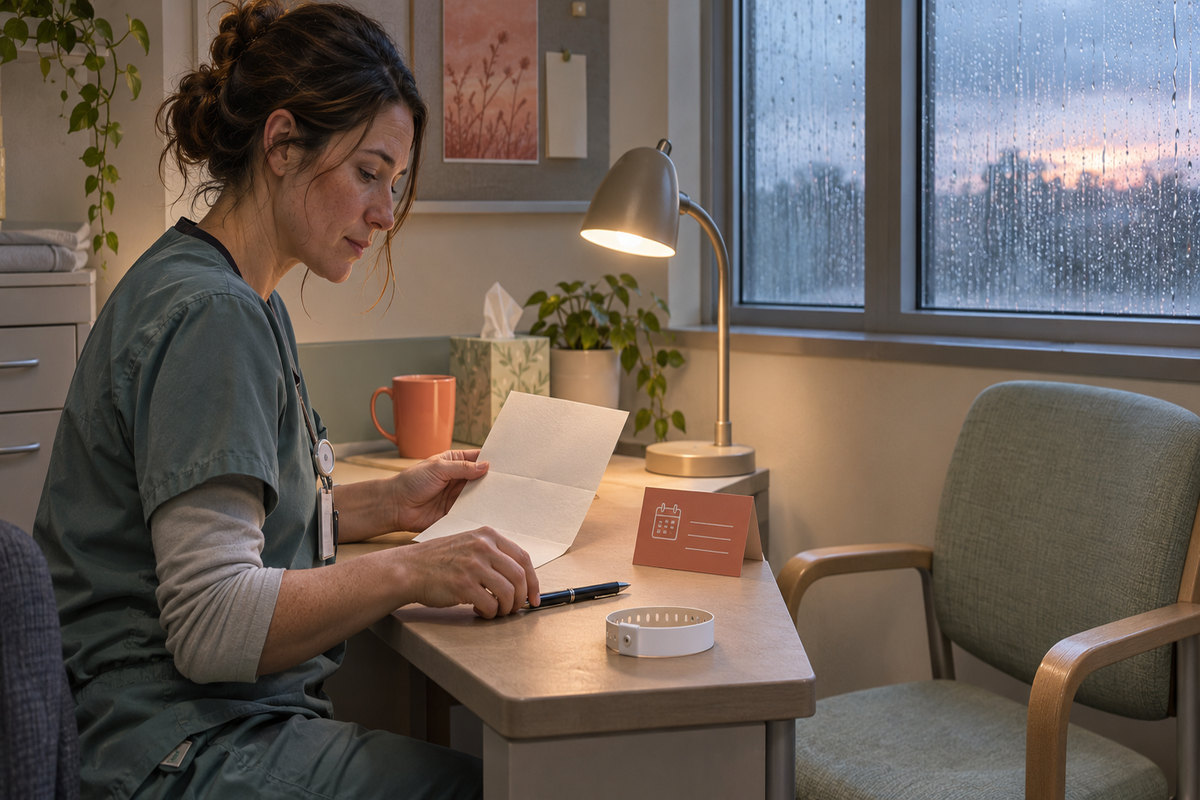
The Nature Communications study analyzed 145 people at two level-one trauma centers in New York City. Within 24 hours of trauma, a trained research coordinator asked participants to describe the event in a brief, video-recorded interview; the transcript was manually reviewed. Researchers assessed PTSD one month later using the Clinician-Administered PTSD Scale for DSM-5, or CAPS-5, described in the paper as the diagnostic interview standard. PREVIA uses several model-assisted stages to identify symptoms, reactions, risk factors and protective factors before producing a risk estimate and explanation. [1]
The design addresses a real operational challenge: emergency clinicians must prioritize immediate injuries and may have limited time for a detailed psychological assessment. The paper’s interview prompt resembles a familiar emergency-room question, but the researchers collected it as a separate, consented, video-recorded study interview. They did not establish that routine medical notes can replace this protocol or that a hospital can adopt the system without workflow, consent and privacy changes. [1]
PREVIA is not a single model asked one broad question. The paper describes a layered process combining different models and prompts: first extracting clinically relevant dimensions, then synthesizing findings, then generating a risk score with an explanation. The structure is intended to make the process easier to inspect than an unexplained binary label. It does not guarantee that the extracted evidence is complete or that the explanation faithfully captures every influence on the score. [1]
The metric that looks impressive—and the one that changes the story
For its main configuration, the study reports an area under the receiver operating characteristic curve of about 78.5%, sensitivity around 95.4% and precision around 46.8%. These statistics answer different questions. Sensitivity measures how many people who later met the study outcome were flagged. Precision asks how many people flagged actually met it. A high sensitivity can be useful when missing a patient is costly; lower precision means the care team must be prepared to review many alerts that do not correspond to the later outcome.
In a subset of 30 randomly selected cases, the paper compared PREVIA with an emergency clinician experienced in PTSD research. Both produced similar AUROC values in that limited sample. Such a small comparison should not be interpreted as proving equivalence to clinicians generally. It is a preliminary benchmark, conducted in a specific setting and against one expert’s assessments of a subset. [1]
The study also evaluates subthreshold symptoms, not just the formal one-month PTSD outcome. That may matter clinically because people can experience serious distress without crossing a diagnostic threshold. But any intervention triggered by a risk score needs to be proportionate: an invitation to a follow-up conversation is different from assigning a diagnosis, changing treatment or making an insurance decision.
Why a promising result still needs another hospital
The authors explicitly call for larger independent validation. Their analysis included adults aged 18–80 who were medically stable, fluent in English and able to consent; it excluded several groups, including people with severe traumatic brain injury, self-inflicted injury or suicidal ideation, intoxication, psychotic symptoms, ongoing trauma exposure or legal custody. The data came from two centers within one New York academic health system; performance can change across regions, languages, patient populations, documentation practices and care settings. The enrolled sample was 145 people, not a nationwide deployment. A system evaluated on English-language research interviews may not transfer to routine notes, other dialects, brief responses or translated speech. [1]
There is also a privacy question. Trauma narratives can contain highly sensitive details about a person’s health, family, safety and circumstances. A hospital considering such a tool would need to know where text is processed, who can access it, how long it is retained, whether the models are fixed and monitored, and how a patient can challenge an incorrect interpretation. Those safeguards are not established simply by a paper reporting predictive performance.
The clinical workflow matters just as much as the model. A flag is useful only if a trained person can review it, explain the next step and connect patients to appropriate support. If a hospital has no available follow-up care, adding a risk estimate may create anxiety without help. Past emergency-care research on LLM recommendations similarly emphasizes that clinical decisions depend on context and resource availability, not just a model output. [4]
What the result means for patients and hospitals
Patients should not treat PREVIA as a public diagnostic service; it is a research system in a study. A person worried about their mental health after trauma can seek care from a qualified clinician, regardless of whether an algorithm recognizes their symptoms. For hospitals and researchers, the sensible next step is a prospective external study: test the tool across different sites, publish calibration and subgroup results, track false-positive follow-up burden, and make human review part of the protocol.
The strongest idea here is modest. A routine conversation may hold information that clinicians could use to offer support earlier. AI may help organize that signal, but the right outcome is not simply a more accurate score. It is whether a patient receives timely, respectful care without having their experience reduced to a model’s prediction. [1] [2]
For related context, read our reporting on AI-assisted emergency-room decision support and clinical AI validation beyond benchmark scores.
Frequently asked questions
Does PREVIA diagnose PTSD?
No. The study evaluates risk prediction for PTSD one month after trauma, using emergency-department narratives. A risk estimate is not a diagnosis and would require a clinician-led care pathway.
How large was the PREVIA study?
It included 145 patients at two New York City level-one trauma centers. The authors say the findings need validation in larger, independent patient cohorts before broader conclusions or clinical deployment.
What does 95 percent sensitivity mean here?
In this study setup, the reported sensitivity means the system identified a high share of patients who later met the study outcome. Its reported precision was about 47 percent, so many people flagged as high risk did not meet that outcome.
Sources & further reading
Keep reading

AI-Exposed Workers May Be Facing a Slower Job Search, Not a Layoff Wave
A Cleveland Fed analysis links higher AI exposure to weaker job finding and worse outcomes for younger workers, while finding no clear rise in job separations.

Students Are Using AI for Homework Faster Than Schools Can Set the Rules
A new survey reports widespread AI homework use, but its public sample details conflict. The gap calls for school guidance and stronger evidence.
AI Proved Parts of Signal’s Code. Here Is What That Actually Guarantees
Google DeepMind used Lean-checked proofs on Signal’s libsignal code. The result is meaningful assurance with a carefully bounded scope, not a blanket guarantee.
/* Comments */
Comments are offline right now — we reconnect automatically, nothing is lost.