
Why Rubin’s Biggest MLPerf Gain Appears on a Communication-Heavy MoE Run
MLPerf Training v6.1 shows Vera Rubin nearly halving one 1,024-GPU MoE run. The result is a fabric and system story, not a universal GPU multiplier.
On this page
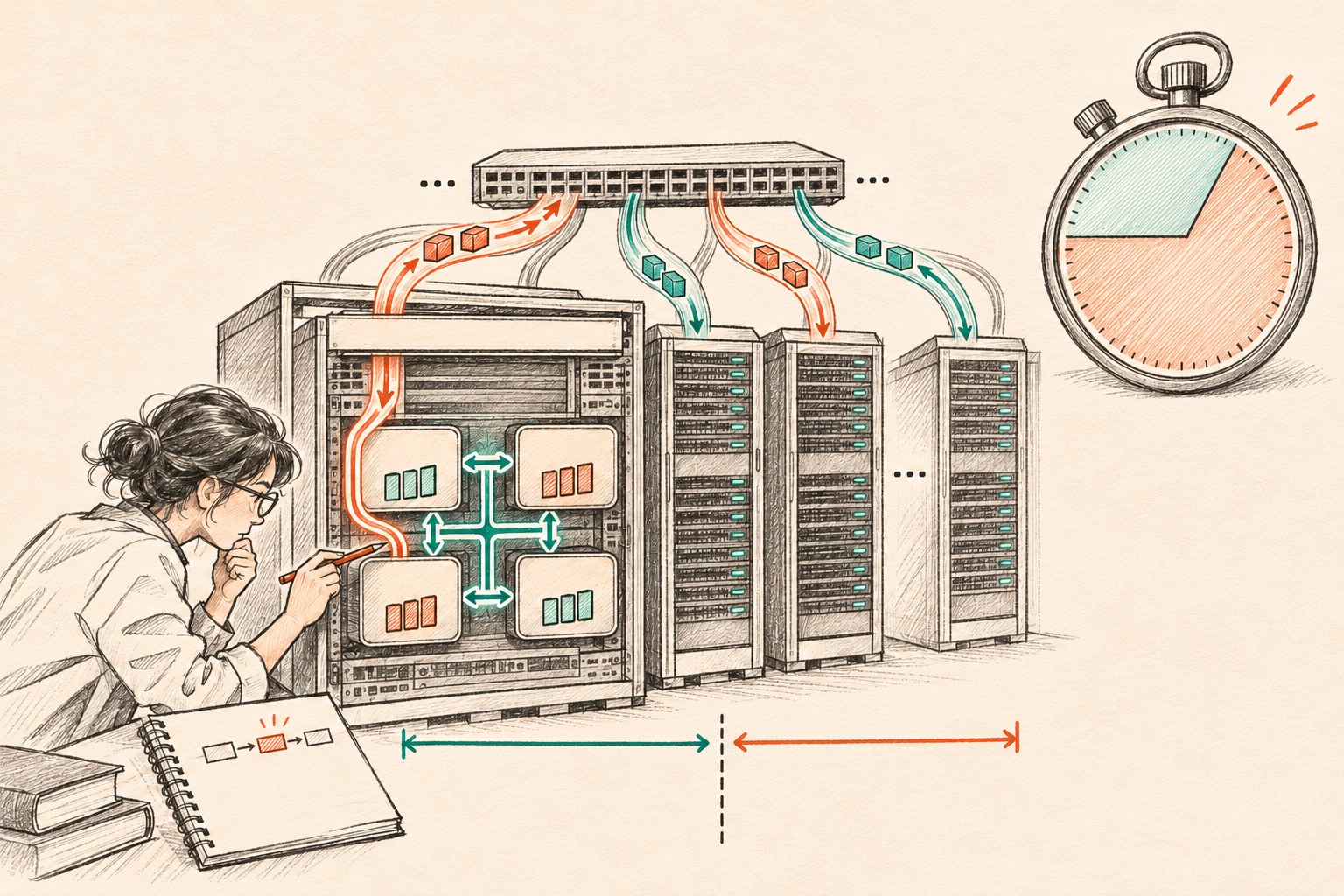
A benchmark time can hide the most useful engineering clue. In this MLPerf round, most same-count Vera Rubin comparisons sit between 1.4x and 1.6x; the largest gain, about 2x per GPU, appears on a 671-billion-parameter mixture-of-experts run. That pattern points toward a system bottleneck: when a training step spends substantial time exchanging token data, faster compute alone is not the whole explanation.
Read the comparison before the headline
NVIDIA’s November 16 technical post compares seven MLPerf Training v6.1 closed-division workloads. Its table reports Rubin-versus-GB300 per-GPU advantages from 1.4x on Qwen 3.5 GRPO and DLRMv4 to 2x on DeepSeek-V3 671B. The DeepSeek comparison uses 1,024 GPUs for each system and records 4.14 minutes on Rubin against 8.03 minutes on GB300. Both are named submissions in the same benchmark round, which is more informative than comparing unrelated vendor demonstrations. [1] [2]
The same post also reports a 1.38-minute DeepSeek result on 10,240 GB300 GPUs. That is a different question: absolute time at ten times the scale, not a same-size generational comparison. It is useful evidence that scale-out can work, but it should not be blended into the 2x per-GPU figure. MLCommons’ result explorer and supplemental discussion provide the system configuration context needed to distinguish these comparisons. [3]
Why an MoE run makes the fabric visible
A dense transformer generally uses the same broad set of weight matrices for each token. A mixture-of-experts (MoE) layer instead has multiple expert networks and a routing step that selects which experts process each token. In distributed expert parallelism, those experts are placed across accelerators. The training step must route token activations to the selected experts, run expert computation, and return the outputs.
That creates communication phases, often implemented with all-to-all collectives. If tokens are unevenly routed, some experts can receive more work than others. If expert GPUs span racks, data must cross the scale-out network as well as the faster scale-up links inside a rack. An iteration is then constrained by the slowest combination of compute, synchronization and data movement. NVIDIA itself highlights the DeepSeek run’s communication-heavy shape and reports above 97% scaling efficiency from 256 to 1,024 Rubin GPUs. That is a useful system metric, but it is a vendor interpretation of its own submission; the benchmark record remains the primary result. [1] [2]
The basic performance model is familiar: useful work is limited by the slowest stage that cannot be overlapped. If an iteration requires compute time C and communication time M, its duration is not simply the advertised peak FLOPS translated into seconds. Depending on overlap and synchronization, the critical path can approach max(C, M) or a larger portion of C + M. Higher link bandwidth can reduce M, but only when the communication pattern, topology, message sizes, software collectives and network contention let the workload use it.
This is why the 2x result should be read as a workload-specific systems outcome. It does not isolate the GPU chip from the NVLink fabric, memory subsystem, scale-out networking, compiler, kernels or tuning. MLPerf evaluates a full system and software stack. A team considering Rubin for its own training should ask whether its workload has similar expert traffic, scale and software maturity—not just whether it uses an MoE model.
The benchmark’s boundaries matter
MLPerf is valuable because rules, workload definitions and submitted configurations are published and reviewed. Yet even a standardized suite is not a complete proxy for a production cluster. The v6.1 round contains a mix of cloud and on-premises submissions, accelerator counts, server/rack shapes and software stacks. MLCommons calls out the round’s breadth and emphasizes comparisons within comparable workload and system categories. A number measured on a closed, available configuration should not be treated as a universal estimate for a different model, sequence length, token distribution, utilization target or facility. [2] [3]
There is another caveat in NVIDIA’s post: it includes later software reruns that are explicitly described as unverified. Those are not the official MLPerf submissions and should not be quoted as benchmark results. This article uses only the named official comparison table and the relevant MLCommons records. [1]
For platform engineers, the practical checklist is concrete:
- Match the model shape. Determine whether the workload is dense, MoE, recommender or post-training; each stresses a different part of the system.
- Measure communication. Profile collective time, bytes moved, skew between experts and overlap with compute before assuming a GPU upgrade will solve a training bottleneck.
- Keep scale-up and scale-out separate. Record whether a run stays inside one NVLink domain or crosses racks, and test the network path at the target cluster size.
- Compare complete configurations. Accelerator count, model quality target, software versions and availability class belong beside elapsed time.
- Use your own representative run. A reproducible benchmark with your sequence lengths and routing distribution is more decision-useful than a headline multiplier.
For the topology boundary behind this distinction, see our guide to NVL72 NVLink domains and collective communication. The broader distributed-systems guide to partial failure explains why a slow participant can hold up a synchronized job.
The important result is the shape of the gain
The v6.1 result is impressive, but its engineering lesson is more specific than “new GPU, twice as fast.” Rubin’s advantage grows on the large MoE workload, where token movement and distributed coordination matter. That suggests the rack-scale fabric and software deserve as much scrutiny as arithmetic throughput when planning a training cluster.
MLPerf establishes the measured performance of named submissions under defined rules. It does not prove the same speedup for a customer’s model or show which one subsystem caused the difference. Treat the result as a strong hypothesis for workloads with similar communication patterns, then validate it with a representative end-to-end run.
Frequently asked questions
Did Rubin make every MLPerf Training v6.1 workload twice as fast?
No. The reported per-GPU improvements over matched GB300 NVL72 submissions span roughly 1.4x to 2x across seven workloads. The 2x figure applies to the named DeepSeek-V3 671B comparison at 1,024 GPUs.
Why does a mixture-of-experts workload stress networking?
A mixture-of-experts model routes tokens to selected expert networks. Distributed expert parallelism moves token activations to the GPUs holding those experts and sends results back, making collective communication and fabric behavior part of step time.
Sources & further reading
Keep reading
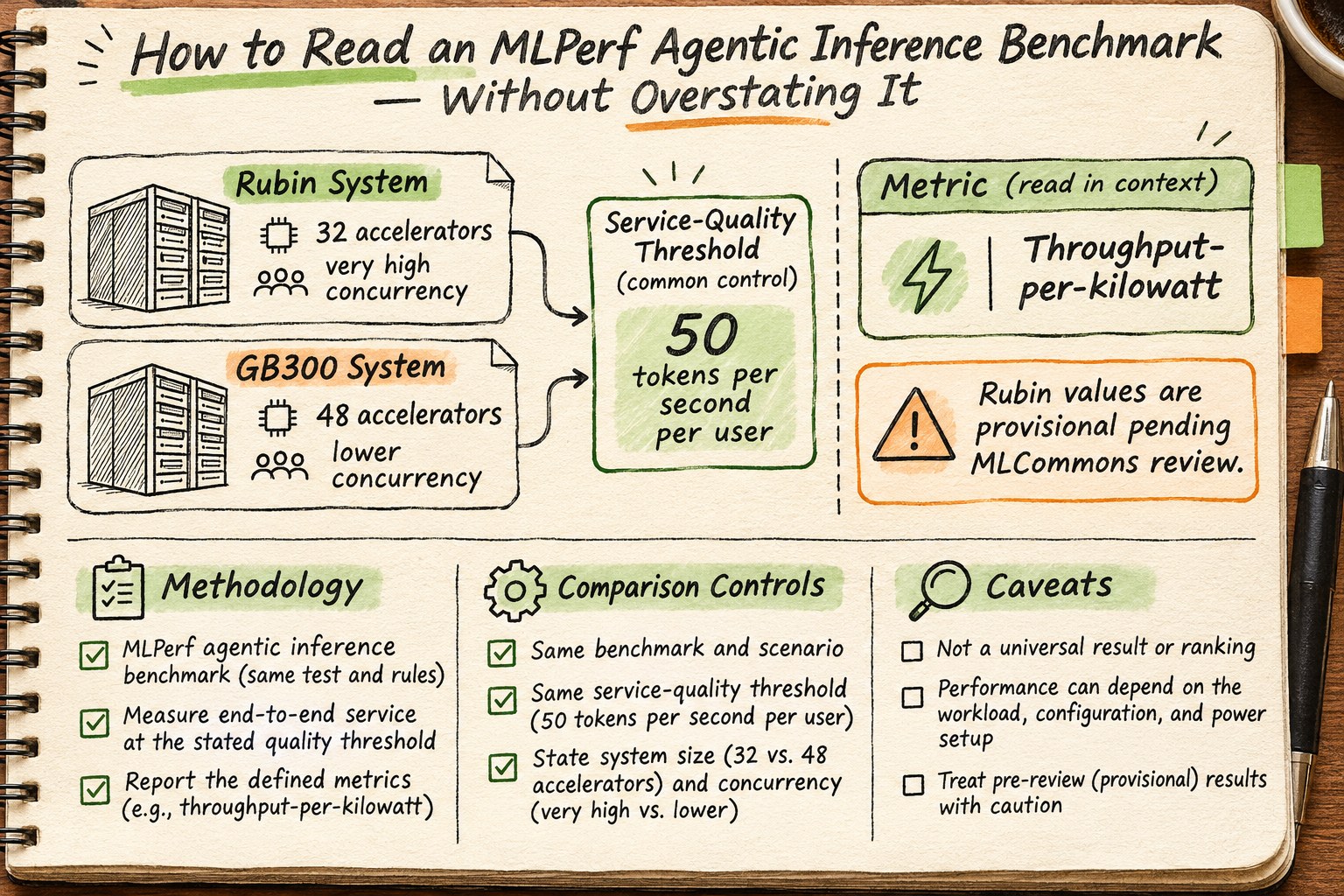
How to Read MLPerf’s New Agentic Inference Results Without Overstating Them
MLPerf Endpoints v1.0 measures tokens, interaction quality and power for multi-turn agents. Here is what its first Vera Rubin comparisons do and do not prove.
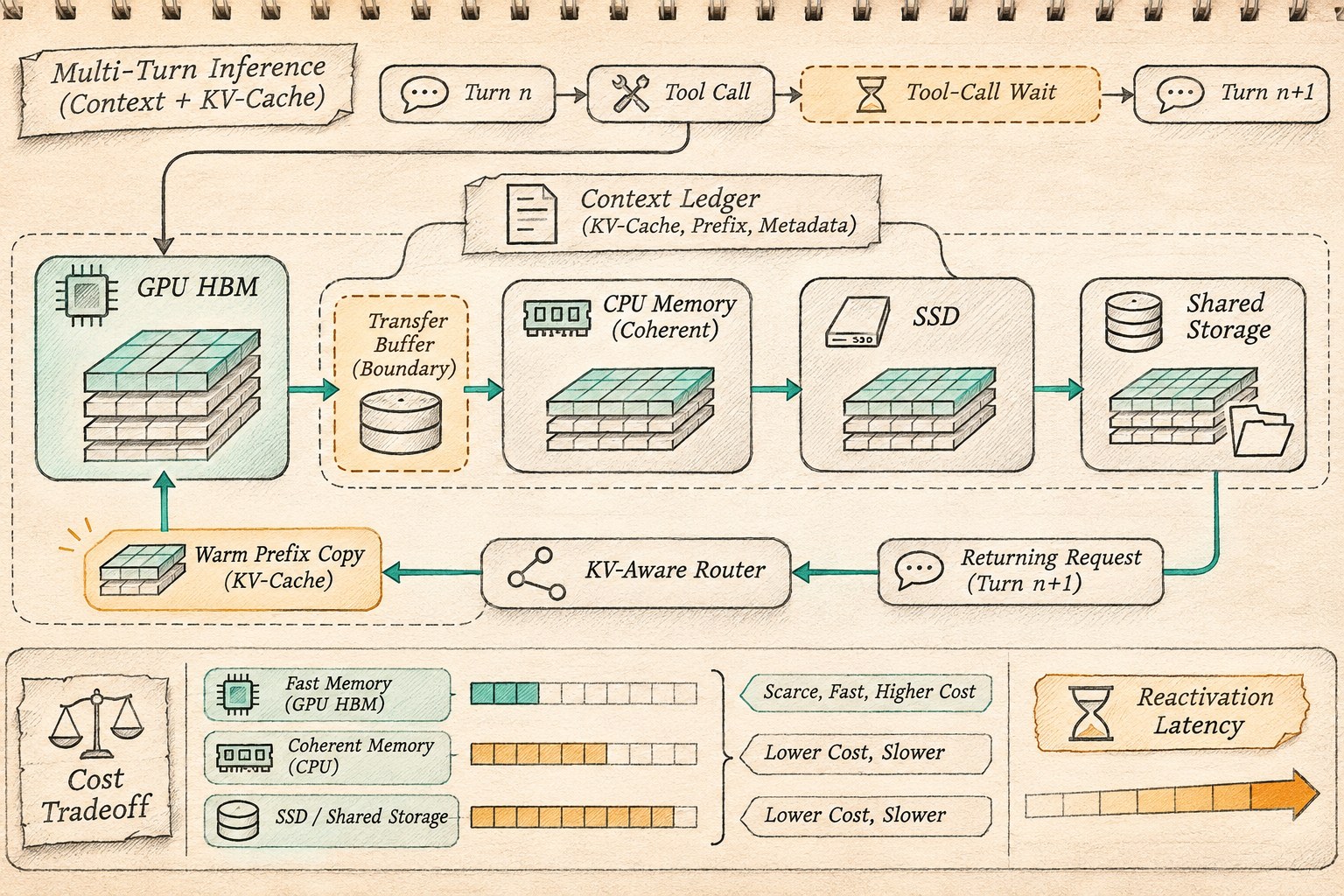
Agentic Inference Turns the KV Cache Into a Placement and Routing Problem
Agents leave KV state idle during tool calls. GPU, CPU and storage tiers can preserve it, but transfer cost and routing decide the payoff.
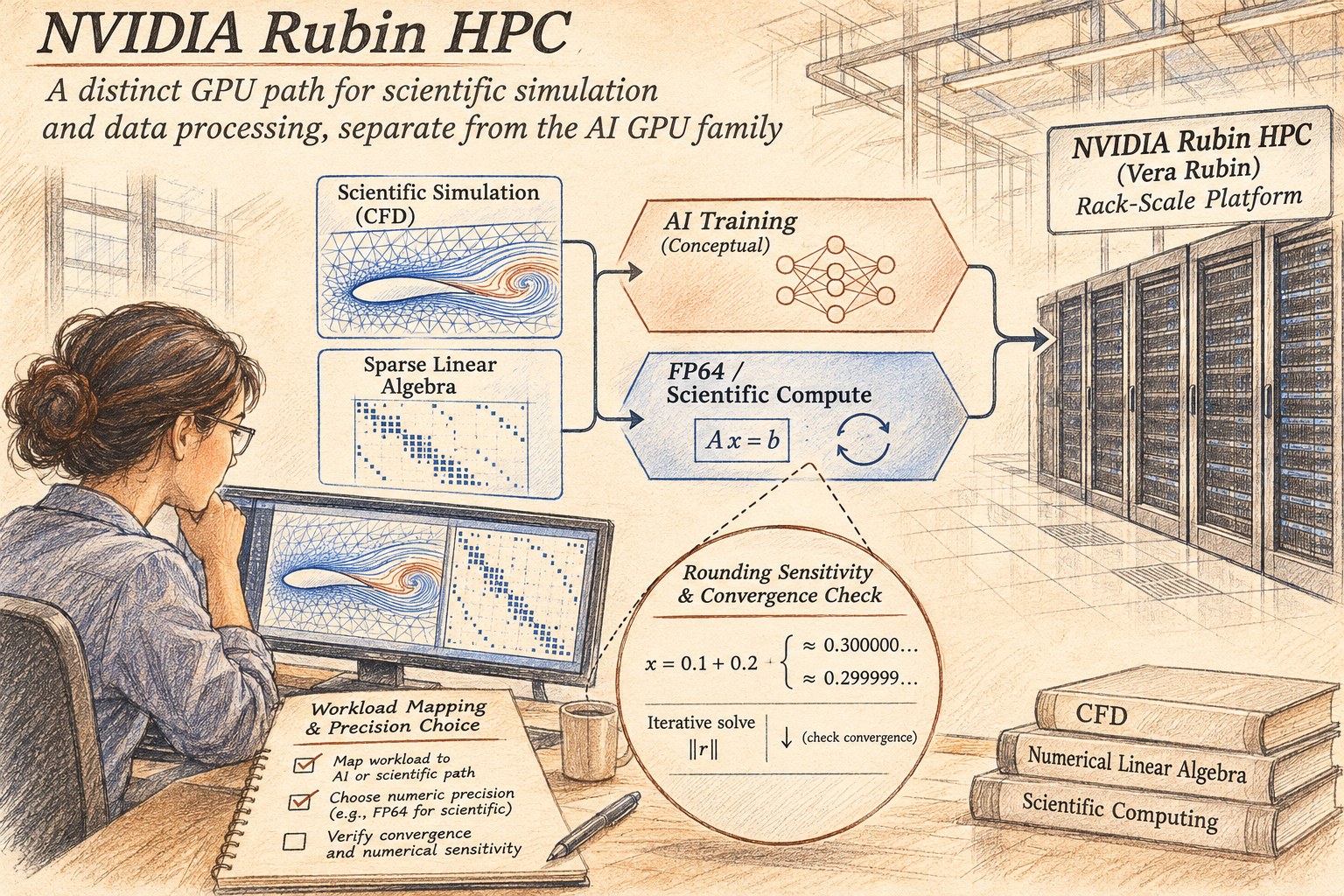
NVIDIA’s Vera CPU Rack Makes the CPU a First-Class HPC System Again
Vera targets simulation workloads needing memory bandwidth, CPU throughput and InfiniBand. Its announced 2027 availability remains a forecast.
/* Comments */
Comments are offline right now — we reconnect automatically, nothing is lost.