
NVIDIA’s Vera CPU Rack Makes the CPU a First-Class HPC System Again
Vera targets simulation workloads needing memory bandwidth, CPU throughput and InfiniBand. Its announced 2027 availability remains a forecast.
On this page
AI infrastructure has made accelerator FLOPS the headline, but many scientific workloads still spend time in CPU-side numerical kernels, data preparation and orchestration. NVIDIA’s new Vera CPU rack makes that part of the system an explicit product. The technical question is whether high memory bandwidth and a tightly integrated CPU/network platform can improve the full application, not whether a CPU should compete with a GPU at matrix multiplication.
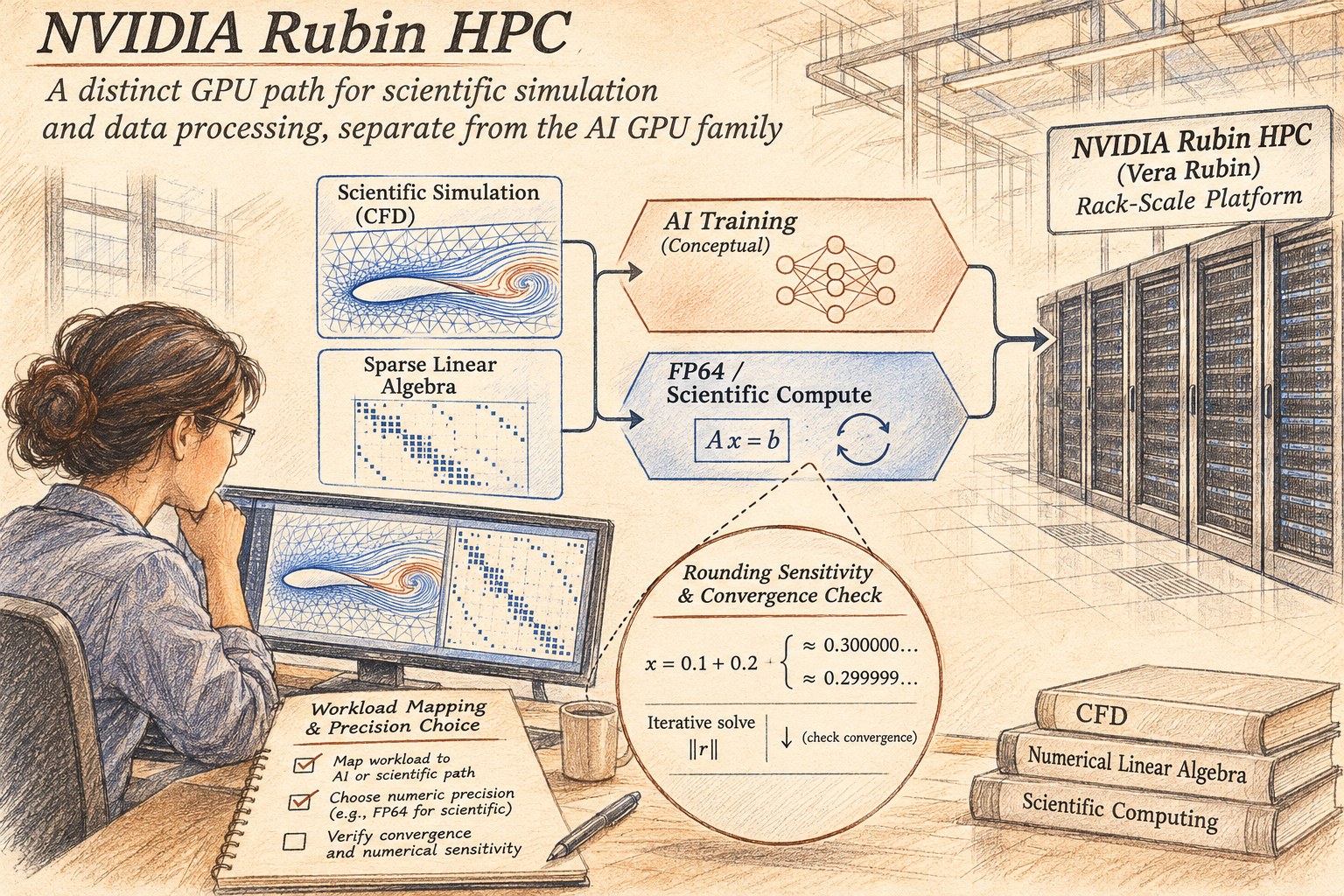
What NVIDIA announced
At SC26, NVIDIA described a rack-scale system of 192 Vera CPUs connected by Quantum-X800 InfiniBand. The company says the liquid-cooled system provides more than 200 terabytes per second of aggregate peak memory bandwidth for simulation and AI workflows. NVIDIA says DKRZ selected Vera CPUs for its HLRE-5 climate-science system and lists Dell, HPE, Lenovo and Supermicro as planned system providers. The announcement says Vera CPU racks are expected from those partners beginning in early 2027; as of this article’s publication date, that is forward-looking availability, not a claim that every system is generally orderable. [1]
The CPU has 88 NVIDIA-designed Olympus cores, 176 threads through Spatial Multithreading, and a server memory subsystem based on LPDDR5X. NVIDIA’s product page lists up to 1.2 TB/s of memory bandwidth and up to 1.5 TB of capacity per CPU, while its tuning guide gives configuration-dependent values and distinguishes capacities and bandwidth for different memory builds. A quoted peak must therefore stay attached to the supported configuration. [2] [3]
Why a CPU rack can matter in an accelerator era
Scientific software often contains multiple phases. A simulation may repeatedly update a grid, exchange boundary data, solve sparse systems, run control logic and write checkpoints. Some kernels vectorize well across GPUs; others are limited by irregular memory access, branch behavior, synchronization, or data structures that remain CPU-oriented. Moving only the most parallel kernel to an accelerator can leave the end-to-end job waiting on CPU work or data movement.
Vera’s stated design emphasizes high per-core throughput under load, large memory bandwidth, coherent CPU-GPU links and rack-level networking. The Vera tuning guide lists 88 cores, up to 1.5 TB LPDDR5X, up to roughly 1.1 TB/s all-core memory bandwidth in supported configurations, and up to 1.8 TB/s bidirectional second-generation NVLink-C2C. These are architecture and platform specifications, not an application speedup. A program benefits only if its working set, memory-access pattern and parallel implementation can use the hardware. [2]
The coherent CPU-GPU connection also makes a hybrid system possible: CPUs can manage control-heavy work and large data structures while GPUs execute suitable parallel kernels. Coherence reduces some explicit data-management burden, but it does not erase latency, bandwidth contention or the need to place data well. Profilers still need to show whether a workload is limited by arithmetic, memory bandwidth, network exchanges or synchronization.
Read the WRF figure as a projection
NVIDIA’s announcement says its benchmarked Weather Research and Forecasting (WRF) model projects 1.6x performance and 2x energy-efficiency gains compared with x86 CPUs. It also points to a performance brief for detailed benchmark results and test configurations. Those are vendor-provided results. They are useful for understanding what NVIDIA chose to test, but they are not an independent evaluation of every WRF setup or a prediction for a different scientific application. [1] [4]
For buyers, the relevant questions are: which WRF version and resolution, how many sockets and nodes, what compiler flags, what precision, what parallel decomposition, what memory configuration, what power boundary, and whether the comparison reaches target solution quality? A strong benchmark should publish enough of that context for a team to reproduce it. Even then, local input data, I/O and communication patterns can shift the bottleneck.
How to evaluate a CPU rack for your workload
- Profile the application by phase. Separate compute, memory stalls, MPI communication, I/O and serial control paths.
- Measure the working set. Estimate capacity per process, memory bandwidth demand, NUMA placement and whether the workload fits the chosen memory tier.
- Validate scaling, not just one node. Test strong and weak scaling over the intended node count and inspect network time, synchronization and load imbalance.
- Check numerical requirements. Record precision, residual tolerance, convergence behavior and output quality. Faster execution is not useful if it changes acceptable error bounds.
- Compare at a clear power boundary. Include CPU, memory, network and cooling assumptions when reporting energy efficiency.
- Test the compiler and libraries. NVIDIA says HPC SDK 26.11 is available and a next-generation Fortran compiler is in public beta; confirm support for the application’s language features and dependencies before planning migration. [1]
The best candidate may be a CPU-heavy simulation, an agent execution environment, or the host side of an accelerated workflow—not a workload already saturating GPUs efficiently. A capacity plan should compare total time-to-solution and energy at the quality target, not peak bandwidth alone.
Precision is one part of that quality target. Our guide to FP64 Tensor Core arithmetic and Ozaki II explores how numerical method and hardware mode interact. The network side is covered in our modern server and network infrastructure guide.
A systems bet, not a CPU-versus-GPU verdict
The Vera CPU rack signals that NVIDIA sees more infrastructure value in CPU-side memory and execution than a conventional host socket can provide in some workloads. Its core count, LPDDR5X bandwidth, coherent GPU link and InfiniBand fabric are designed as one rack-scale system. Whether that integration pays off depends on the application’s critical path and the eventual software ecosystem.
Treat the announced numbers as configuration-specific vendor claims, and the early-2027 partner availability as a forecast until actual systems ship. For an HPC team, the next step is to map its own kernels, data motion and numerical checks to a reproducible benchmark. The CPU has returned to the center of the conversation because modern scientific systems are heterogeneous; the right unit of comparison is the whole simulation, not one chip’s peak specification.
Frequently asked questions
Is NVIDIA Vera a GPU?
No. Vera is NVIDIA’s custom data-center CPU. The announced rack-scale platform connects 192 Vera CPUs using Quantum-X800 InfiniBand and targets scientific simulation, data processing and agentic science workloads.
Does NVIDIA’s projected 1.6x weather-model gain prove all CPU workloads will be faster?
No. NVIDIA describes a projected result for the open-source WRF weather model and its benchmark configuration. Other applications can have different instruction mix, memory behavior, parallel scaling and software readiness.
Sources & further reading
Keep reading
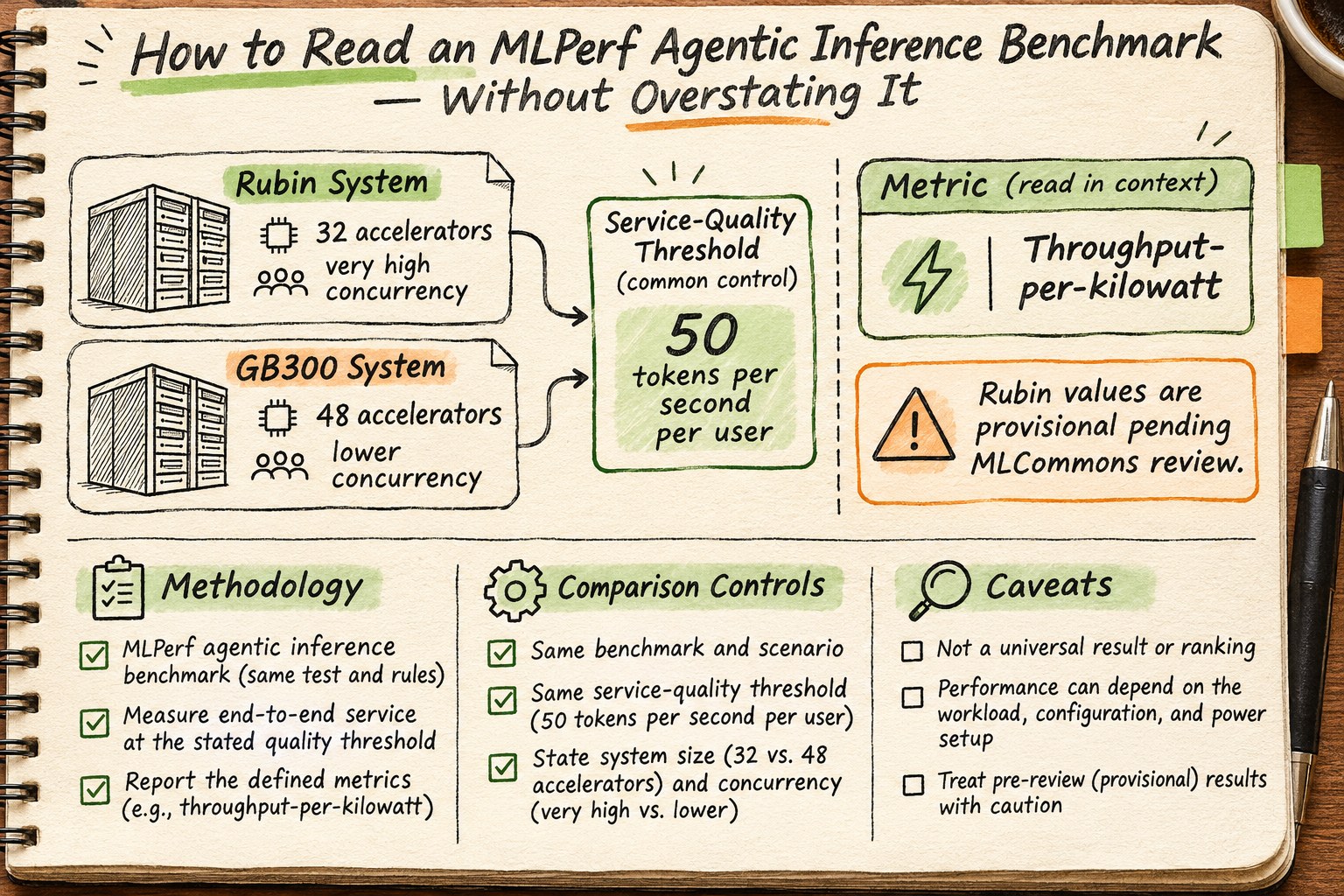
How to Read MLPerf’s New Agentic Inference Results Without Overstating Them
MLPerf Endpoints v1.0 measures tokens, interaction quality and power for multi-turn agents. Here is what its first Vera Rubin comparisons do and do not prove.
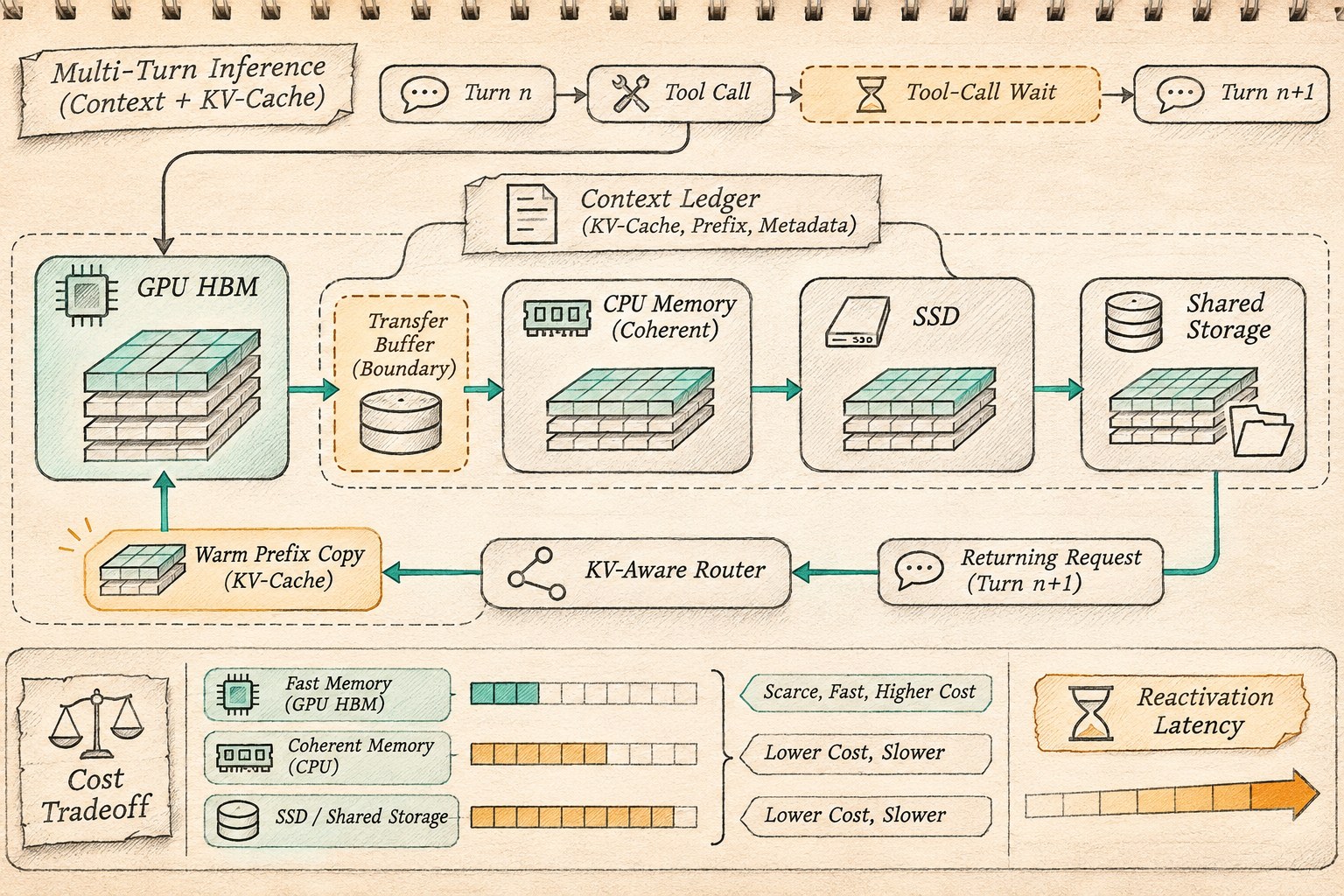
Agentic Inference Turns the KV Cache Into a Placement and Routing Problem
Agents leave KV state idle during tool calls. GPU, CPU and storage tiers can preserve it, but transfer cost and routing decide the payoff.
Why Rubin’s Biggest MLPerf Gain Appears on a Communication-Heavy MoE Run
MLPerf Training v6.1 shows Vera Rubin nearly halving one 1,024-GPU MoE run. The result is a fabric and system story, not a universal GPU multiplier.
/* Comments */
Comments are offline right now — we reconnect automatically, nothing is lost.