
The Kubernetes Work Hidden Behind a Vera Rubin ‘Day One’ Cluster
Vera Rubin readiness spans drivers, kernel settings, GPU Operator, DRA and topology validation. A reproducible cluster recipe is part of the hardware launch.
On this page
A rack can pass power-on checks and still fail at the point where Kubernetes asks a device plugin what kind of GPU it found. New accelerators change interfaces all the way from driver and kernel support to resource discovery and workload placement. NVIDIA’s Vera Rubin Kubernetes recipe is notable because it describes both the validated layers and a real integration defect found in early testing.
“Same rack architecture” still means software changes
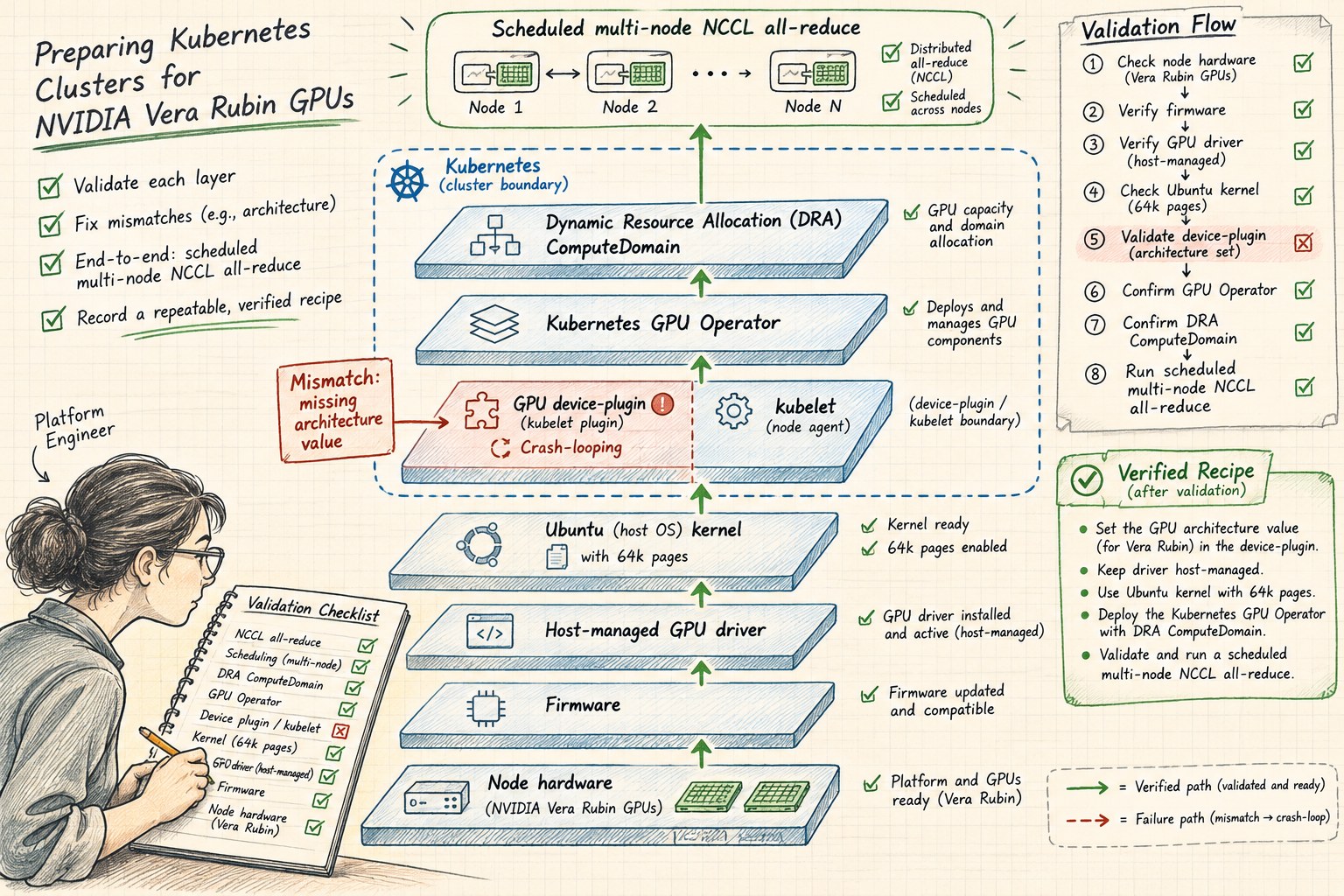
NVIDIA describes Vera Rubin NVL72 as an evolution of the MGX rack-scale architecture used for GB200 systems, but its day-one software guidance lists several changes. The post’s tested configuration uses a host-managed R615.23 open GPU driver, Ubuntu 26.04 with a 64-kilobyte page kernel, GPU Operator 26.7.0 and the Kubernetes DRA driver v0.5.0 with ComputeDomains. The article explicitly says R615.23 is the tested version, not a confirmed minimum for eventual official support. Platform teams should not copy the number as a universal requirement without checking the current support matrix. [1]
That distinction is important for fleet planning. A validated recipe is an evidence package for a specific combination, not proof that every adjacent version works. The controller, device plugin, kernel module, firmware and Kubernetes API each evolve on separate release schedules. A compatible combination must be tested together, and the bill of materials must identify the exact versions that were validated.
DRA changes how devices become schedulable
Kubernetes Dynamic Resource Allocation provides an API for drivers and administrators to describe device classes and resource claims. A workload requests a claim; the scheduler places its Pod where the requested resource can be allocated. Kubernetes documents DRA as stable since v1.35, though the feature originated earlier and supported functionality depends on the specific driver and cluster components. [2]
NVIDIA’s recipe uses DRA ComputeDomains to represent GPU capacity and topology-aware allocations. The important boundary is between Kubernetes’ generic claim and the vendor driver’s device-specific inventory. If the plugin fails to identify a new architecture or expose its resources, the scheduler cannot make a good placement decision. Operators may see a Pod stuck pending, a device resource absent, or a plugin restarting even though the rack itself appears healthy.
NVIDIA reports exactly this class of early integration problem: AICR validation found an unmapped Rubin architecture value in a dependency, causing the DRA driver’s kubelet plugin to crash-loop. The fix propagated through the software stack and was included in the official driver release cited in the post. This is not evidence that the whole stack was unstable; it is evidence that early-hardware readiness depends on architecture values being understood by every discovery layer. [1] [4]
Why a reproducible recipe helps—and what it cannot guarantee
NVIDIA AI Cluster Runtime (AICR) captures tuned settings as reusable recipes, generates deployment bundles for existing tooling and validates a running cluster. This is useful operationally because teams can compare a generated configuration with the one actually running on nodes. It also creates a place to attach validation evidence: deployment success, Kubernetes conformance and a cross-node collective performance gate. NVIDIA reports that its early Rubin recipe passed an NCCL all-reduce test at 744.71 GB/s bus bandwidth on a 16-GiB operation. That is a specific result from NVIDIA’s reference cluster and configuration, not a guaranteed customer-network throughput. [1]
A recipe can reduce configuration drift, but it cannot guarantee production fitness for every site. Firmware, BIOS, NICs, switch configuration, cooling, workload shape, tenant isolation and scheduling policy all matter. Nor does passing NCCL all-reduce prove that a particular training workload will scale linearly. It is one useful gate in a larger acceptance plan.
A practical rollout sequence
- Pin the stack. Record GPU firmware, host driver, kernel, GPU Operator, DRA driver, Kubernetes release, device plugin and networking components.
- Validate discovery first. Confirm that every node reports the expected architecture, allocatable resources and topology. Alert on plugin restarts and missing resource classes.
- Test a claim lifecycle. Create a representative DRA resource claim, schedule a workload, confirm allocation and release, and verify recovery after a node or plugin restart.
- Run both conformance and collectives. Kubernetes API correctness and multi-node GPU communication are different gates. Record the cluster configuration beside each result.
- Test the real workload. Run the expected model or scientific job at target concurrency, scale and checkpoint cadence. A microbenchmark cannot establish application behavior.
- Roll gradually. Keep a known-good node pool, compare canary and control results, and stop expansion when scheduling, NCCL or application error rates regress.
The hidden requirement is observability across the stack. A generic “GPU unavailable” alert is too late and too vague. Teams need to know whether firmware failed enumeration, the host module did not load, the DRA plugin did not map the architecture, the claim could not be allocated or the network test failed.
The resource boundary connects to serving state as well. Our explainer on KV-cache placement and routing shows why a scheduler may need to account for state locality alongside accelerator availability. For cross-GPU collectives, see the NVL72 rack topology guide.
Day one is a compatibility contract
The Vera Rubin example shows why accelerator readiness is a platform engineering problem. The GPU is only one component in a chain that must expose correct capabilities to drivers, kernels, operators and schedulers. DRA offers a structured resource model; AICR recipes can make tested choices repeatable; early testing can still uncover gaps like an unknown architecture value.
Treat the vendor recipe as a starting point with a clearly scoped evidence set. Before adopting a new rack for production, validate the exact versions, device discovery, claim flow, network fabric and representative workload in your own environment. That is what turns “hardware available” into “cluster ready.”
Frequently asked questions
Does a Kubernetes upgrade alone make a cluster Vera Rubin ready?
No. Readiness also depends on compatible firmware, host GPU drivers, kernel configuration, GPU Operator components, device-resource allocation, topology and workload validation. A scheduler upgrade cannot repair a mismatch lower in the stack.
What did NVIDIA’s early Vera Rubin validation uncover?
NVIDIA reports that a missing architecture value in a dependency caused the DRA device-plugin kubelet component to crash-loop. The issue was fixed through the software stack; it demonstrates why early-hardware clusters need end-to-end validation.
Sources & further reading
Keep reading
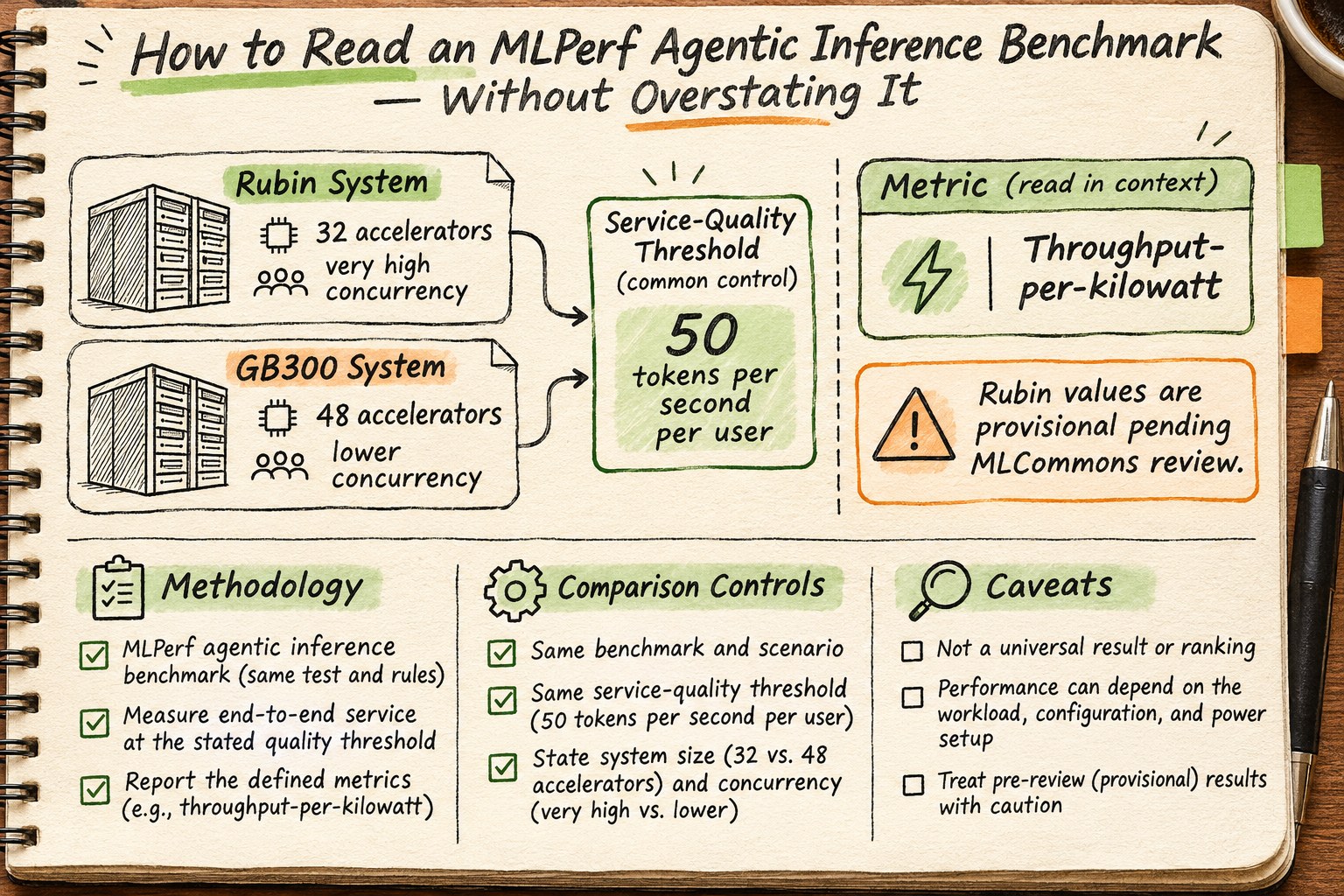
How to Read MLPerf’s New Agentic Inference Results Without Overstating Them
MLPerf Endpoints v1.0 measures tokens, interaction quality and power for multi-turn agents. Here is what its first Vera Rubin comparisons do and do not prove.
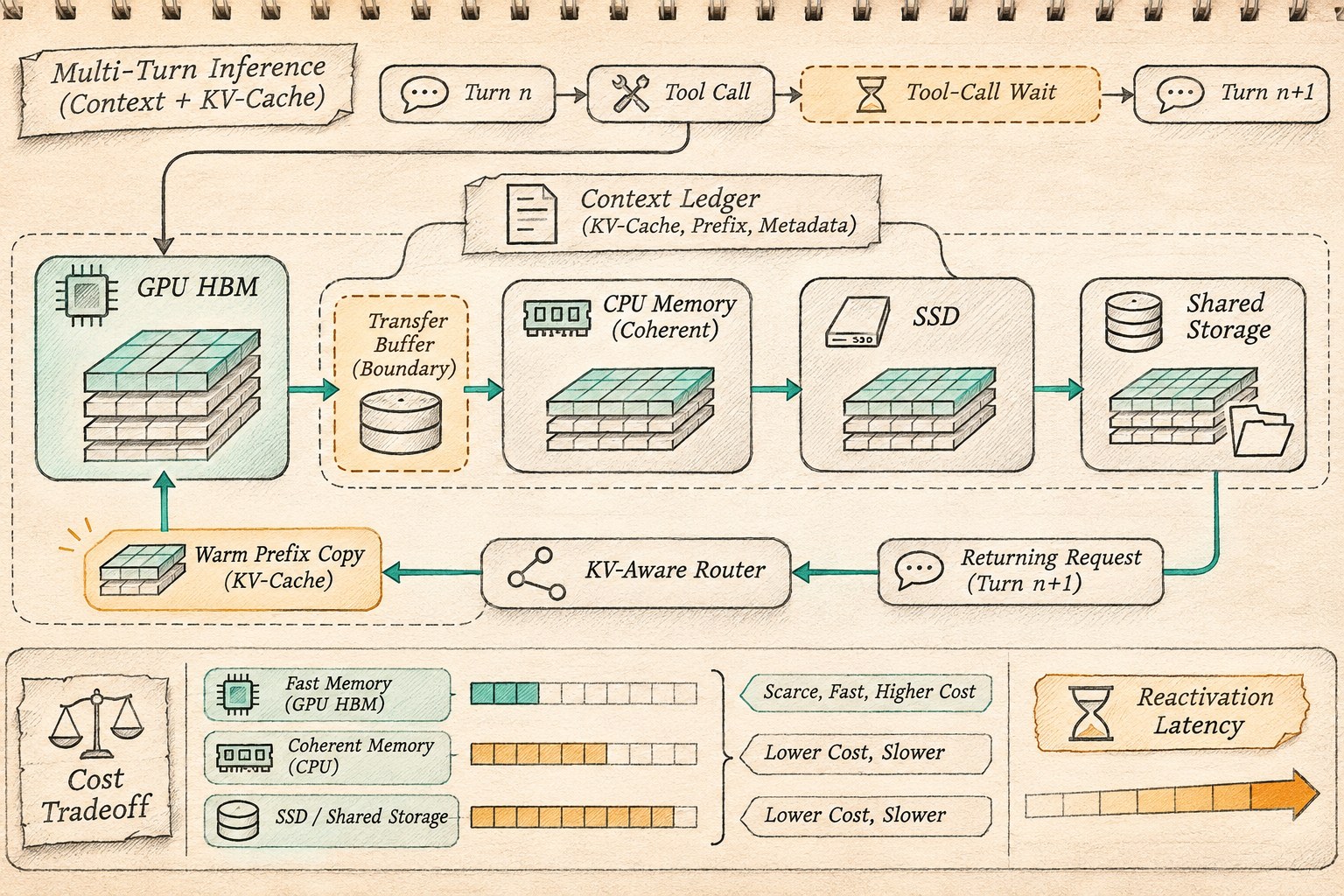
Agentic Inference Turns the KV Cache Into a Placement and Routing Problem
Agents leave KV state idle during tool calls. GPU, CPU and storage tiers can preserve it, but transfer cost and routing decide the payoff.
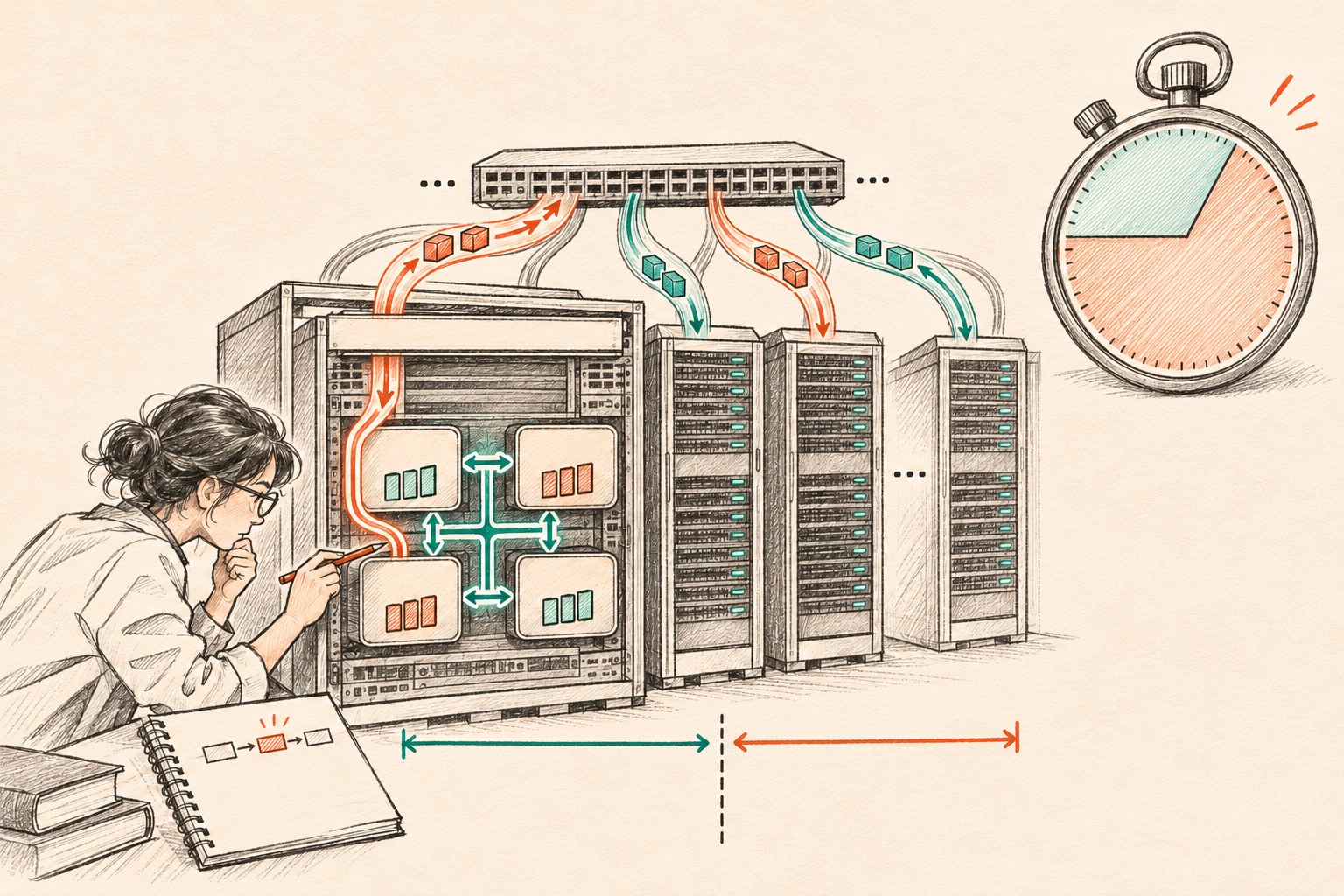
Why Rubin’s Biggest MLPerf Gain Appears on a Communication-Heavy MoE Run
MLPerf Training v6.1 shows Vera Rubin nearly halving one 1,024-GPU MoE run. The result is a fabric and system story, not a universal GPU multiplier.
/* Comments */
Comments are offline right now — we reconnect automatically, nothing is lost.