
When Prompting and RAG Fail: The Engineering Guide to Fine-Tuning, LoRA, and QLoRA
A definitive guide on knowing when to escalate past prompting and RAG into supervised fine-tuning, parameter-efficient LoRA adapters, and 4-bit QLoRA.
On this page
Most engineering teams building with language models begin with prompt engineering. When prompts fail to provide up-to-date facts or domain data, teams build a Retrieval-Augmented Generation (RAG) pipeline. For 80% of applications, this combination works. But when an application requires an uncompromising adherence to strict output structure, domain jargon, peculiar stylistic tone, or complex classification logic, prompting and RAG hit a hard wall.
You cannot prompt an LLM to reliably output complex, idiosyncratic DSLs without bloating context windows to 20,000 tokens and ballooning API bills. You cannot RAG your way into teaching a general-purpose model how to think like a seasoned risk compliance underwriter. At this boundary, fine-tuning transitions from an optional luxury into a mandatory engineering architectural requirement.
The Model Customization Escalation Ladder
Every customization technique solves a fundamentally different failure mode. Confusing information retrieval with behavioral adaptation leads to failed architectures:
+-----------------------------------------------------------------------------+
|                     MODEL CUSTOMIZATION ESCALATION LADDER                   |
+-----------------------------------------------------------------------------+

 Level 1: System Prompting & Few-Shot In-Context Learning
   - Solves: Task specification, temporary guidelines, basic tone.
   - Limit: Fragile, easily overridden by user prompts, consumes context budget.

 Level 2: Retrieval-Augmented Generation (RAG)
   - Solves: Missing, dynamic, or private enterprise factual knowledge.
   - Limit: Retrieval noise, chunking artifacts, zero behavioral change.

 Level 3: Supervised Fine-Tuning (SFT) via LoRA / QLoRA
   - Solves: Deep structural formatting, domain tone, complex internal classification.
   - Limit: Static knowledge frozen at training time, high dataset preparation bar.

 Level 4: Full Parameter Continued Pre-Training
   - Solves: Novel languages, massive vocabulary expansions, new domain alphabets.
   - Limit: Millions of dollars in compute, extreme risk of catastrophic forgetting.
The golden rule of LLM systems architecture is simple: Use RAG for factual knowledge; use fine-tuning for behavior, style, and structure.
Why Full Parameter Fine-Tuning Is Outdated for Most Teams
In the early days of BERT and GPT-2, fine-tuning meant taking every weight tensor in the model, computing gradients across all parameters, and updating the full matrix using AdamW optimizer states.
For a modern 70B parameter model, full parameter fine-tuning is economically prohibitive for ordinary teams:
Memory Required (Full Fine-Tuning) = Weights + Gradients + Optimizer States (AdamW)
  - FP16 Weights: 140 GB
  - FP16 Gradients: 140 GB
  - FP32 AdamW States (12 bytes/param): 840 GB
  - Total Dedicated Memory: > 1,120 GB of VRAM (Requires a cluster of 16x H100 GPUs)
Moreover, modifying all 70 billion parameters causes Catastrophic Forgetting: the model gains the ability to parse your specialized legal contracts but loses its broad logical reasoning, common-sense arithmetic, and general coding capability.
LoRA: Low-Rank Adaptation Under the Hood
Published by Hu et al. in 2021, Low-Rank Adaptation (LoRA) revolutionized model training by freezing the base model entirely and injecting small, trainable low-rank decomposition matrices into the attention layers.
       Original Frozen Weight Matrix W (d x k)
       +-------------------------------------+
       |                                     |
 x --->|            [FROZEN W]               |-----------------------+
       |                                     |                       |
       +-------------------------------------+                       v
                          +                                        ( + ) ---> Output h
                          |                                          ^
       Trainable Low-Rank Matrices                           |
       +-------------------+     +---------------------+     |
 x --->|  Matrix A (d x r) | --->|   Matrix B (r x k)  |-----+
       +-------------------+     +---------------------+
           (Down-projection)         (Up-projection)
The mathematical intuition is grounded in the fact that weight updates during adaptation have a very low intrinsic dimension:
- Instead of training a massive update matrix $\Delta W$ of dimensions $d imes k$ (e.g., $4096 imes 4096 = 16,777,216$ parameters).
- LoRA decomposes $\Delta W$ into two small matrices: $B imes A$, where $A$ has dimension $d imes r$ and $B$ has dimension $r imes k$.
- The rank $r$ is typically chosen as 8, 16, 32, or 64.
If $d = 4096$ and rank $r = 16$:
- Number of trainable parameters per layer: $(4096 imes 16) + (16 imes 4096) = 131,072$ parameters.
- Parameter reduction: Over 99.2% fewer parameters to compute and store!
Key Operational Advantages of LoRA
- Zero Base Model Degradation: Because original weights $W$ remain untouched, catastrophic forgetting is drastically minimized.
- Multi-Tenant Adapter Serving: You load a single base model into GPU memory once, and swap tiny 50MB LoRA adapter weights dynamically per request depending on which customer or enterprise workflow is executing.
- Lossless Merging: For latency-critical production, adapter weights can be fused back into the base weights (
W_fused = W + (alpha/r)(BA)), introducing zero runtime inference overhead.
QLoRA: Fine-Tuning 70B Models on a Single Consumer GPU
While LoRA eliminated gradient and optimizer memory for 99% of parameters, the base model itself still had to reside in 16-bit memory (140 GB for a 70B model).
Dettmers et al. introduced QLoRA (Quantized LoRA), introducing three innovations that allow a 70B model to be fine-tuned on two consumer 24GB GPUs:
+-----------------------------------------------------------------------------+
|                          QLORA THREE CORE INNOVATIONS                       |
+-----------------------------------------------------------------------------+

 1. 4-bit NormalFloat (NF4)
    - An information-theoretically optimal quantile quantization data type
      specifically designed for zero-mean, normal-distribution neural weights.

 2. Double Quantization (DQ)
    - Quantizes the quantization scale constants themselves, saving an additional
      0.37 bits per parameter (~3 GB on a 70B model).

 3. Paged Optimizers
    - Uses CUDA unified memory to automatically page AdamW optimizer states out
      to system CPU RAM during unexpected gradient memory spikes.
With QLoRA, base model weights are compressed into 4-bit NF4 memory (consuming only 35 GB), while backpropagation and gradient updates flow purely through the FP16 LoRA adapter parameters.
The Practical Dataset Rule: Quality Over Volume
The most frequent mistake in enterprise fine-tuning is dumping hundreds of thousands of low-quality, scraped web documents into an SFT pipeline. SFT is not pre-training; it is teaching the model which style and format to apply to existing knowledge.
1,000 meticulously verified, manually curated examples
                          BEATS
100,000 noisy, synthetically generated web scraped pairs
High-Fidelity Dataset Architecture
A production training pair must exhibit uncompromising consistency:
- Consistent Delimiters: Strict, unyielding system instructions and formatting boundaries.
- Negative Examples: Pairs demonstrating how the model should refuse out-of-scope tasks or handle ambiguous inputs.
- Reasoning Chains: If the task requires multi-step evaluation, the output must explicitly demonstrate intermediate reasoning steps before declaring the final JSON answer.
Architectural Takeaway
Do not resort to fine-tuning to update factual information like product inventory, pricing, or company policies; use RAG with vector search and deterministic relational joins.
Reach for QLoRA and LoRA adapters when:
- You need the model to output strict, syntactically complex custom schemas with 99.9% reliability.
- You must compress a 20-shot, 4,000-token prompt into a zero-shot model call to slash latency and API bills.
- You are training a specialized model on proprietary internal logic where public frontier models consistently miss subtle corporate nuances.
Keep reading
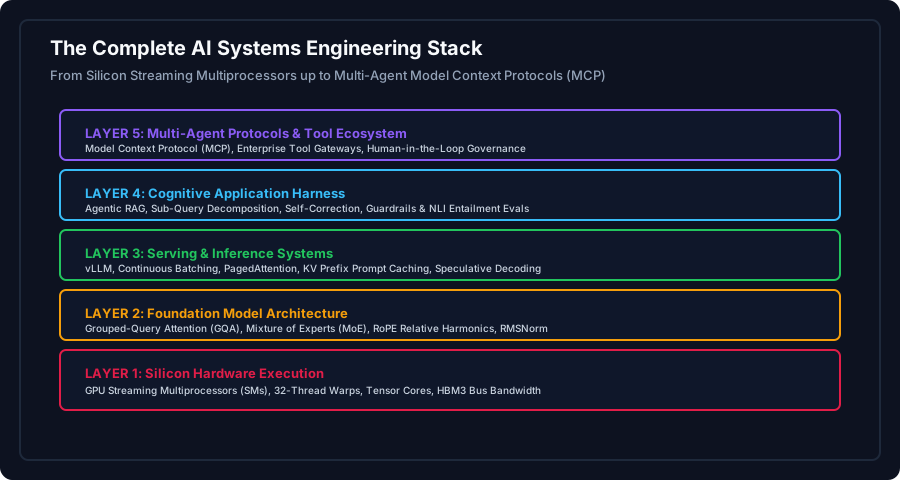
The AI Engineering Stack: From GPU Warps and FlashAttention to Agents and MCP
A cohesive architectural map of modern AI engineering: connecting GPU streaming multiprocessors, KV cache memory, RAG, and multi-agent protocols.
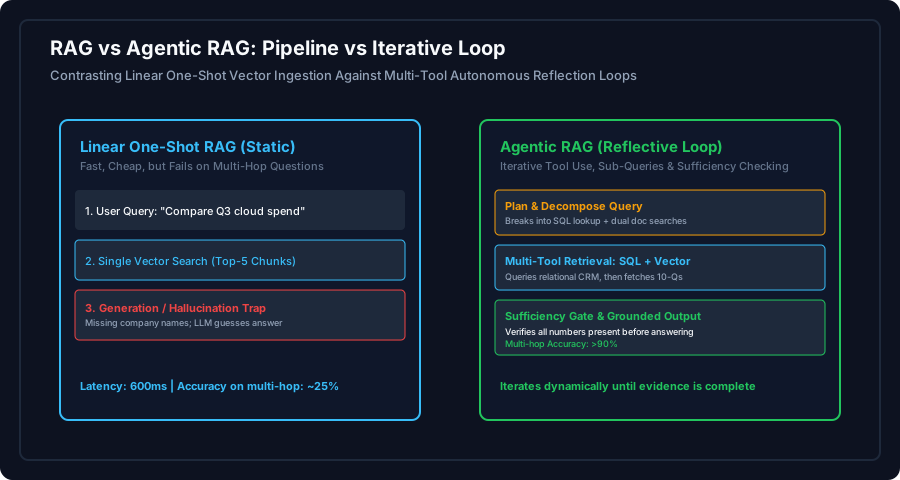
From One-Shot Retrieval to Agent Loops: How RAG Differs From Agentic RAG
Why static one-shot RAG fails on multi-hop questions, and how Agentic RAG introduces iterative planning, query rewriting, and sufficiency checks.
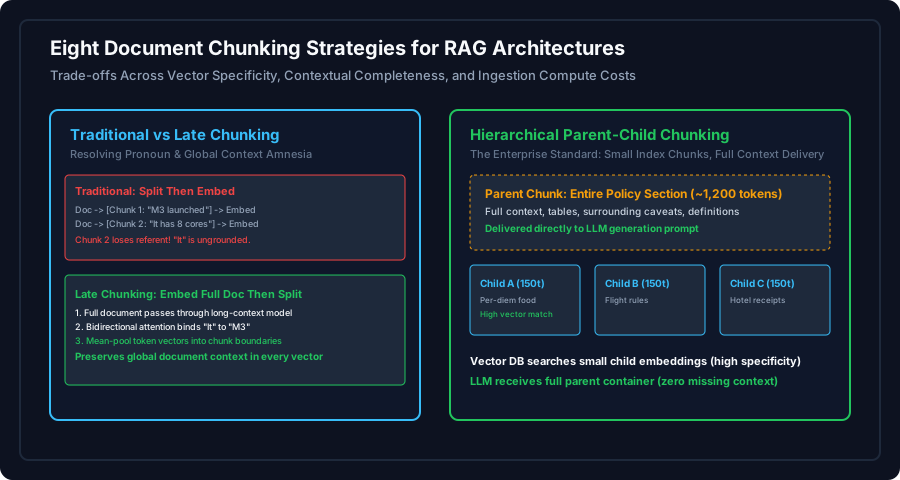
Choosing a Chunking Strategy for RAG: Fixed, Semantic, Late, and Hierarchical
A comprehensive architectural evaluation of eight document splitting strategies for RAG agents: trade-offs across retrieval recall, cost, and boundary noise.
/* Comments */
Comments are offline right now — we reconnect automatically, nothing is lost.