Claude and ChatGPT Both Went Down the Same Day, Then Claude Broke Four More Times
Downdetector logged 2,000+ Claude and 10,000+ ChatGPT reports on July 14, 2026, then Anthropic's status page logged four more incidents by July 16.
On this page
For a few hours on July 14, two of the most heavily used AI products on the planet were both breaking at once, for unrelated reasons, in front of the same audience of users mashing refresh on Downdetector and wondering if it was just them.
What actually broke, and when?
Claude went first. Downdetector had logged more than 2,000 reports of Claude problems by 2:40 p.m. PT on July 14, most of them tagged to Claude Chat, according to GV Wire. Anthropic’s own status checker was already responding in real time, describing “an outage affecting features such as document creation in claude.ai, Cowork Remote, Claude Code Remote, and Claude Design.”
That quote isn’t just a vague acknowledgment — it lines up almost exactly with an entry in Anthropic’s public incident history. Status.claude.com lists a “Partial outage of claude.ai: container creation” running from 21:31 to 22:16 UTC on July 14, which converts to 2:31–3:16 p.m. PT: a 45-minute window that brackets the 2:40 p.m. Downdetector snapshot almost precisely. It’s a rare case where a crowd-sourced outage spike and a vendor’s own after-action log point at the same 45 minutes.
ChatGPT’s incident, a couple hours later the same day, was both bigger and more chaotic in how it unfolded. GV Wire’s live-updating report shows reports crossing 4,000 by 4:57 p.m. PT while OpenAI’s status checker still showed no known issues. One minute later, at 4:58 p.m., the checker flipped: “We are investigating login issues and intermittent errors affecting ChatGPT.” Reports kept climbing after the acknowledgment, not before it — past 5,000 within the minute, past 7,000 by 5:07 p.m., and past 10,000 by 5:18 p.m. PT.
Why did Anthropic’s status page keep lighting up after that?
Because July 14 wasn’t a one-off — it was the first of five model-serving entries Anthropic logged across three days. The day after the Downdetector spike, status.claude.com recorded an “elevated errors on multiple models” incident from 14:04 to 15:11 UTC on July 15 — about 67 minutes, roughly 7:04 to 8:11 a.m. PT, with no further detail posted beyond “this incident has been resolved.”
Then came July 16, the day this story actually publishes, which had three more model-serving entries of its own — plus a fourth, unrelated incident logged the same day: an “Enterprise SSO sign-in failures” issue running 09:23 to 10:27 UTC, 64 minutes, which Anthropic tracked separately since it’s a login problem rather than a model error:
- Elevated errors on Claude Sonnet 5 — 08:39 to 08:53 UTC, 14 minutes.
- Elevated errors for Claude Opus 4.7 — 08:58 to 13:30 UTC, roughly 4 hours 32 minutes, running overnight into the early morning Pacific.
- Elevated errors for multiple models — logged 18:36–22:53 UTC, with Anthropic’s own resolution note narrowing the actual impact window to 11:30 a.m.–3:15 p.m. PT (18:30–22:15 UTC), about 3 hours 45 minutes, adding that “most errors were experienced within the first hour of the impact window.”
Four distinct model-serving incidents in roughly 48 hours — five counting the SSO failure — stacked on top of a Downdetector spike that had already put both Claude and ChatGPT in the same news cycle.
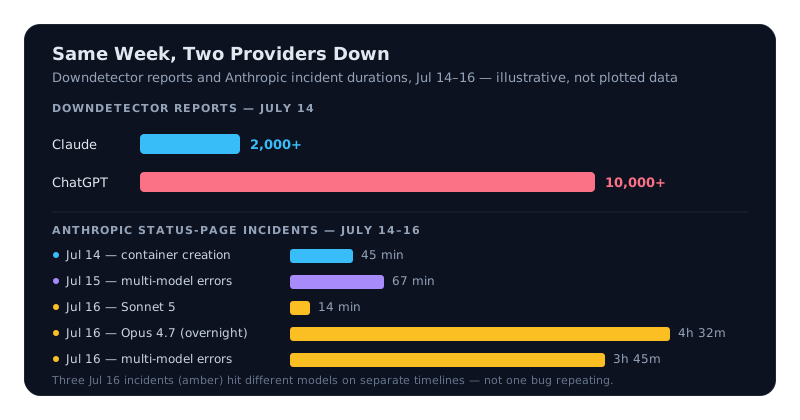
Downdetector counts self-reported user complaints in real time — it can spike fast and doesn’t tell you the underlying cause or true duration. A provider’s own status page logs confirmed incidents with defined start/end times, but only for what the provider chooses to disclose and how granularly. The July 14 Claude entries line up unusually well across both; treat that alignment as the exception, not the rule, when reading outage reporting generally.
- Jul 14: claude.ai container creation, 45 min
- Jul 15: multiple models, ~67 min
- Jul 16: Sonnet 5, 14 min
- Jul 16: Opus 4.7, ~4h32m (overnight)
- Jul 16: multiple models, ~3h45m
- 4:57pm PT: 4,000+ reports, no known issue
- 4:58pm PT: status flips to “investigating”
- 5:07pm PT: 7,000+ reports
- 5:18pm PT: 10,000+ reports
- Cause cited: login + intermittent errors
Why does this matter for developers building on these APIs?
Because “always-on” AI infrastructure is still infrastructure, and infrastructure still breaks on schedules nobody controls — including, on this evidence, schedules that hit two competing providers in the same week. If your product routes user requests through Claude or ChatGPT with no fallback path, a 14-minute Sonnet 5 blip or a 4,000-report ChatGPT login failure isn’t an abstract risk; it’s an outage you inherit without having caused it or gotten to choose the timing. That single-provider exposure is the same structural concern raised about Anthropic’s own Reflect dashboard encouraging teams to lean harder on one vendor’s tooling — this week is a concrete argument for the other side.
The more useful signal here isn’t that outages happened — Claude’s own incident history lists 23 entries for July 2026 and 47 for June, the overwhelming majority of them short, single-model “elevated errors” events that most users never notice. What’s notable about this week is the clustering: a same-day Downdetector spike across two unrelated providers, followed by four more distinct Anthropic model-serving incidents in the next 48 hours, several of them touching different models (Sonnet 5, Opus 4.7, and cross-model errors) rather than one bug repeating.
That pattern argues for treating model-provider outages the same way engineering teams already treat cloud-region outages: not a hypothetical to plan for someday, but a recurring operational reality with its own runbook.
Do
- Wrap every model API call in retries with backoff and an explicit timeout
- Watch status.claude.com and your provider’s official status page directly, not just Downdetector spikes
- Design a real fallback for outage windows — cached response, secondary model, or an honest “try again shortly”
- Log which model/component was in the request when a failure occurs, since incidents are often model-specific
Don't
- Assume a single provider’s uptime covers your whole product’s uptime
- Treat a 14-minute resolved incident and a 4-hour one as equivalent risk just because both say “resolved”
- Wait for a public outage before writing an incident-response runbook for your AI dependency
- Silently retry against the same failing model indefinitely instead of degrading gracefully
Is AI reliability actually getting worse, or just more visible?
The frequency data argues for “more visible,” not “getting worse” — Anthropic was already logging dozens of short incidents a month before this week, most going unnoticed outside people directly affected. What changed on July 14–16 wasn’t the underlying incident rate so much as the coincidence of timing: Claude and ChatGPT both spiking publicly on the same day, then Claude stacking four more model-serving incidents into the following 48 hours, gave outside observers an unusually concentrated window to notice a pattern that’s normally spread out and easy to miss.
That’s worth sitting with rather than dismissing. Frontier labs are shipping model updates and infrastructure changes at a pace that makes some rate of “elevated errors” incidents close to unavoidable — Claude’s history alone shows incidents tied to specific model versions (Opus 4.5, 4.7, 4.8, Sonnet 4.5, Sonnet 5) recurring through May, June, and July. The interesting engineering question isn’t whether incidents happen; it’s whether the blast radius stays contained to one model version while others keep serving traffic, which is exactly what the July 16 pattern shows — Sonnet 5 broke separately from Opus 4.7, on a different timeline, both distinct from the later cross-model incident the same day.
For developers, the takeaway isn’t to panic about provider reliability — it’s to stop assuming a status page you haven’t checked in months still reflects reality. The providers publish these numbers. This week just made them impossible to ignore. Teams already thinking about incident-response discipline for their own infrastructure should extend the same habit outward, to the model providers they now depend on just as heavily.
Frequently asked questions
How many outage reports did Claude and ChatGPT get on July 14, 2026?
Downdetector logged more than 2,000 Claude reports by 2:40 p.m. PT on July 14, 2026, and more than 4,000 ChatGPT reports by 4:57 p.m. PT. ChatGPT's count then climbed fast, passing 5,000 within a minute, 7,000 by 5:07 p.m., and 10,000 by 5:18 p.m. PT.
What did Anthropic's own status page say about the July 14 Claude outage?
Anthropic's status history lists a 'Partial outage of claude.ai: container creation' running from 21:31 to 22:16 UTC on July 14 — squarely inside the Downdetector spike window. Its live status checker described 'an outage affecting features such as document creation in claude.ai, Cowork Remote, Claude Code Remote, and Claude Design.'
Did Claude have more outages after July 14?
Yes. Status.claude.com logged an 'elevated errors on multiple models' incident on July 15 lasting roughly 67 minutes, then three more model-serving incidents on July 16 alongside a separate 64-minute Enterprise SSO sign-in failure: a 14-minute Sonnet 5 issue, a roughly 4.5-hour overnight Opus 4.7 issue, and a second multi-model incident lasting about 3 hours 45 minutes.
What did ChatGPT's status checker say was wrong?
Per Downdetector reporting on GV Wire, OpenAI's status checker initially showed no known issues as reports crossed 4,000, then updated a minute later to say: 'We are investigating login issues and intermittent errors affecting ChatGPT.' Reports kept rising after that update, eventually surpassing 10,000.
Is this outage pattern actually unusual for AI providers?
Not in frequency — Claude's status history lists 23 incidents in July 2026 alone and 47 in June, mostly brief single-model 'elevated errors' events. What made this week stand out was Claude and ChatGPT spiking on Downdetector the same day, followed by four more Claude model-serving incidents (plus a separate SSO login failure) in the next 48 hours.
/* Comments */
Comments are offline right now — we reconnect automatically, nothing is lost.