
One Vendor Flaw Just Exposed 14.2 Million Logins Across Six Japanese ISPs
A flaw in one unnamed vendor's software let attackers into a shared email platform, exposing up to 14.2 million accounts across six Japanese ISPs.
On this page
Six separate internet providers, six separate brands, six separate customer bases — and one shared piece of email infrastructure sitting behind all of them, with one unpatched hole in it. That’s the shape of the KDDI breach, and it’s the shape of most infrastructure risk in 2026: the failure never happens at the brand you signed up with, it happens one or two vendors upstream of it.
What exactly did KDDI disclose?
KDDI Corporation, one of Japan’s largest telecom operators, confirmed that an attacker exploited a vulnerability in third-party software to gain unauthorized access to an email platform it operates on behalf of itself and five partner ISPs — STNet, JCOM, Chubu Telecommunications, NIFTY, and BIGLOBE. In its account of the intrusion, KDDI stated it “confirmed that some information from email services provided by various ISP operators may have been leaked to an external party,” per SC Media’s report. The company has said there “remains a possibility that customers’ email addresses and passwords were obtained by unauthorized third parties as a result of the incident,” as BleepingComputer quoted from KDDI’s disclosure.
The headline number is stark: up to 14.2 million accounts, spanning current customers, former customers, and inactive accounts that were never formally closed. That range matters — “up to” is doing real work in that sentence, because KDDI itself is describing an outer boundary of exposure rather than a confirmed, itemized count. Nobody outside KDDI’s forensics team currently knows how many of those 14.2 million accounts had passwords actually taken versus merely sitting in a database the attacker could have reached.
Why did one flaw take down six ISPs at once?
Because the six ISPs weren’t running six separate email systems — they were running one, operated by KDDI on their behalf. That’s a completely ordinary infrastructure decision: standing up and securing an email platform is expensive, so smaller ISPs like STNet or BIGLOBE outsource it to a larger operator with the scale to run it properly. The tradeoff is that “run it properly” now means one vendor’s patch cadence, one vendor’s access controls, and one vendor’s blind spot become five other companies’ blind spots too, simultaneously, without any of those five companies’ own security teams ever touching the vulnerable code.
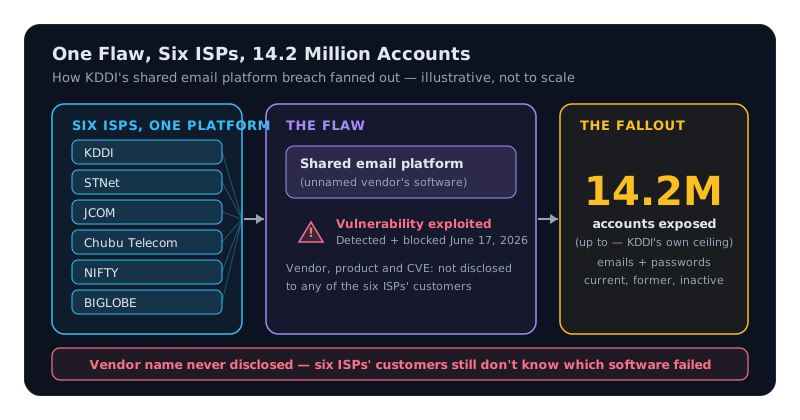
Every outlet that has covered this story — Security Affairs, BleepingComputer, SC Media — describes the flaw only as “a vulnerability in third-party software.” No vendor, no product name, no CVE identifier has been published. For six ISPs’ worth of customers trying to assess their own exposure, that’s the least satisfying part of the disclosure: they know the wound, not the weapon.
That silence isn’t unusual — vendors and their enterprise customers routinely coordinate disclosure timing so a patch ships before the vulnerable component is named publicly. But it does mean the rest of the industry can’t yet check whether it runs the same software, which is precisely the information a vulnerability disclosure is supposed to eventually provide.
- Vulnerability in unnamed third-party software
- Shared email platform, six ISPs affected
- Up to 14.2 million accounts in scope
- Detected and blocked June 17, 2026
- Email addresses + passwords potentially exposed
- Regulators and affected ISPs notified
- Name of the vulnerable vendor/product
- CVE identifier, if one exists yet
- Exact count of passwords actually exfiltrated
- Share of passwords stored in plaintext
- Full timeline of attacker activity pre-detection
- Whether other KDDI-run platforms share the flaw
How exposed were the passwords, really?
Unclear, and that ambiguity is itself a finding. Coverage of the incident notes that some passwords on the platform were stored hashed or encrypted, but the extent of any plaintext exposure has not been pinned down in KDDI’s public statements. That’s a meaningfully different risk profile depending on the answer: a database of properly hashed, salted passwords is an inconvenience if leaked; a database with any meaningful share of plaintext or weakly-hashed passwords is a credential-stuffing event waiting to happen across six customer bases at once, because plenty of those 14.2 million people reused that email password somewhere else.
KDDI’s response has been the standard playbook: it says it implemented technical defensive measures, reported the incident to Japanese regulatory authorities, and is urging affected customers to reset their email passwords immediately and enable two-factor authentication where it’s available. None of that is wrong, but none of it answers the plaintext question either — and until it’s answered, “reset your password” is advice given under uncertainty about how much protection the old password ever actually provided.
What does this mean for teams that outsource infrastructure to a bigger vendor?
It means the size of your own security team stopped being the ceiling on your risk the moment you signed the contract. STNet, JCOM, Chubu Telecommunications, NIFTY, and BIGLOBE didn’t write the vulnerable code, didn’t choose the third-party software, and — as far as the public record shows — didn’t get a say in when the flaw got patched. They inherited KDDI’s exposure the moment they outsourced email to KDDI, and their customers are now managing the fallout of a decision made in someone else’s stack. It’s the same asymmetry that showed up when Accenture’s own cloud keys leaked days after this KDDI disclosure — a services vendor’s incident becomes every client’s incident, on a timeline the client doesn’t control.
That’s not an argument against shared infrastructure — running one well-secured platform for six ISPs is, in theory, safer than five under-resourced ISPs each running their own. It’s an argument for treating vendor risk assessment as an ongoing obligation rather than a procurement checkbox, because the blast radius of “our vendor’s vendor had an unpatched flaw” scales with how many customers that vendor serves, and KDDI’s platform served a lot of them.
Do
- Ask every infrastructure vendor what their patch SLA is for third-party vulnerabilities, in writing
- Assume shared credentials across your own products are compromised the moment a vendor discloses a breach
- Push vendors for plaintext-vs-hashed clarity before deciding how urgently to force password resets
- Treat “up to X million” disclosures as the ceiling for planning, not the confirmed floor
Don't
- Assume a vendor’s scale means their patch cadence is faster than yours would be
- Wait for a CVE number before auditing whether you run comparable third-party software
- Let “we’ve implemented technical measures” substitute for a specific remediation timeline
- Reuse an email account password anywhere else, breach or not
What should the 14.2 million affected users actually do?
Reset the password on the affected email account today, and reset it anywhere else that password — or a close variant of it — was reused, since that’s the real multiplier on a credential leak like this one. Turn on two-factor authentication if the ISP offers it; KDDI’s own advisory leads with exactly that recommendation. And treat any unexpected password-reset or login-alert email tied to these accounts with more suspicion than usual for the next few months, since leaked credentials tend to get tested opportunistically long after the headline fades.
For everyone watching from outside the affected six, the more durable lesson isn’t about KDDI specifically. It’s that “third-party software” is now doing the same load-bearing, faceless work in breach disclosures that “human error” used to do — a phrase precise enough to sound like an explanation and vague enough to protect the one company that could actually fix it before its name becomes attached to a headline like this one.
Frequently asked questions
What happened in the KDDI data breach?
Attackers exploited a vulnerability in unnamed third-party software to reach a shared email platform serving six Japanese ISPs — KDDI, STNet, JCOM, Chubu Telecommunications, NIFTY, and BIGLOBE. KDDI disclosed that the email addresses and passwords of up to 14.2 million current, former, and inactive customers may have been exposed.
When did KDDI find out, and how fast did it respond?
KDDI says it detected the intrusion on June 17, 2026, and blocked the attacker's access that same day while rolling out technical defensive measures. The company notified affected ISPs and Japanese regulators as part of its response, though the disclosures detailing the full scope followed over the subsequent weeks.
Was the vendor behind the flaw named?
No. KDDI and every outlet that covered the breach — Security Affairs, BleepingComputer, and SC Media included — describe the flaw only as "a vulnerability in third-party software," without naming the vendor, the product, or a CVE. Six ISPs' customers still don't know which specific tool actually failed.
What data was exposed, and was it protected?
Email addresses and account passwords. Some passwords were stored hashed or encrypted, but reporting on the incident notes the extent of any plaintext exposure is unclear. KDDI's own statement is careful hedging: there "remains a possibility that customers' email addresses and passwords were obtained by unauthorized third parties."
What should affected customers do now?
KDDI has urged customers across all six ISPs to reset their email passwords immediately and enable two-factor authentication wherever it's offered. The company says it has deployed technical defensive measures and reported the incident to Japanese regulatory authorities, but has not said when — or whether — the vendor will be named.
/* Comments */
Comments are offline right now — we reconnect automatically, nothing is lost.