
AI Agent Transparency Needs Evidence Outside the Agent's Own Story
Microsoft's new initiative highlights an operational rule for agent oversight: reconstruct identity, authority and actions from independent records.
On this page
An agent reports that it completed a refund. That statement may be accurate, mistaken or incomplete. Did the right user authorize the workflow? Did the agent use the approved account? Did the payment system accept the change, or did a timeout leave the result uncertain? Microsoft’s AI Transparency Initiative, announced at Ignite on November 17 with more than 40 organizations, frames this as a verification problem: organizations need evidence they can check independently of the model provider’s account. [1]
Separate the agent’s explanation from the event record
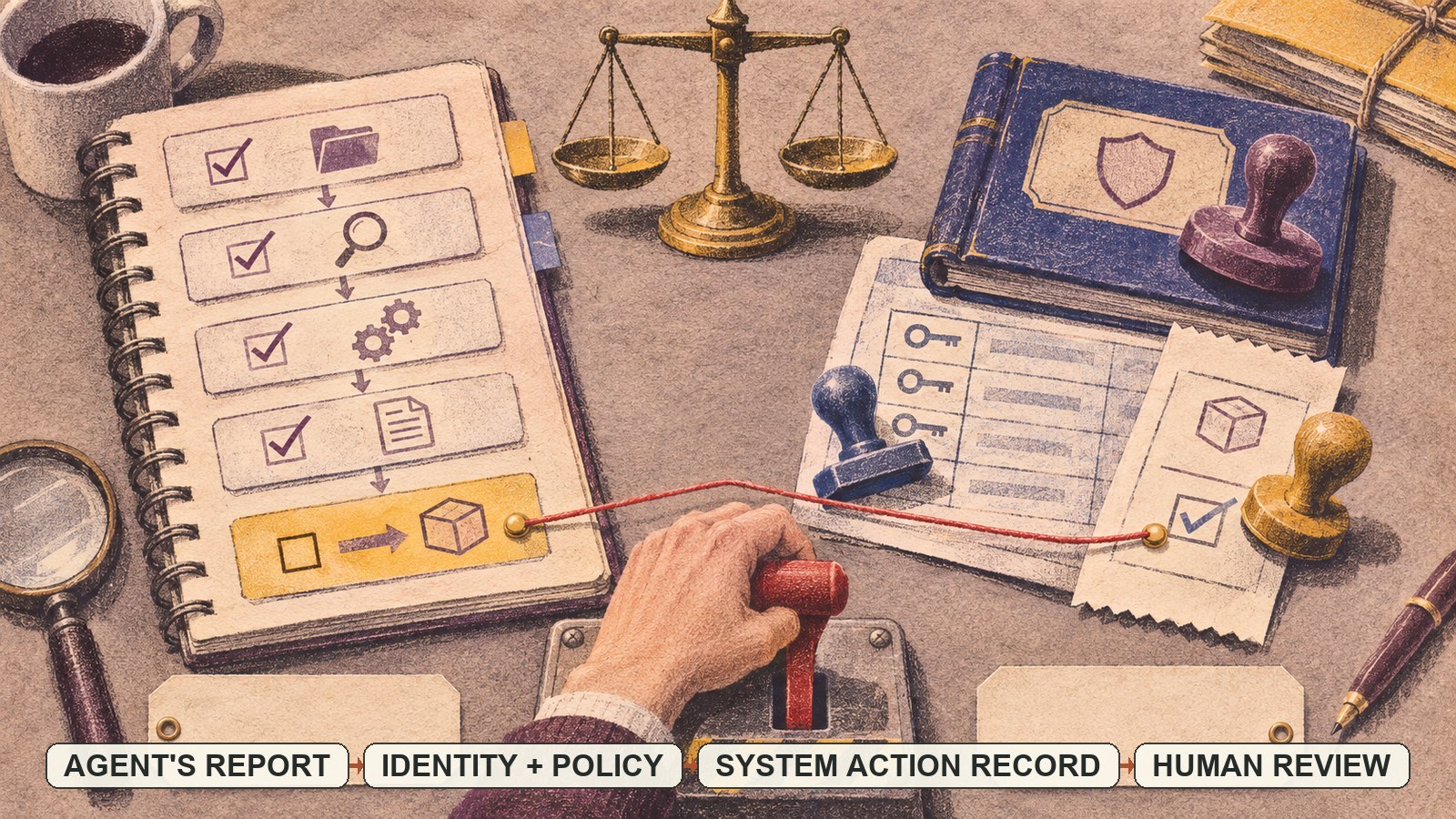
A language model can summarize a plan or explain a tool call. Its text is not necessarily a trustworthy audit record. The runtime can record what it invoked; identity infrastructure can record which principal and delegated scopes were active; the target service can record whether a write succeeded. Those systems answer different questions, so collecting only one transcript creates blind spots.
Microsoft’s initiative organizes its principles as see, verify and control. Its announcement calls for visibility into the prompt, intended task, model/runtime, data and tools accessed, and actions taken. It also says evidence should identify its source so a model-reported signal can be compared with independent records from identity and policy systems. The third principle is control: organizations should enforce what data and actions are permitted, and retain the relevant evidence when providers change. [1]
This aligns with NIST’s AI Agent Standards Initiative, which calls for secure operation on behalf of users and interoperability. The initiative’s existence is not itself a standard or certification. Microsoft’s announcement says it will participate in the effort and work with more than 40 organizations toward a common approach. The technical details and governance mechanisms are still being developed. [1] [2]
Build an evidence chain around authority and outcome
A practical event record can include: the human or service that initiated the job; the intended task and approval; the agent’s delegated identity and scope; model and runtime versions; tools and data accessed; policy decisions; each requested action; and the target system’s response. Add a stable correlation ID across systems and a trusted timestamp. Store high-risk records in a system the agent cannot rewrite after the fact.
The record must distinguish a request from its result. An agent may send a write request and time out before receiving the response. Retrying without an idempotency key could repeat the action; declaring success from the model’s own final message could misreport the state. The authoritative system should supply the event that confirms whether the operation completed. For high-impact actions, the workflow should pause for a person when identity, scope or outcome is ambiguous.
This is closely related to tool-use permission boundaries: tool access is a capability granted by an application, not something an agent should grant itself. A credential with broad access may make a demo easier while making post-incident reconstruction and containment harder. Short-lived, narrow delegated credentials and a policy check outside the model reduce that problem.
Threat modeling should include the logs themselves
A detailed log can contain sensitive prompts, documents, tokens or personal information. Auditability does not mean copying every prompt into a permanent store. Define which evidence is necessary, redact secrets at collection, restrict access, set retention, and document how records can be corrected or deleted under applicable obligations. Separate operational metadata from sensitive content when possible.
Security teams should also consider tampering and missing events. MITRE ATLAS catalogs adversarial techniques against AI systems, including attempts to manipulate agent context and misuse tools. Joint government guidance on agentic services recommends monitoring agent operations and using multiple independent monitoring systems to cross-check reports. These sources support a defense-in-depth approach; neither guarantees that a specific logging design will detect every failure. [3] [4]
A useful exercise is to simulate a disputed action: the agent says it changed a record, the application times out, and the user denies authorizing it. Can the team identify the delegated principal, check the policy decision, establish whether the target system committed the change, and stop further actions? If the answer depends on a model-generated summary alone, the evidence chain is incomplete.
Standards work still needs testable interfaces
A common transparency framework will be useful only if it defines interoperable event fields, provenance, integrity and policy semantics that can be checked across providers. The Microsoft announcement points toward those goals and a broad coalition, but the public release does not yet specify a wire format, conformance suite or required retention controls. Teams should not claim compliance with a draft collaboration or assume one vendor’s dashboard will provide portable evidence.
Start with a small, reviewable boundary: one agent, one sensitive tool and one independent record from the system that executes the action. Define which actions need a human approval, how denial is enforced, what happens on timeout, and who can query or alter evidence. Then test whether the records let an operator reconstruct the workflow without trusting the agent’s narrative.
The deeper point is modest but consequential: autonomy makes provenance more important. A system that can act on a user’s behalf needs evidence of delegated authority and observed outcomes, not only a confident explanation after the fact. Industry standards may make those records easier to exchange; teams can design the separation today.
Frequently asked questions
Why should an AI agent not be the only source of its activity log?
A model can describe what it believes happened, but independent identity, policy and system records are needed to verify which principal authorized an action and whether the action actually occurred.
Is Microsoft's AI Transparency Initiative already a technical standard?
No. Microsoft announced a collaboration and plans to work with NIST and more than 40 organizations toward open standards; the announcement does not publish a ratified standard or compliance test.
What should teams record for AI agent actions?
Track the task owner and intent, delegated identity and permissions, model and runtime versions, data and tools accessed, decisions and resulting actions, plus an independent timestamped record from the system that executed them.
Sources & further reading
Keep reading

Persistent AI Agents Need a Trusted Control Plane and a Small Work Box
OpenAI's OpenClaw deployment shows why persistent agents need separate control services, sandboxed work, brokered secrets and auditable identity.

IBM’s LLMON Tries to Put a Boundary Between Instructions and Data
LLMON structures model context and reports lower indirect-injection success in selected tests. It is promising, but not a security boundary.

Prompt Injection Is a Permission-Boundary Problem
Treating retrieved text as untrusted is not enough: tool permissions, argument checks and action approvals must be enforced outside the model.
/* Comments */
Comments are offline right now — we reconnect automatically, nothing is lost.