
Connecting LLMs to the Real World: From ReAct Regex to Function Calling and MCP
How language models evolved from fragile text regex parsing to constrained JSON function calling and the universal Model Context Protocol standard.
On this page
A Large Language Model isolated inside a datacenter is essentially an encyclopedic brain in a jar. It can generate poetry, analyze historical treaties, and write Python algorithms, but it cannot check the current price of Bitcoin, query your production Postgres database, or restart a failing Kubernetes pod.
To act upon the real world, language models require tools.
Over the last four years, the mechanism for connecting LLMs to external systems evolved through three distinct architectural generations:
- Generation 1: ReAct Regex Text Parsing (2022 to 2023): Instructing the model to emit structured text tags like
Action: Search[query]that application host code parsed using regular expressions. - Generation 2: Native Function Calling and Constrained Decoding (2023 to 2024): Fine-tuning model weights on dedicated tool-call tokens and using grammar-constrained logit masking to guarantee valid JSON outputs.
- Generation 3: The Model Context Protocol (2024 to present): An open, vendor-neutral standard establishing dynamic capability discovery, resource streaming, and bidirectional communication over JSON-RPC.
This article examines the technical mechanics of each generation, why early tool patterns failed in production, and how modern systems engineer reliable tool integration.
Generation 1: The Brittle Era of ReAct and Regex
Early agent frameworks (such as early LangChain and AutoGPT) relied on prompt-engineering patterns like ReAct (Reasoning and Acting):
System Prompt:
"You are an assistant with access to tools.
When you need to use a tool, format your output exactly as:
Thought: <reasoning>
Action: <tool_name>[<argument>]
Observation: <result>"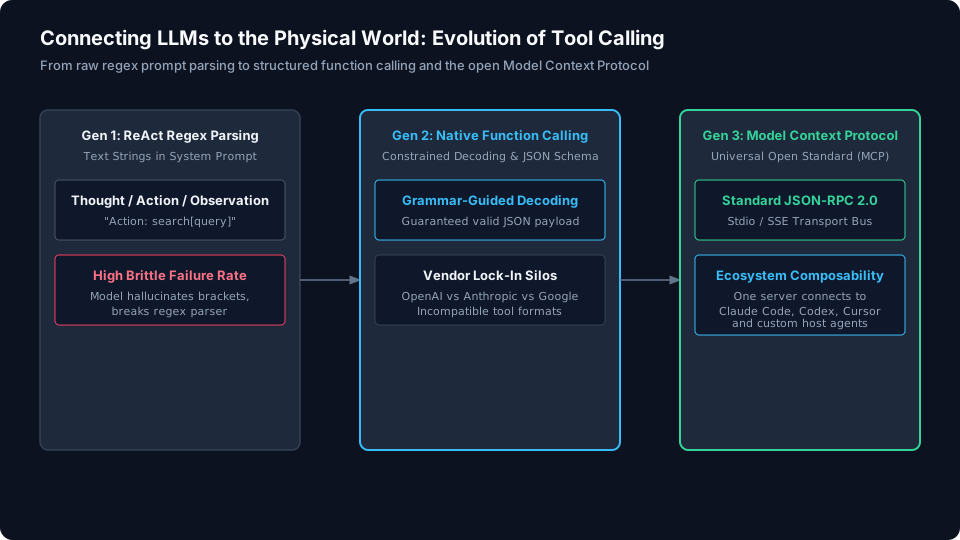
Why ReAct Broke at Scale
Because the model was generating free-form natural language tokens, minor stochastic variations caused catastrophic parser failures:
- The model would emit
Action: search("query")instead ofAction: search[query]. - The model would hallucinate markdown backticks inside arguments, breaking regex groups.
- The model would attempt to generate the
Observation:token itself rather than waiting for host execution, inventing fake tool outputs.
Generation 2: Native Function Calling via Constrained Logits
In mid-2023, model providers introduced native Function Calling. Rather than passing tools as unstructured text in system prompts, client code passed formal JSON Schema specifications alongside the prompt.
Grammar-Constrained Logit Masking
To prevent malformed JSON, inference engines implement constrained decoding:
- When the model emits a special
<tool_call>start token, the inference runtime activates a Context-Free Grammar (CFG) parser. - At every generation step, the grammar parser calculates the set of all syntactically valid next tokens that satisfy the JSON Schema.
- The engine masks out the logits of all illegal tokens, setting their probabilities to negative infinity.
If the schema demands an integer for port_number, the model physically cannot emit a quotation mark or letter.
The Problem: The N-Times-M Integration Tax
While native function calling solved schema compliance, it created a fragmented ecosystem. If you built a tool for PostgreSQL, you had to rewrite its adapter for OpenAI’s schema, Anthropic’s tool format, and Google’s Gemini SDK.
Generation 3: The Model Context Protocol (MCP)
To eliminate the integration tax, the industry converged around the Model Context Protocol (MCP). Inspired by the Language Server Protocol (LSP) that revolutionized code editors, MCP establishes a client-server architecture over JSON-RPC 2.0.
The MCP Lifecycle
[ Host Agent Client ]                        [ MCP Server (e.g. Postgres) ]
        │                                                  │
        │─── 1. initialize {"protocolVersion": "2024-11-05"} ──►│
        │◄── 2. result {"serverInfo": {"name": "db-mcp"}} ───────│
        │                                                  │
        │─── 3. tools/list ────────────────────────────────►│
        │◄── 4. returns array of available tool schemas ───│
        │                                                  │
        │─── 5. tools/call {"name": "query", "sql": "..."}─►│
        │◄── 6. returns {"content": [{"type": "text", ...}]}─│
Architectural Benefits of MCP:
- Dynamic Tool Discovery: Agents do not need hardcoded tool definitions. They query
tools/listat runtime, discovering arguments and descriptions dynamically. - Resource Streaming: Servers can expose direct read-only context streams (
resources/read), allowing agents to inspect log tails, schemas, or design canvases without multi-turn token overhead. - Pluggable Composability: A single MCP server written in Python or TypeScript connects seamlessly to Claude Code, OpenAI Codex, Cursor, or proprietary in-house orchestration loops.
Key Takeaways for Systems Architects
- Abandon String Parsing: Never parse LLM tool intents using string splitting or regex; enforce strict JSON Schema validation.
- Adopt Open Protocol Standards: Build integrations as modular MCP servers rather than vendor-locked SDK wrappers.
- Enforce Timeout and Safety Guards: Tool invocations must enforce strict client-side timeouts, circuit breakers, and rate limiters to prevent runaway agent loops.
Keep reading
Cloudflare's Clairic Targets Document Extraction, Not Chat
Cloudflare's updated Clairic and compact 9B Clairic-flash extract typed fields from text, images and PDFs, with open weights now available.

OpenAI’s 200,000-Researcher Goal Turns AI Access Into a Grant-Design Question
OpenAI says 50,000 new researchers can apply for free ChatGPT Plus grants. The first-come model, usage limits and data terms deserve close reading.

OpenAI’s New CSAM Classifier Is a Triage Signal, Not an Automated Verdict
OpenAI offers a classifier to vetted child-safety organizations. Scores can prioritize review, but people remain responsible for decisions.
/* Comments */
Comments are offline right now — we reconnect automatically, nothing is lost.