
The 'AI Washing' Debate: Is Big Tech Using AI to Disguise Mass Layoffs?
AI mentions on earnings calls surged 310% in early 2026. With AI now the top cited reason for US job cuts, the line between strategy and spin blurs.
On this page
In early 2023, Salesforce CEO Marc Benioff announced the elimination of roughly 8,000 positions. He told employees the company had “hired too many people leading into this economic downturn.” The stock, which had already fallen nearly 50% over the prior year, rose approximately 3% on the announcement—investors viewed the cuts as overdue discipline. Two years later, Amazon CEO Andy Jassy told employees the company would need “fewer people doing some of the jobs that are being done today” due to AI. The framing was different. The workforce reduction was the same. Welcome to the “AI washing” debate.
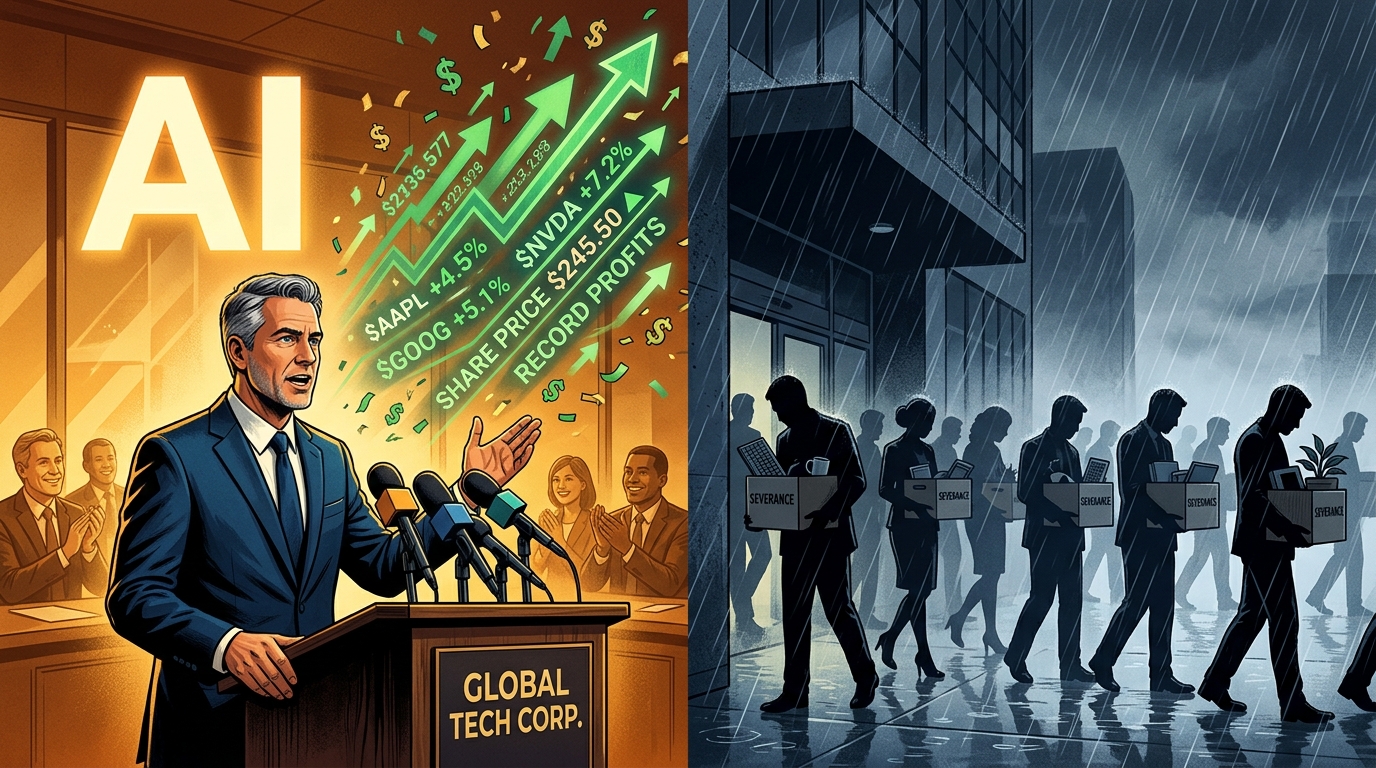
The Rise of AI as Corporate Vocabulary
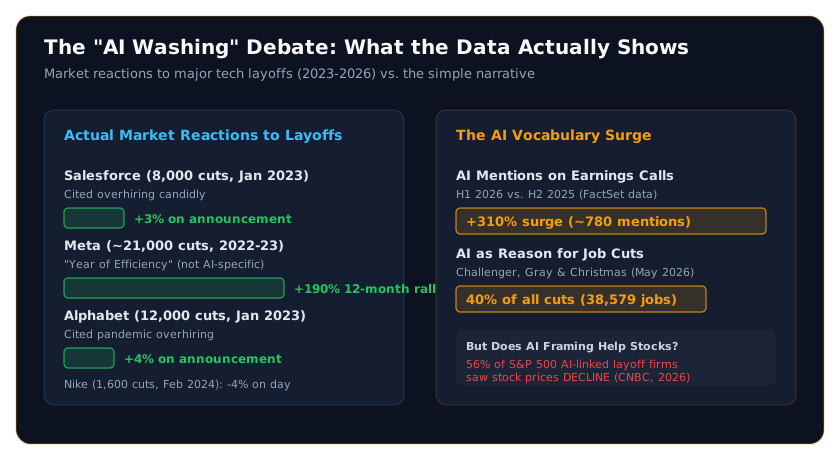
The scale at which AI has infiltrated corporate communications is striking. According to FactSet data, mentions of AI-related terms on S&P 500 earnings calls surged by approximately 310% in the first half of 2026 compared to the second half of 2025—reaching roughly 780 mentions and exceeding the previous three years combined. A record 337 S&P 500 executives mentioned AI during earnings calls, the highest level in a decade. [1]
Meanwhile, outplacement firm Challenger, Gray and Christmas reported that by May 2026, AI was the single most-cited reason for US corporate job cuts for the third consecutive month. That month alone saw 38,579 AI-attributed layoffs—roughly 40% of all announced cuts, up from just 7% in January 2026. [2]
The question is whether this linguistic surge represents genuine organizational transformation or a rebranding of conventional cost-cutting.
The Case Studies: What Actually Happened
The most commonly cited examples of “AI washing” are more nuanced than the simple narrative suggests:
- Salesforce (January 2023): Benioff cut 8,000 roles and was candid about the cause: pandemic overhiring. Rather than punishing the honesty, the market rewarded it—Salesforce stock rose roughly 3% on the announcement, and the company went on to be one of the top-performing enterprise software stocks of 2023.
- Meta (2023): Mark Zuckerberg declared 2023 the “Year of Efficiency,” cutting approximately 21,000 positions across two rounds (11,000 in late 2022, 10,000 in early 2023). The framing was primarily about building a “leaner, more technical company” and organizational flattening—not explicitly about AI replacing workers. Meta’s stock surged roughly 190% over the following twelve months.
- Alphabet (January 2023): Sundar Pichai cut 12,000 roles, acknowledging that Google had hired for “a different economic reality than the one we face today.” The stock rose roughly 4% on the day. Pichai did reference Google’s longstanding AI-first positioning, but the layoff rationale was primarily about the post-pandemic correction. [6]
- Nike (February 2024): Nike eliminated approximately 1,600 positions (about 2% of its workforce) as part of a $2 billion cost-cutting plan. The stock fell roughly 4% on the announcement, with investors reading it as confirmation of slowing consumer demand.
The Data Contradicts the Simple Narrative
The popular framing—“honest layoffs are punished, AI-washed layoffs are rewarded”—does not survive contact with the data.
A May 2026 CNBC analysis tracked 23 S&P 500 companies that explicitly tied job cuts to AI: as of May 15, 13 of them (56%) traded below their price at the announcement, and those decliners were down about 25% on average. The market, it turns out, is more sophisticated than the “just say AI” caricature suggests. [6]
What separates the winners from the losers is not the word “AI” in the press release. It is whether the underlying business fundamentals support the narrative. Meta’s 190% rally was not caused by saying “AI” on an earnings call—it was driven by genuine margin improvement, a return to revenue growth, and massive engagement gains across its apps. Salesforce’s recovery came from disciplined execution, not from avoiding the word “overhiring.”
The evidence suggests the market rewards credible operational improvement—whether framed as “efficiency,” “AI transformation,” or plain cost discipline. What it punishes is deteriorating fundamentals, regardless of how the press release is worded. The risk of AI washing is not that it fools investors, but that it fools executives into believing language can substitute for strategy.
The Amazon Memo: Where AI Washing Meets Reality
In June 2025, Amazon CEO Andy Jassy stated in a company-wide memo that Amazon would need “fewer people doing some of the jobs that are being done today” and that AI efficiency gains would “reduce our total corporate workforce” over the coming years. [5]
Amazon subsequently cut approximately 14,000 positions in October 2025 and roughly 16,000 more in January 2026 across retail, cloud, and media divisions. But when pressed on the later round, Jassy pivoted: the cuts were “not really financially driven, and it’s not even really AI-driven, not right now at least. It’s culture.” [5]
The contradiction is telling. The same executive cited AI as a workforce reduction driver in June, then distanced the actual cuts from AI five months later. This pattern—claiming AI credit for strategic positioning while denying AI blame for specific pain—is at the heart of what critics call AI washing.
- Phase 1: The ZIRP Hangover
Companies that overhired during the zero-interest pandemic era find themselves with bloated headcounts and declining operating margins as rates rise.
- Phase 2: The Narrative Choice
Leadership must explain workforce reductions to Wall Street. The framing choices range from candid (“we overhired”) to aspirational (“we are reallocating toward AI”).
- Phase 3: The Linguistic Surge
AI mentions on earnings calls surge 310% as executives learn the vocabulary—but the market’s reaction depends on fundamentals, not framing alone.
- Phase 4: Growing Scrutiny
Investors, analysts, and labor researchers begin distinguishing genuine AI transformation from rebranded austerity. The 56% stock-decline rate for AI-linked cuts suggests the market is already adjusting.
The Code Quality Question
There is a separate, technical dimension to the AI washing debate. If companies are genuinely replacing human developers with AI tools, the output quality matters.
A GitClear analysis of 211 million lines of code found that code churn—the rate at which recently written code is modified or deleted—rose from a pre-AI baseline of 3.3% to 7.1% in 2025, with the increase concentrated in patterns characteristic of AI-generated output: moved code, copy-pasted code, and code updated shortly after creation. [4]
Meanwhile, Veracode’s 2025 GenAI Code Security Report, analyzing more than 100 large language models across Java, JavaScript, Python, and C#, found that AI-generated code introduced security flaws in 45% of tests. [3]
These findings do not prove that AI coding tools are net negative—but they complicate the corporate narrative that AI can seamlessly replace the developers being laid off.
Where the Debate Goes from Here
“AI washing” has succeeded at one thing: making AI the default vocabulary for every corporate restructuring announcement. Whether that linguistic dominance translates to genuine operational transformation or merely delays a reckoning with post-pandemic cost structures is the open question.
The data so far is mixed. Markets reward companies that combine cost discipline with genuine strategic repositioning. They increasingly punish companies that use AI as a fig leaf for deteriorating fundamentals. And the technical evidence suggests that AI tools, while powerful, are not yet the frictionless developer replacement that earnings call rhetoric implies.
The most honest assessment may be the simplest: some of these layoffs are genuine AI-driven restructuring, some are pandemic corrections dressed in AI clothing, and most are some combination of both. The challenge for investors, workers, and regulators alike is distinguishing one from the other—a task that gets harder every time the word “AI” appears on another earnings call.
Frequently asked questions
What is "AI washing" in the context of corporate layoffs?
"AI washing" refers to the practice of framing conventional cost-cutting or post-pandemic overhiring corrections as forward-looking "AI productivity transformations" on earnings calls, in order to position restructuring as strategic investment rather than operational retreat.
How much has AI language increased on corporate earnings calls?
According to FactSet data, mentions of AI-related terms on S&P 500 earnings calls surged roughly 310% in the first half of 2026 compared to the second half of 2025, reaching approximately 780 mentions—exceeding the previous three years combined.
Has AI become the leading reason cited for US job cuts?
Yes. Outplacement firm Challenger, Gray and Christmas reported that by May 2026, AI was the single most-cited reason for US corporate job cuts for the third consecutive month, accounting for 38,579 announced cuts—roughly 40% of all job losses that month.
Does framing layoffs as AI-driven actually boost stock prices?
Not consistently. A May 2026 CNBC analysis of 23 S&P 500 companies that tied layoffs to AI found 13 of them (56%) trading below their announcement-day price. Market reaction depends on company fundamentals, not just the narrative framing of cuts.
What is the difference between genuine AI restructuring and AI washing?
Genuine AI restructuring involves measurable changes in workflows, tooling, and organizational design driven by AI adoption. AI washing, by contrast, rebrands ordinary cost-cutting with AI terminology without corresponding changes in how work is actually performed—a distinction analysts and investors are increasingly scrutinizing.
Sources & further reading
- FactSet – AI mentions on S&P 500 earnings calls surge 310% in H1 2026
- Challenger, Gray & Christmas – May 2026 Job Cuts Report
- Veracode – 2025 GenAI Code Security Report
- GitClear – Code churn in the AI era
- Amazon CEO Andy Jassy June 2025 memo on AI and workforce
- CNBC – AI-related layoffs a boost for stocks? Not necessarily
/* Comments */
Comments are offline right now — we reconnect automatically, nothing is lost.