
The $1.65 Trillion Time Bomb: The Off-Balance-Sheet Debt Powering the AI Boom
Big Tech carries $1.65 trillion in hidden off-balance-sheet compute obligations, exceeding its $1.35 trillion in reported debt. What happens next?
On this page
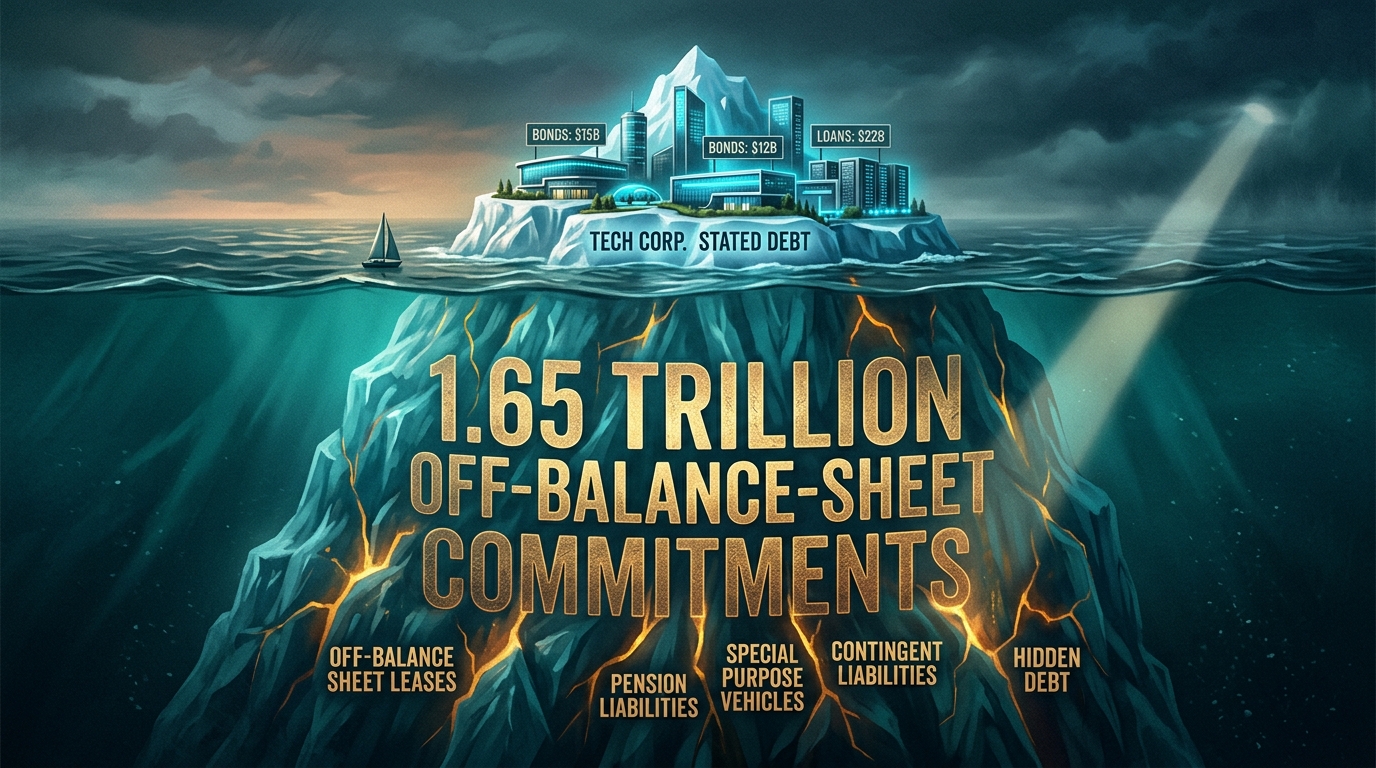
When investors look at the balance sheets of the largest tech companies, they see cash fortresses. Trillions in market capitalization, billions in quarterly net income, and manageable stated corporate debt. But a Nikkei Asia investigation published in July 2026 revealed a far more complex picture: an estimated $1.65 trillion in off-balance-sheet obligations quietly binding Big Tech to fixed, long-term commitments that dwarf what appears on their formal balance sheets. [1]
The Zero-Interest Trap Meets the 5% Reality
The origins of today’s corporate vulnerability trace back to the pre-pandemic era of Zero Interest Rate Policy (ZIRP). With the Federal Reserve’s benchmark rate hovering near 0.25%, money was virtually free. Tech conglomerates used dirt-cheap borrowing to fund stock buybacks, push valuations higher, and underwrite massive speculative capital expenditures.
When pandemic-era surges in digital consumption convinced executives that hyper-growth was permanent, they embarked on an unprecedented compute arms race—committing hundreds of billions to build out AI data centers, procure specialized GPUs, and lock down regional energy grids.
Then the macroeconomic tides turned:
- Pandemic stimulus collided with supply chain friction, triggering rampant global inflation.
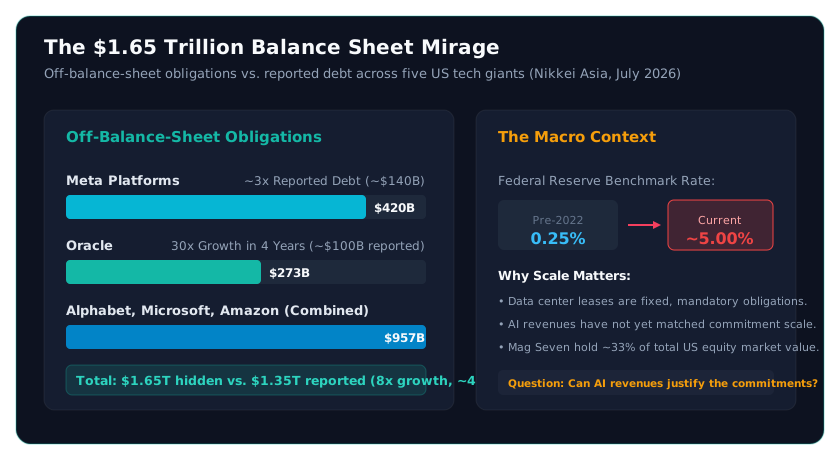
- The Federal Reserve responded with the most aggressive rate-hiking cycle in four decades, pushing the benchmark rate from 0.25% to approximately 5.0%.
- The cost of new borrowing and refinancing rose dramatically, straining companies with large fixed-payment obligations.
Under normal financial prudence, a sharp rise in the cost of capital would cause corporations to curtail speculative expenditures. Big Tech did the opposite. Terrified of falling behind in the frontier model race, the largest tech companies doubled down on infrastructure commitments.
The $1.65 Trillion Off-Balance-Sheet Mountain
Rather than financing facilities entirely through standard corporate debt—which would have been highly visible to credit rating agencies and equity analysts—companies structured much of their AI infrastructure buildout through long-term operating leases, take-or-pay energy contracts, unconditional hardware purchase commitments, and special purpose vehicles. [1]
These obligations appear in SEC 10-K filing footnotes rather than on the primary balance sheet. Since roughly 2022, the size of these commitments across the “Big Five” has grown eightfold, reaching an estimated $1.65 trillion—roughly 122% of the $1.35 trillion these same companies formally report: [2]
- Meta Platforms: Holds the single largest individual burden at roughly $420 billion—nearly three times its reported balance-sheet debt of approximately $140 billion. Much of this is arranged through special purpose vehicles and legally distinct subsidiaries. [3]
- Oracle: In its aggressive bid to become an AI cloud hyperscaler, Oracle’s off-balance-sheet commitments have grown more than 30 times in four years, reaching approximately $273 billion—largely driven by data center commitments for the Stargate AI project. [2]
- Alphabet, Microsoft, and Amazon: Account for the remaining $957 billion in commitments, spanning multi-gigawatt power agreements, custom silicon contracts, and server infrastructure leases.
| Company | Off-Balance-Sheet Obligations | Key Detail |
|---|---|---|
| Meta Platforms | ~$420 Billion | ~3x its ~$140B reported debt |
| Oracle Corporation | ~$273 Billion | 30x growth in four years (Stargate) |
| Alphabet, Microsoft, Amazon | ~$957 Billion (combined) | Leases, energy contracts, hardware |
| Total Big Five | $1.65 Trillion | vs. ~$1.35T in reported debt |
Why These Obligations Differ from Equity Bets
To understand why some credit analysts have raised concerns, consider the legal nature of these liabilities.
When a tech company invests equity into an experimental software product that fails, the loss is limited to the cash burned; the project is shut down, and the balance sheet absorbs the write-off.
Off-balance-sheet infrastructure commitments are fundamentally different. They are mandatory, fixed, non-cancelable obligations:
- If a company leases a 100-megawatt data center under a 15-year agreement, it must make the monthly lease payment whether the GPUs inside are generating billions in API revenue or sitting idle.
- If a firm signs a take-or-pay contract with a utility provider, it must pay for the electricity whether its models are serving enterprise clients or running unmonetized workloads.
Some commentators have compared this structure to the off-balance-sheet Special Purpose Vehicles that defined the Enron scandal. It is worth noting a critical distinction: unlike Enron, Big Tech’s accounting technically complies with modern GAAP and IFRS lease disclosure rules—the figures are disclosed, albeit deep inside 10-K footnotes. The concern is not illegality but rather that the practical effect is similar: investors and rating agencies may systematically underestimate true corporate leverage when obligations are not prominently displayed on the balance sheet. [2]
These obligations represent fixed financial overhead locked in at the exact moment when interest rates are elevated and generative AI software revenues are still maturing.
- 1. Massive Fixed Commitments
Hyperscalers sign 10-to-20-year leases for compute, land, and energy, locking in fixed annual cash outflows totaling hundreds of billions.
- 2. The Monetization Question
Enterprise AI adoption is growing, but revenues have not yet scaled to match the pace of infrastructure investment—creating a gap between commitments and returns.
- 3. The Cash Flow Pressure
To maintain margins while servicing mandatory data center payments, companies have pursued aggressive cost optimization—including significant workforce reductions.
- 4. The Concentration Risk
The Magnificent Seven represent roughly one-third of total US stock market capitalization. Any significant credit stress in this group could have broader market implications.
The Systemic Question
The tech sector has operated under the assumption that its cash-rich software businesses make it largely immune to traditional debt crises. But the Nikkei investigation raises a question financial history teaches us to take seriously: what happens when extreme leverage meets delayed revenue? [1]
Today, roughly one-third of the total value of the US stock market is concentrated in the Magnificent Seven companies. If enterprise demand for AI products does not expand fast enough to generate the returns required to justify $1.65 trillion in fixed obligations, these companies will face growing pressure on their cash flows.
They cannot easily walk away from these contracts. Breaking leases would trigger defaults for data center developers and real estate investment trusts. Continuing to service them during periods of slower growth would drain cash flow into lease payments and debt service.
The workforce reductions that swept the tech industry from 2022 to 2026 were driven by multiple factors—pandemic overhiring corrections, efficiency programs, and genuine AI-driven workflow changes. But the scale of hidden infrastructure obligations adds another lens: companies carrying $1.65 trillion in mandatory fixed payments have a powerful incentive to cut variable costs wherever possible.
Whether this represents a manageable growing pain of the AI era or an emerging systemic risk depends on a question no one can answer yet: will AI revenues arrive fast enough to justify the largest off-balance-sheet buildout in corporate history?
Frequently asked questions
What is off-balance-sheet debt in the context of Big Tech's AI buildout?
Off-balance-sheet liabilities represent binding, long-term financial commitments—primarily multi-decade data center leases, power purchase agreements, and guaranteed hardware purchase commitments—that appear in SEC filing footnotes rather than on the primary corporate balance sheet, obscuring a company's true financial leverage.
How much off-balance-sheet debt does Big Tech hold for AI infrastructure?
According to a July 2026 Nikkei Asia investigation, five US tech giants (Meta, Alphabet, Microsoft, Amazon, Oracle) carry an estimated $1.65 trillion in off-balance-sheet obligations—roughly 122% of the $1.35 trillion these same companies formally report on their balance sheets.
Which companies hold the largest hidden debt burdens?
Meta holds the largest individual burden at roughly $420 billion—nearly three times its reported balance-sheet debt of approximately $140 billion. Oracle's off-balance-sheet commitments have grown more than 30 times in four years to approximately $273 billion, driven largely by Stargate AI data center commitments.
Why do higher interest rates make these obligations more significant?
Many of these commitments were entered during the zero-interest-rate era when capital was cheap. With the Federal Reserve benchmark rate rising from 0.25% to approximately 5%, the cost of new borrowing and refinancing has increased dramatically, making fixed mandatory payments more burdensome relative to cash flows.
Why has this been compared to Enron-era accounting?
Some commentators draw parallels to Enron because structuring trillion-dollar commitments off standard balance sheets can mask true corporate leverage from investors and rating agencies. However, unlike Enron, Big Tech's accounting technically complies with modern GAAP and IFRS lease disclosure rules, and the figures appear in 10-K footnotes.
/* Comments */
Comments are offline right now — we reconnect automatically, nothing is lost.