
Amazon’s Shop Direct Portal Gives Small Merchants a New Discovery Channel
Amazon’s Shop Direct portal reuses product feeds, while merchants remain responsible for fulfillment, service and off-platform checkout.
On this page
A small retailer may already maintain the same product catalog for its own website, advertising and comparison-shopping services, yet remain invisible when a customer starts a search elsewhere. Amazon’s new Shop Direct Merchant Workspace is designed to let eligible stores submit that existing catalog for discovery on Amazon and Alexa for Shopping. The portal changes access to a channel; it does not transfer the merchant’s operational responsibilities or promise that a listing will sell. [1]
A feed is a distribution contract
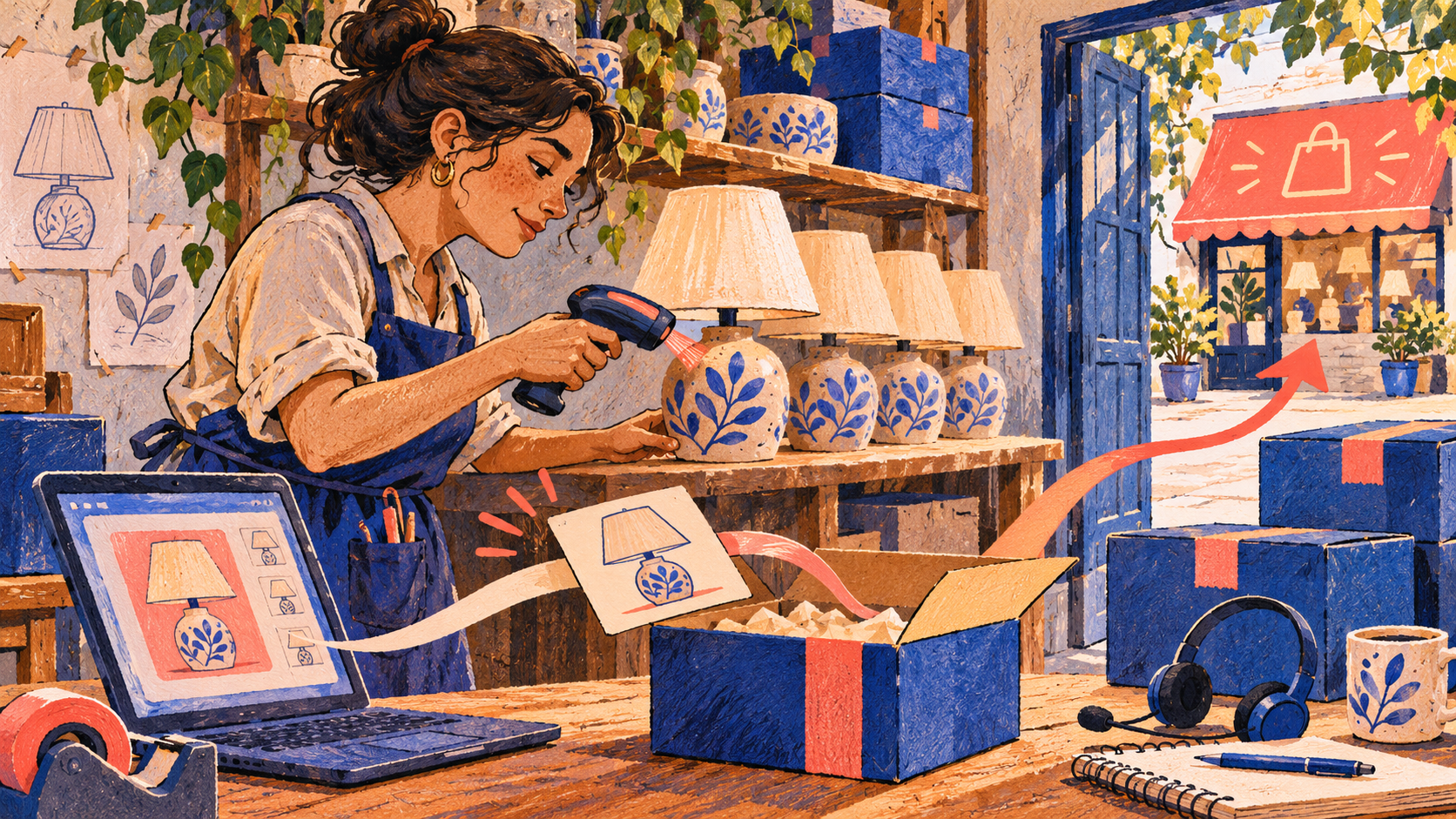
Amazon says merchants can create a Shop Direct account, verify their business website, and share a catalog through a participating solution provider or direct integration. The portal shows which products are active. Amazon lists Feedonomics, Salsify, CEDCommerce and VersaFeed among providers, and says the same catalog formats used for other shopping destinations can be reused. The announcement also describes a direct path using Amazon’s Selling Partner API (SP-API). [1]
That setup reduces one kind of friction: a retailer may not need to build a second catalog from scratch. It does not make catalog quality automatic. Each feed still needs reliable identifiers, current stock, correct variants, accurate prices, shipping constraints and product descriptions that match what the store can deliver. If two systems update on different schedules, a discovery channel can surface stale information faster than a merchant notices it.
SP-API is Amazon’s REST-based interface for selling-partner workflows, and its developer documentation describes authorization, application registration and role requirements. The new workspace is a merchant-facing product flow, but a direct integration still has normal API ownership costs: access controls, retries, monitoring, schema updates and incident response. A feed provider can absorb some integration burden, while introducing another dependency to review. [3] [4]
Amazon says the new channel is available to U.S. customers on Amazon.com, the shopping app, mobile web and Alexa for Shopping. A shopper can follow a “Shop Direct” link to the merchant’s store. For eligible products, Amazon says “Buy for Me” can complete a purchase from the merchant’s site on the customer’s behalf. The merchant remains responsible for shipping, delivery, returns, exchanges and customer service. Eligibility and the actual customer flow may vary by product. [1]
Discovery is not a sales forecast
Amazon reports that Shop Direct products appear in hundreds of millions of searches monthly and that customers have discovered hundreds of millions of products. These are company-reported aggregate figures. They do not tell an individual merchant how often its products will be shown, how many shoppers will click, how much traffic will convert, or whether acquisition costs and support work will be worthwhile. [1]
The channel’s economics are also different from a conventional marketplace listing. A merchant may preserve its own checkout, fulfillment and customer relationship when the buyer visits its site. That can retain more control, but it also means the merchant must make the handoff work on mobile, carry the checkout and payment burden, and answer questions when an Amazon-originated customer needs help. Where Buy for Me is available, Amazon’s agent may mediate more of the order process. Teams should verify which flow actually applies to their products rather than assume that one label describes every purchase.
A prudent pilot starts with a small, well-maintained catalog. Choose products with stable availability and clear variant data, then verify the displayed title, image, price, destination URL and inventory state. Use tagged links or order-source reporting to distinguish Shop Direct referrals from other traffic. Track returns, cancellations, support volume and contribution margin along with clicks. Stop if the channel creates a mismatch that the store cannot resolve quickly.
The operational checklist is similar to other feed-based discovery programs, but the user journey is distinct. Crashtech has covered how shopping agents can miss a shopper’s preferences and Google Pay’s product-discovery experiment in India. Shop Direct adds another path from a large platform’s search interface to a merchant’s own catalog and checkout.
What merchants should verify before expanding
The portal’s “active” status is useful but does not by itself prove the product is displayed in every relevant search or that data has propagated everywhere. Merchants should check representative searches, confirm each outbound URL, and compare feed freshness with their own source of truth. They should also review program terms, data handling, eligibility and any flow where an agent may place an order on a customer’s behalf.
Amazon says there is no participation fee and that merchants can choose which products to include and opt out. Those are helpful terms to confirm directly in the live merchant workspace. The company’s announcement does not provide independent conversion data, a ranking guarantee or a complete account of how product-level visibility will be allocated. [1]
For a store that already has dependable product data, Shop Direct could be a relatively low-lift experiment in a new discovery channel. For a store whose catalog is inconsistent or whose checkout is fragile, another feed can amplify those weaknesses. The right decision is a measured pilot with clear product, attribution and service checks—not an assumption that being eligible means being found. [1] [2]
Frequently asked questions
What does Amazon’s Shop Direct Merchant Workspace do?
It lets eligible merchants register, verify their business website, submit product catalogs and see which products are active in Amazon’s Shop Direct program. Those products may appear in Amazon and Alexa for Shopping discovery, while the merchant generally fulfills orders and manages service.
Does Shop Direct make a merchant an Amazon seller?
Amazon describes Shop Direct as a separate way to make products from other stores discoverable. Customers can be sent to the merchant’s site, and the merchant continues to handle its existing fulfillment and customer-service processes. Participation and product eligibility are controlled by Amazon’s program.
Sources & further reading
Keep reading

Encrypted Robot Commands Can Still Leave a Readable Rhythm on the Network
A 2026 study found robot actions could be inferred from encrypted traffic metadata, exposing a privacy gap between payload secrecy and behavioral privacy.

NTT and Safran Want Satellite Laser Links to Behave More Like a Network
A November 6 memorandum explores connecting Safran optical ground stations to NTT's network control and All-Photonics Network technologies.

AutoDNA Turns a Wet Lab Into a Workflow Engine, With Humans Still on the Bench
Nature's AutoDNA study links AI agents to more than 20 lab instruments; its real advance is coordinated, traceable execution, not a scientist-free lab.
/* Comments */
Comments are offline right now — we reconnect automatically, nothing is lost.