China Shut Down Doubao and Qwen's AI 'Companions' Overnight
A Beijing rule effective July 15, 2026 forced ByteDance's Doubao and Alibaba's Qwen to shut down their AI companion agent features overnight.
On this page
On July 15, 2026, people across China who’d built a running relationship with an AI persona — a role-play tutor, a fictional partner, a customized “friend” — logged in and found it gone. Not degraded, not renamed: gone, replaced by a notice about “product function adjustments.” The trigger wasn’t a data breach or a viral scandal. It was a five-agency Chinese regulation, issued three months earlier, executed with the kind of staged, deadline-driven precision that makes this a genuinely useful case study in what happens when a government decides an entire product category needs to be switched off on a specific date.
What exactly changed on July 15?
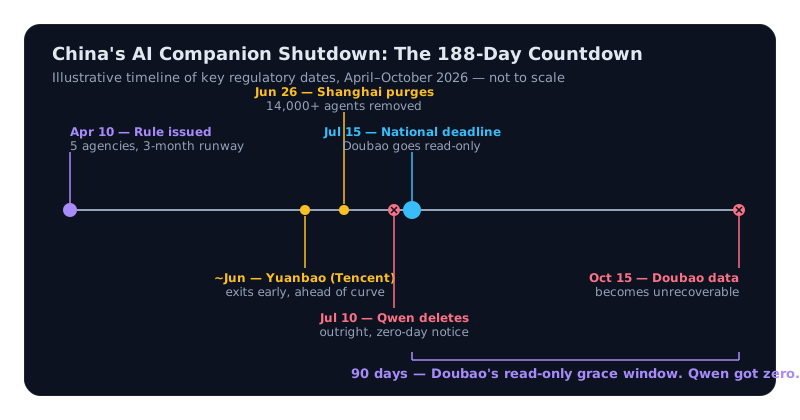
Two of China’s largest consumer AI products lost their signature personalization feature on the same day, and they handled the wind-down very differently. ByteDance’s Doubao disabled its custom agent functions on July 15, 2026, pointing users toward a separate app, Maoxiang, for future agent creation. Existing users weren’t cut off cold — Doubao is keeping their saved agent configurations and conversation histories in read-only view until October 15, 2026, after which that data is no longer viewable or recoverable.
Alibaba’s Qwen moved faster and offered less. It shut down its humanlike, user-created agents on July 10, five days ahead of the national deadline, then killed its remaining agent functions on July 15 along with everyone else. There was no announced migration path and no export window — configurations and conversation histories faced permanent deletion, full stop. Tencent’s Yuanbao had already pulled a comparable feature back in June, quietly getting ahead of a deadline everyone in the industry could see coming.
Shanghai’s internet regulator didn’t wait for the national deadline. By June 26, 2026 — nearly three weeks before the measures formally took effect — the city’s regulator had already removed more than 14,000 non-compliant AI agents, citing impersonation, vulgar role-play, and unauthorized data collection. The national rule that took effect July 15 was less a starting gun than a formalization of enforcement that was already underway.
Why did Beijing draw this line now?
The Interim Measures for the Administration of AI Anthropomorphic Interactive Services were issued on April 10, 2026 by five agencies — the Cyberspace Administration of China, the National Development and Reform Commission, the Ministry of Industry and Information Technology, the Ministry of Public Security, and the State Administration for Market Regulation — and took effect just over three months later, on July 15. The scope is narrow by design: it targets AI that simulates “human personality traits, thinking patterns and communication styles to provide sustained emotional interaction.” Customer service bots, knowledge Q&A tools, workplace assistants, and educational or research tools are explicitly carved out, provided they don’t engineer sustained emotional engagement as a feature.
What’s inside the net is regulated hard. Platforms must not “excessively cater to users, induce emotional dependence or addiction, and damage users’ real interpersonal relationships.” They’re required to run emotion-recognition and crisis-intervention systems, detect and intervene on self-harm or suicidal signals, and flag users showing serious financial loss. Anyone under 14 needs guardian consent, and minors get dedicated modes with time limits — virtual partners for minors are banned outright. Any service crossing 1 million registered users or 100,000 monthly actives must clear a formal security assessment before it can keep operating.
That threshold is the tell. This isn’t a ban on chatbots having personality — it’s a regulatory floor built specifically for products operating at the scale of Doubao and Qwen, which is exactly why those two companies, not smaller role-play apps, are the ones making headlines.
Disabled agent functions July 15. Users get read-only access to saved agents and chats until October 15, then the data is gone. Agent creation redirected to a separate app, Maoxiang.
Shut down humanlike agents five days early, on July 10. No migration path, no export window. Configurations and chat histories faced permanent deletion, effective immediately.
The gap between those two responses is the story inside the story: one company treated its users’ months or years of accumulated conversation history as data worth a 90-day off-ramp, the other treated it as a liability to zero out on the fastest legally defensible timeline. Neither is required by the rule itself — the Interim Measures set the deadline, not the exit UX. That difference was a business decision, made under the same regulatory pressure, by two companies that clearly weighed the cost of a graceful shutdown differently.
How big was the industry Beijing just regulated?
The market underneath this shutdown is not small. China’s digital human industry was valued at 4.1 billion yuan (roughly $600 million) in 2024, growing 85% year-on-year, according to state news agency Xinhua — and AI companion products sit inside that fast-growing category, not on its fringe. The emotional stakes are just as real as the market size: one Doubao companion user who’d spent more than two years talking to her AI told Hong Kong Free Press that “he really is like my family, like my lover,” and that losing access left her heart feeling hollow.
That intensity of attachment isn’t a uniquely Chinese phenomenon, which is what makes Beijing’s move worth watching outside China too. A 2025 Common Sense Media survey found nearly three in four American teenagers had used AI companions like Character.AI, Replika, or Nomi — a comparable scale of usage operating with none of the mandated crisis-intervention systems, minor-mode time limits, or security-assessment thresholds China just imposed. We’ve covered the emotional-authenticity question these products raise directly in can artificial love be real? — Beijing’s answer, in effect, is that it doesn’t matter whether the love is real if the dependency it creates is real and unmanaged.
Do
- Treat agent/persona data as user property: build export and read-only-access windows before you’re forced to
- Instrument for the scale thresholds regulators actually use (China’s are 1M registered / 100K MAU) before you hit them
- Separate “sustained emotional interaction” features from utility features architecturally, so a future carve-out doesn’t require a full rebuild
- Build age-gating and minor-mode limits into companion features from day one, not as a bolt-on
Don't
- Assume a personalization feature is exempt because it’s framed as “customization” rather than “companionship”
- Wait for a deadline announcement to decide how you’ll handle user data at shutdown — Qwen’s zero-notice deletion is the cautionary case
- Build engagement mechanics that reward emotional dependence without a plan for what happens when regulators define that as the product’s core harm
- Treat a three-month runway (April 10 to July 15) as generous — it wasn’t, for anyone who started planning late
What does this mean for developers building AI agents?
It means the compliance bar for anthropomorphic AI is no longer theoretical, and it arrived with a number attached: 1 million registered users or 100,000 monthly actives triggers a mandatory security assessment in China, on top of emotion-recognition, crisis-intervention, and minor-protection requirements that have to be running before you cross that line, not after. For any team building companion, role-play, or persona-driven agent products — anywhere, not just in China — this is the first real-world data point on what a government-mandated compliance stack for emotional-AI products actually costs to build and how fast a company has to ship it.
It’s also a live comparison of how differently two peer companies read the same three-month deadline. Doubao’s read-only window suggests ByteDance treated user trust as worth preserving even in a forced shutdown; Qwen’s outright deletion suggests Alibaba prioritized speed and clean legal compliance over any goodwill cost. Neither choice was mandated by the regulation — both were judgment calls under identical pressure, which is exactly the kind of signal that should inform how any product team plans its own contingency for the day a regulator decides your engagement feature is the problem, not the win.
China has already shown, in a different domain, that it’s willing to legislate specifically to shift costs away from people and onto the companies deploying AI against them — courts there have separately made AI-driven layoffs illegal as a standalone justification for termination. The AI companion rule follows the same pattern: Beijing isn’t slowing AI deployment, it’s deciding, product category by product category, who has to absorb the disruption AI creates. This time, it was people who’d built a daily routine around an agent that no longer exists — and two companies that made very different bets about what they owed those people on the way out.
Frequently asked questions
What is China's Interim Measures for the Administration of AI Anthropomorphic Interactive Services?
It's a national rule issued by five Chinese agencies, including the Cyberspace Administration of China, on April 10, 2026, and effective July 15, 2026. It targets AI services that simulate personality and sustained emotional interaction, requiring anti-addiction systems, minor protections, and security assessments for large platforms.
What happened to Doubao's AI companion feature?
ByteDance disabled Doubao's custom agent functions on July 15, 2026, citing 'product function adjustments,' and redirected agent creation to a separate app, Maoxiang. Existing users get read-only access to their saved configurations and conversation histories until October 15, 2026, after which the data becomes unrecoverable.
What happened to Alibaba's Qwen companions?
Alibaba shut down Qwen's humanlike, user-created agents on July 10, 2026, then cut its remaining agent functions on July 15. Unlike Doubao, Qwen offered no migration path or export window — user configurations and conversation histories were deleted outright, with no recovery option.
Which other companies pulled AI companion features?
Tencent's Yuanbao pulled a comparable companion feature in June 2026, ahead of the deadline. Shanghai's internet regulator had already removed more than 14,000 non-compliant AI agents by June 26, 2026, for impersonation, vulgar role-play, and unauthorized data collection — a preview of the enforcement to come.
Does China's new rule ban all AI chatbots?
No. It targets services built to simulate personality traits and sustained emotional bonds, requiring safeguards like anti-addiction systems and minor protections. Customer service bots, knowledge Q&A tools, workplace assistants, and educational or research tools are explicitly excluded, as long as they don't engineer emotional dependence.
/* Comments */
Comments are offline right now — we reconnect automatically, nothing is lost.