How Meta Actually Tracks You: Inside Facebook, Instagram and WhatsApp's Surveillance Machine
A localhost backdoor beat Incognito Mode. Instagram DMs lost encryption entirely. Here's how Meta's tracking machine really works, fact by fact.
On this page
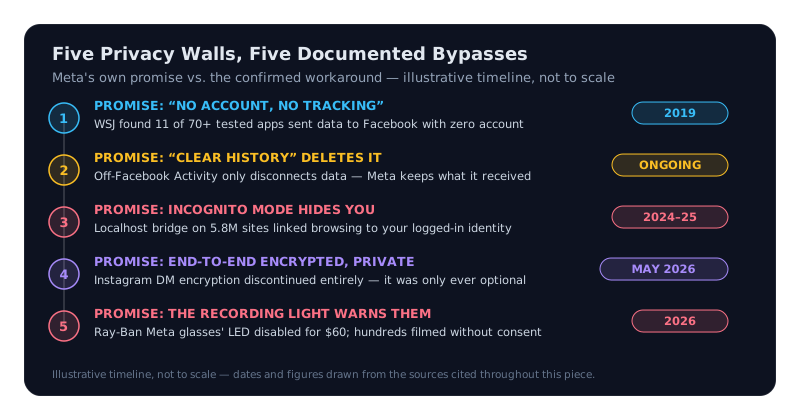
Every privacy setting is a promise. “No account, no tracking.” “Clear history, gone.” “End-to-end encrypted, private by design.” “Incognito Mode, invisible.” Meta’s own record, documented independently across a decade of investigations, court filings, and academic disclosures, shows each of those promises has had a real, confirmed exception — not a rumor, an actual mechanism, with a date attached. This is a tour of five of them, and what happened after each one got caught.
How much data are we actually talking about?
Four new petabytes of data, every single day — that’s the figure Facebook’s own engineers put on the record in an October 2014 blog post, alongside 600,000 queries and 1 million map-reduce jobs run daily. And that was before Instagram’s growth years, before WhatsApp’s billion-plus users, before Reels, before Meta AI. The company has never published an updated figure of that specificity, which is itself notable: the one moment Meta quantified its own data engine precisely, it was already almost incomprehensibly large.
Does skipping the app or the account actually stop the tracking?
No — and the clearest proof came from outside Meta entirely. In February 2019, Wall Street Journal reporters Sam Schechner and Mark Secada tested more than 70 iOS apps and found at least 11 sending sensitive personal data to Facebook through its App Events analytics SDK, seconds after the user entered it, regardless of whether that person had a Facebook account. Instant Heart Rate: HR Monitor sent heart-rate readings. Flo Period & Ovulation Tracker sent menstruation and pregnancy-intention data. Realtor.com sent the property listings and prices someone had just viewed. None of it required a Facebook login — the SDK just phoned home. Facebook told the flagged developers to stop; at least five apps did.
So what does “Clear History” actually clear?
Not what it sounds like. Meta’s real, currently-live Off-Facebook Activity tool — populated by Meta Pixel and the Facebook SDK sitting inside thousands of other apps and sites — lets you see which of them sent your activity to Facebook, and offers a button to “clear” it. Consumer Reports and MIT Technology Review both tested what that button actually does: it disconnects the activity from your identifiable profile and stops it feeding ad targeting on your account. It does not delete the underlying data Meta already received, and it does nothing to copies already shared onward.
The distinction matters because the two words get treated as synonyms in casual conversation about privacy tools, and they aren’t. Clearing your Off-Facebook Activity is closer to unlisting your phone number than shredding the phone book — the data Meta already holds stays exactly where it was.
How did Meta’s apps beat Incognito Mode entirely?
By routing tracking data through the phone’s own network stack instead of the browser. On June 3, 2025, researchers Narseo Vallina-Rodriguez (IMDEA Networks), Gunes Acar (Radboud University), and Tim Vlummens (KU Leuven) disclosed that Meta Pixel, embedded on an estimated 5.8 million websites, had since September 2024 been sending cookies and metadata through the device’s own loopback interface (127.0.0.1) to the Facebook and Instagram apps, which silently listened on fixed local ports. The technique hid the tracking cookie inside WebRTC’s SDP “ICE-ufrag” field, shipped over STUN — bridging a person’s anonymous web browsing to their logged-in app identity and Android Advertising ID, bypassing Incognito Mode, cookie-clearing, and Android’s app-permission sandbox entirely. Meta shut it down by 7:45 CEST the same day Chrome 137 shipped countermeasures blocking the abused ports. (Yandex reportedly used a similar, older method since 2017; no confirmation it has stopped.)
Are your messages actually private?
It depends which app. Instagram DMs had optional, opt-in, per-conversation encryption since 2023 — never on by default, never prominently surfaced. On May 8, 2026, Meta discontinued it entirely, citing low adoption: only standard in-transit encryption now applies, and Meta can technically access DM content, including images, video, and voice notes. Messenger, meanwhile, completed default end-to-end encryption for personal chats and calls in 2023 and still has it — an odd reversal where “just messaging” is now more private than the app built around private conversations.
| Channel | Encryption status (2026) | What that means |
|---|---|---|
| Messenger (personal chats) | Default end-to-end, since 2023 | Meta cannot read message content |
| Instagram DMs | None — discontinued May 8, 2026 | Meta can technically access content |
| WhatsApp (personal chats) | End-to-end by default | Meta cannot read message content |
| WhatsApp Business (Cloud API) | Decrypted on arrival, per Meta’s own docs | Business sees plaintext; retained up to 30 days |
WhatsApp’s own developer docs confirm the fourth row isn’t a leak, it’s the design: messages sent to a business via the Cloud API are decrypted by Meta’s infrastructure and forwarded in plaintext, and Meta explicitly excludes business-messaging chats from its default encryption.
Why was the Facebook Pixel sitting on hospital and abortion-clinic websites?
Because it was installed like any other analytics tool, and it didn’t distinguish sensitive context from ordinary web traffic. The Markup’s June 2022 investigation found Meta Pixel on 33 of the top 100 US hospitals’ websites, sending appointment data — including doctor names and appointment types — covering more than 26 million patient visits in 2020, and inside password-protected patient portals at seven health systems, capturing medication names, allergic reactions, and sexual-orientation survey answers. A companion investigation found the Pixel on roughly 294 of 2,500 crisis-pregnancy-center sites tested, capturing whether a visitor was considering abortion, a pregnancy test, or emergency contraception. Meta’s own “sensitive health data filtering,” introduced in July 2020, failed to catch any of it. The bills came due: Novant Health settled for $6.6 million in August 2022 (1.3 million patients notified), and Advocate Aurora Health for $12.25 million, court-approved in July 2024, covering more than 2.5 million people. It’s the same underlying dynamic Crashtech has traced in how surveillance pricing turns a routine transaction into a data-harvesting session — infrastructure built for ordinary analytics, repurposed on contact with sensitive data.
Can you actually stop Meta from training AI on your posts?
Only if you live in the right place. Meta confirmed it trains Meta AI and Llama on public posts, photos, and comments across Facebook, Instagram, and Threads — not private messages, not under-18 EU accounts. It paused the EU rollout in June 2024 after Irish Data Protection Commission intervention, then resumed for UK users in September 2024.
Switzerland, Brazil, Japan, and South Korea join the EU/UK/EEA in getting a GDPR-based objection form. Privacy group noyb has still criticized the form itself as an unnecessarily complex deterrent.
No formal objection mechanism exists at all. If your posts are public, they’re training data — there is no button, form, or setting that changes that.
Why does Meta keep building workarounds for the walls regulators put up?
Because the incentive to keep the data flowing is enormous, and Meta has already shown what happens when a wall actually works. When Apple’s App Tracking Transparency shipped in 2021, Meta’s own CFO quantified it as a roughly $10 billion hit to 2022 revenue — the same year Meta shares fell about 26% in a single day, February 3, 2022, erasing an estimated $232 billion in market value, at the time the largest single-day loss in US stock market history. Meta’s documented response was Conversions API (CAPI): a server-to-server channel letting advertisers send customer data straight from their own servers to Meta, bypassing the browser and device layer ATT governs. By 2023, Meta disclosed 43% of its iOS behavioral ad data was arriving through server-side sources rather than Apple’s device identifier — read by privacy researchers as evidence CAPI functions as a structural workaround for the exact restriction Apple imposed. It’s a pattern that runs through Meta’s broader strategic decisions over the past two years: faced with a wall, the default move is an engineered path around it, not a change of course.
What about the Ray-Ban glasses everyone’s wearing now?
They add a camera to the same incentive structure, and the documented record is already uncomfortable. The recording LED that’s supposed to signal “this person is filming you” can be physically defeated: 404 Media reported a hobbyist charging $60 to permanently disable it via circuit modification, and Meta shipped a mandatory update starting around July 7, 2026 that disables the camera entirely if tampering is detected. A BBC investigation in January 2026 found “hundreds” of covertly filmed videos and identified nearly 50 women filmed without consent.
Then, in February 2026, Swedish outlets Svenska Dagbladet and Göteborgs-Posten reported that Sama — the Nairobi outsourcing firm previously reported on for Facebook content moderation from 2019–2023 — had contractors reviewing Ray-Ban Meta glasses footage that included nudity, bathroom use, and financial documents. Meta ended the contract; roughly 1,108 workers got six days’ notice. A US class-action followed on March 4, 2026 (Gina Bartone of New Jersey and Mateo Canu of California), alleging deceptive marketing about human review of footage, alongside a UK ICO information request and a Kenya Data Protection Commissioner investigation. Separately, a leaked internal Reality Labs memo reported by the New York Times and Biometric Update in February 2026 described a planned, unconfirmed facial-recognition feature codenamed “Name Tag” for a possible late-2026 rollout — including a leaked line about launching “during a dynamic political environment” when critics would be distracted. Meta shelved a similar idea in 2021 after backlash.
Do
- Check Off-Facebook Activity periodically — it won’t delete data, but it does stop ad-targeting use going forward
- Use Messenger over Instagram DMs if you want default end-to-end encryption in 2026
- Install a free, open-source app like Nearby Glasses (Android only) to get alerted to BLE-broadcasting smart glasses nearby
- Treat any app requesting health, financial, or location data as a Facebook SDK candidate, account or not
Don't
- Assume deleting the Facebook app removes you from tracking — the SDK lives inside thousands of other apps
- Assume “encrypted messaging app” still describes Instagram DMs — it stopped being accurate on May 8, 2026
- Assume Incognito Mode or clearing cookies defeats every tracking channel — the localhost bridge didn’t care about either until Chrome forced the issue
- Trust a recording light on any smart glasses as a hard guarantee — it’s a design choice, not a physical law
None of these mechanisms required a hidden conspiracy to exist — each one is documented in Meta’s own disclosures, court filings, regulator actions, or independent research that Meta didn’t dispute. What connects a 2014 engineering blog post to a 2026 smart-glasses lawsuit is the same operating logic: build the pipeline first, let the wall get built around it later, and when the wall actually holds, as Apple’s did in 2021, engineer a path underneath it rather than turn the pipeline off. The $232 billion the market wiped off Meta in a single day in 2022 wasn’t a warning that changed the model. It was the receipt for how much the model was worth defending.
Frequently asked questions
Does Facebook track you even if you don't have an account?
Yes. A 2019 Wall Street Journal investigation tested more than 70 iOS apps and found at least 11 — including a heart-rate monitor and a period tracker — sending sensitive data to Facebook via its App Events SDK within seconds, regardless of whether the person using the app had a Facebook account at all.
Does clearing 'Off-Facebook Activity' actually delete your data?
No. Consumer Reports and MIT Technology Review both confirmed the tool only disconnects the activity from your identifiable profile and stops it being used for ad targeting on your account. Meta keeps the underlying data it already received, and any copies already shared with third parties are untouched.
Are Instagram DMs end-to-end encrypted in 2026?
No. Meta discontinued Instagram DM end-to-end encryption entirely on May 8, 2026, citing low adoption of the feature, which had only ever been optional and opt-in since 2023. Messenger, by contrast, completed default end-to-end encryption in 2023 and kept it — making Messenger more private than Instagram DMs today.
What was the 'localhost' tracking bug Meta got caught using?
Academic researchers disclosed on June 3, 2025 that Meta Pixel, embedded on roughly 5.8 million websites, sent tracking cookies through the device's own loopback interface to the Facebook and Instagram apps, silently linking web browsing to a user's logged-in identity — bypassing Incognito Mode, cookie-clearing, and Android's app sandbox. Meta halted it the same day Google shipped countermeasures.
What happened with Meta's Ray-Ban glasses and the Kenya scandal?
Swedish outlets reported in February 2026 that Nairobi outsourcing firm Sama had contractors reviewing Ray-Ban Meta glasses footage containing nudity, bathroom use, and financial documents. Meta ended the contract, roughly 1,108 workers got six days' notice, and a US class-action lawsuit followed in March 2026 alleging deceptive privacy marketing.
Sources & further reading
- Facebook Engineering — Top Open Data Problems (research.facebook.com, Oct 2014)
- NPR — Apps Give Private Data To Facebook Without User's Knowledge or Permission
- Consumer Reports — Facebook's Clear History Tools Won't Actually Delete Your Data
- localmess.github.io — Covert Web-to-App Tracking via Localhost on Android
- MacRumors — Instagram DMs Lose End-to-End Encryption Starting Today
- Meta for Developers — WhatsApp Business Platform Data Privacy & Security
- TechCrunch — How to opt out of Meta using your Facebook and Instagram data to train its AI
- The Markup — Facebook Is Receiving Sensitive Medical Information from Hospital Websites
- TechCrunch — Meta sued over AI smart glasses' privacy concerns
/* Comments */
Comments are offline right now — we reconnect automatically, nothing is lost.