
How Google Actually Tracks You: The Data Empire Behind the Search Box
Chrome logs your keystrokes, ad auctions broadcast your location 747 times a day, and DHS subpoenaed Gmail records in 4 hours. Here's the verified system.
On this page
You don’t need to be logged in, searching for anything unusual, or doing anything wrong for Google to build a profile of you. You just need to open a browser. What follows is not speculation — it is the documented mechanics of a system that starts the moment you type a letter into an address bar and ends with a language model reasoning across your inbox, your photos, and your search history simultaneously. Each piece below is independently verified. Assembled together, they form one pipeline.
Why does one search box need this much infrastructure?
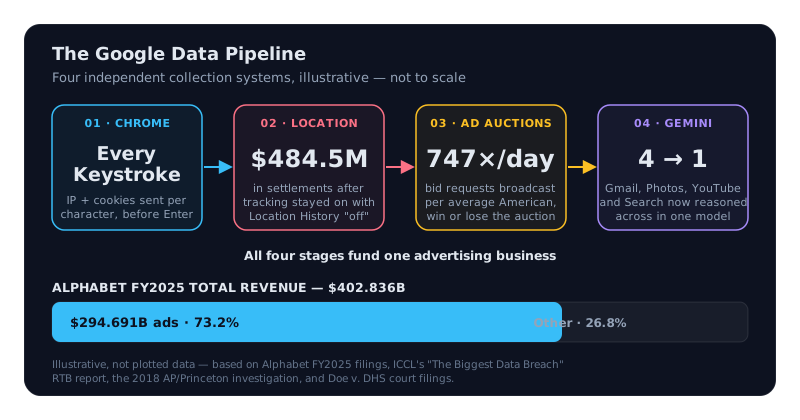
Because the search box isn’t the product — it’s the intake valve for the product. In full-year 2025, Google’s advertising business generated $294.691 billion of Alphabet’s $402.836 billion in total revenue, or 73.2%. In the second quarter of 2025 alone, ads accounted for 74.0% of revenue ($71.34 billion of $96.428 billion). That single ratio explains every design decision that follows: Chrome, Search, YouTube, and now Gemini are not separate products that happen to share a login. They are collection surfaces for the business that pays for all of them.
What does Chrome send before you even hit enter?
Every character. As you type in Chrome’s address bar, the browser sends each keystroke — along with your IP address and cookie-based context — to your default search engine to generate autocomplete suggestions, via a setting called “Improve search suggestions” (Settings > You and Google > Sync and Google services). Chrome does withhold obviously sensitive input like passwords or local file paths, but the keystroke stream itself fires regardless of whether you’re signed into a Google Account — it’s tied to whichever engine is set as default, not to sign-in state.
Signing in isn’t purely opt-in, either. “Allow Chrome sign-in” ships on by default, nudging the browser toward linking your identity the moment you sign into Gmail or YouTube. It wasn’t always a nudge: Chrome 69, released in September 2018, made this fully automatic and silent — signing into any Google service silently signed in the entire browser, triggering a public backlash led by cryptographer Matthew Green’s widely read “Why I’m Done with Chrome.” Chrome 70 added the toggle that still exists today. The mechanism was corrected; the default direction wasn’t.
How does Google know where you are without opening Maps?
Through channels that have nothing to do with GPS. Google can estimate location via IP address, crowdsourced Wi-Fi access-point triangulation from Android devices, Bluetooth beacons, cell towers — and, more surprisingly, the content of your search queries. A 2018 AP/Princeton investigation found that searching “chocolate chip cookies” or simply opening the Maps app stored precise coordinates even with Location History switched off, because a separate setting — Web & App Activity, turned on by default at account creation — kept collecting location independently.
The AP/Princeton finding wasn’t a hacking story — it was a settings-architecture story. Users who believed they had disabled location tracking by switching off “Location History” were still being logged, because a second, separately labeled setting kept the pipeline open. That gap led to a $391.5 million settlement with 40 states (announced November 14, 2022 — the largest multistate consumer-privacy settlement in US history at the time), followed by a separate $93 million California-specific settlement on September 14, 2023.
| Setting | What users believed it did | What it actually controlled |
|---|---|---|
| Location History | Stops Google from logging where you go | Only the visible timeline feature |
| Web & App Activity | Unrelated / general activity logging | Kept storing precise location from searches and app use, on by default |
What happens to your data in the 50 milliseconds after a page loads?
It gets broadcast — win or lose. Real-time bidding (RTB), the auction system behind most display ads, fires a “bid request” to potentially thousands of ad-tech companies simultaneously within a roughly 50-120 millisecond window every time a page or app loads. That request typically contains device and advertising IDs, IP address, often GPS-derived location, and inferred interests. Every recipient gets the data, regardless of who ultimately wins the ad slot.
The Irish Council for Civil Liberties quantified this in its May 2022 report, “The Biggest Data Breach”: RTB broadcasts personal data 178 trillion times a year across the US and Europe combined — 747 times a day for the average American — naming Google and Microsoft/Xandr among the systems involved, and noting the data reaches firms in Russia and China. Follow-on ICCL reporting and an EFF piece from March 2026 document data brokers, and government-linked buyers using a tool called “Patternz,” harvesting this “bidstream” data — including US agencies reportedly using it for location tracking without a warrant.
Google’s own, verbatim policy language: “We never sell your personal information to anyone, including for ad purposes.” Taken literally, on the narrow definition of a direct data sale, that’s true.
Every page load broadcasts your device ID, IP, location, and inferred interests to thousands of firms simultaneously — whether or not they win the auction. No sale required for the exposure to happen.
Can the government get your data without a judge?
In several documented ways, yes. Section 702 of FISA targets non-US persons abroad but incidentally sweeps up Americans’ communications with those targets; a federal court ruled in February 2025 that the government must generally get a warrant to query 702 data using US-person search terms, a still-contested issue. National Security Letters go further: they let the FBI compel non-content subscriber records — names, addresses, IPs, billing details — with no judge required at all. A judge only enters the picture if the recipient challenges the letter, and NSLs usually carry gag orders barring the recipient from even disclosing them.
In Doe v. DHS, the Department of Homeland Security issued an administrative subpoena to Google for a Philadelphia man’s Gmail subscriber records just four hours after he emailed a DHS attorney criticizing the department’s handling of an asylum case, in October 2025. The ACLU, ACLU-PA, and ACLU-NorCal filed a motion to quash on February 2, 2026. DHS withdrew the subpoena on February 5, 2026 — rather than let a court rule on it.
Google’s own track record on notifying affected users has slipped, too. The company broke a decade-long promise to notify users before complying with subpoenas in the case of student journalist Amandla Thomas-Johnson: ICE obtained his address, IP address, phone number, and bank/credit-card data via a subpoena — no judge involved — between April and May 2025, and Google gave him no opportunity to challenge it before complying. EFF filed complaints with state attorneys general over the incident in April 2026.
Is Google tracking you even on sites that aren’t Google’s?
Yes — Google’s footprint extends well past google.com. Google Analytics runs on 47.9% of all websites as of July 2026, according to w3techs. reCAPTCHA protects an estimated 5-7 million websites and 50% of the Fortune 100, by Google’s own figures. That means Google’s infrastructure can potentially observe activity on sites that have no Google branding at all — a scale of reach that has driven scrutiny of how AI-generated search overviews reroute traffic away from the very publishers whose pages Analytics and reCAPTCHA sit on.
That reach converts directly into ad-targeting precision. Google Ads offers named audience categories built from exactly this kind of signal:
| Segment type | Example categories |
|---|---|
| Affinity segments | 150+ interests — Auto Enthusiasts, Golf Enthusiasts |
| In-Market segments | Near-term purchase intent — Athletic Shoes, SUVs (New), Mortgage Loans |
| Detailed Demographics | Parental status (with child-age subcategories), marital status, education, employment |
| Life Events | Graduating, moving, getting married |
Google has also expanded YouTube ad targeting to draw directly on logged-in users’ Google Search history, not just their on-platform viewing — reported by Public Citizen. It’s a pattern that echoes how retailers’ dynamic pricing systems turn behavioral signal into individualized commercial treatment, just at Google’s much larger scale.
What does Gemini’s “Personal Intelligence” change?
It’s the point where the separate collection streams converge. Launched January 14, 2026 in beta for Google AI Pro/Ultra subscribers, “Personal Intelligence” lets Gemini reason across Gmail, Photos, YouTube, and Search history simultaneously. Google states it does not train directly on your raw inbox or photo library for this feature — its own verbatim language is that it trains generative AI models “off of these summaries, excerpts, generated media, and inferences.”
For ordinary Gemini Apps conversations, the exposure runs through a separate setting called “Keep Activity,” on by default for eligible users: chats can be human-reviewed and used to improve or train models, retained per Google’s activity policy, unless a user turns it off. The critical split is contractual, not technical — paid Workspace and enterprise accounts are protected from training use without explicit permission and are not human-reviewed, while personal, free consumer accounts are eligible for training by default, with opt-out available. The Washington Post reported on January 27, 2026 that independent reviewers have criticized Google’s messaging on this distinction as misleading.
What can you actually do about it?
None of this requires exotic tooling to push back on — the relevant controls already exist inside Google’s own settings menus. The gap is mostly that they’re off the beaten path and on by default.
Do
- Turn off “Improve search suggestions” in Chrome Settings > You and Google if you don’t want every keystroke sent per character
- Check “Web & App Activity” directly — turning off Location History alone does not stop it
- Review Gemini’s “Keep Activity” setting if you don’t want free-tier chats eligible for human review and training
- Check “Allow Chrome sign-in” if you don’t want Gmail/YouTube sign-in to nudge the whole browser toward linking identity
Don't
- Don’t assume signing out of your Google Account stops the keystroke stream — it’s tied to your default search engine, not sign-in state
- Don’t assume “we never sell your data” means no exposure — RTB auctions broadcast your data to thousands of bidders regardless of who wins
- Don’t assume turning off one visible setting (like Location History) closes every collection channel — Web & App Activity operates independently
The throughline across all nine of these facts isn’t malice in any single feature — it’s that $294.691 billion in 2025 advertising revenue funds a company whose defaults, almost without exception, point toward more collection rather than less. Nothing here required a hack. It required using a browser, a search box, and an inbox the way they were designed to be used.
Frequently asked questions
Does Chrome send what I type before I even press enter?
Yes. Chrome's 'Improve search suggestions' setting sends each keystroke you type in the address bar, plus your IP address and cookie-based context, to your default search engine to generate autocomplete — and it fires whether or not you're signed into a Google Account, since it's tied to the default engine, not sign-in state.
Can Google know my location without me opening Google Maps?
Yes. A 2018 AP/Princeton investigation found Google stored precise coordinates from ordinary searches and app use even with Location History turned off, because a separate setting, Web & App Activity, was on by default and kept logging location anyway. Google paid $391.5 million to 40 states in 2022 and $93 million to California in 2023 over this.
What is real-time bidding and why does it expose my data hundreds of times a day?
Real-time bidding is the ad-auction system that runs when a page loads: a bid request containing your device ID, IP, often GPS-level location, and inferred interests broadcasts to potentially thousands of ad-tech firms within roughly 50-120 milliseconds. The Irish Council for Civil Liberties documented 178 trillion such broadcasts a year — 747 per average American per day.
Can the government get my Google data without a warrant?
Sometimes, yes. National Security Letters let the FBI compel subscriber records — name, address, IP, billing — with no judge required unless the recipient challenges it. In October 2025, DHS subpoenaed a man's Gmail records four hours after he emailed a DHS attorney; it withdrew the subpoena in February 2026 rather than face a court ruling.
Does Google train Gemini directly on my Gmail and Photos?
Google says no — its stated language is that it trains generative AI models 'off of these summaries, excerpts, generated media, and inferences,' not raw inbox or photo content. For free consumer accounts, ordinary Gemini chats are eligible for human review and training by default via the 'Keep Activity' setting; paid Workspace accounts are contractually excluded.
Sources & further reading
- Alphabet Q4 & Full-Year 2025 earnings release
- Google Chrome Help — How Chrome keeps your URL & search data private
- Google Chrome Help — Sign in to Chrome
- ICCL — The Biggest Data Breach (RTB report)
- ACLU — Doe v. DHS case coverage
- EFF — Google Broke Its Promise to Me. Now ICE Has My Data.
- Google Safety Center — Ads that Respect Your Privacy
- Google Gemini Apps Privacy Hub
/* Comments */
Comments are offline right now — we reconnect automatically, nothing is lost.