New York Just Became the First US State to Halt New AI Data Centers
Hochul's executive order freezes new 50MW+ data center permits for a year, after NY electric bills rose 68% since 2019.
On this page
For two years, the AI infrastructure buildout ran on a simple assumption: hyperscalers propose, municipalities approve, and the grid figures out the rest later. On July 14, 2026, New York broke that assumption at the state level for the first time in the country. Governor Kathy Hochul didn’t ban data centers outright — she pressed pause on the biggest ones, for up to a year, and tied the pause to a bill nobody in the industry particularly wants to see itemized: a 68% rise in what ordinary New Yorkers pay for electricity since 2019.
What exactly did Hochul’s executive order do?
It bars state permits for new “hyperscaler” data centers — defined as facilities drawing 50 megawatts or more of power — for up to one year, effective immediately. That’s a hard stop on new construction in that size class, not a slowdown or an added review step tacked onto the existing process.
The pause isn’t open-ended. It runs alongside three concrete deliverables: a Generic Environmental Impact Statement covering data center development statewide, a Community Investment Framework that Hochul’s office says must be issued within 60 days, and consideration by the Department of Public Service of a new Grid Acceleration Fund. Hochul also directed the DPS to explore requiring data centers to fund their own clean electric generation — distributed energy resources, battery storage — rather than drawing on capacity built for households. Separately, her office says it’s pursuing legislation to repeal sales tax exemptions currently available to massive data centers in the state.
Read plainly, the order is a bet that a year is enough time to build the regulatory scaffolding — standards, cost allocation, community terms — that New York skipped the first time hyperscale proposals started landing in towns like Lansing and East Fishkill. “New York will lead the way in creating the strongest standards in the nation for data center development,” Hochul said announcing the order, “ensuring that when companies succeed because of New York, New Yorkers succeed too.”
Why did New York pull the trigger now?
Because the affordability math stopped being theoretical. New York’s average residential electricity price has climbed nearly 68% since 2019 — a figure that has dominated coverage of the order even though Hochul’s own written announcement leans on qualitative language over that specific number. “These hyperscale AI data centers consume enormous amounts of power, truly threatening to outpace our grid’s capacity,” Hochul said announcing the order in Albany. “They drive up costs for local ratepayers, and I refuse to let those costs get passed down to New Yorkers.”
Public opinion had already moved. A Siena Research Institute poll conducted in June found 46% of respondents believed a one-year moratorium on large data center permits would be good for the state, against just 21% who called it bad — a genuinely bipartisan split, with Democrats backing the idea by 37 points and Republicans by 13. The same poll showed Hochul leading her Republican gubernatorial challenger, Nassau County Executive Bruce Blakeman, by 20 points, which makes the timing, under four months before the fall election, hard to read as coincidental.
This isn’t an isolated New York phenomenon, either. Community opposition to data center siting has been building nationally — $130 billion in proposed AI data center projects were blocked or delayed in the first quarter of 2026 alone, and utilities from Nevada to New York have started rationing grid capacity in ways that put households and hyperscalers in direct competition for the same electrons. New York’s order is the first time that competition produced a statewide regulatory stop, rather than just a lost council vote.
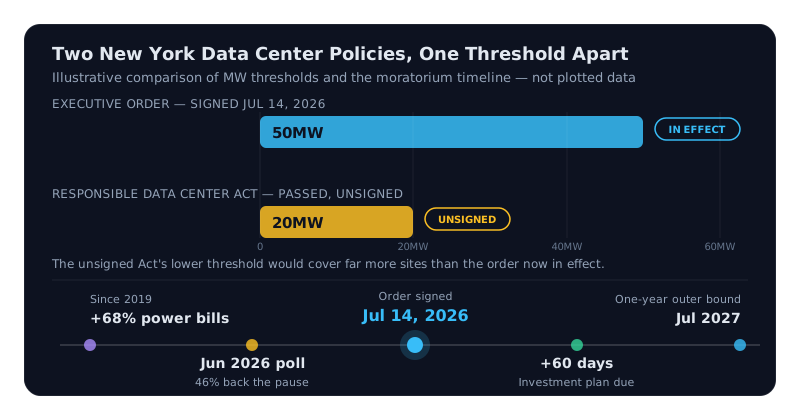
The Responsible Data Center Development Act, already passed by the state legislature earlier this year, would impose its own one-year moratorium — at a 20-megawatt threshold, far lower than the 50MW line in Hochul’s executive order. She hasn’t signed it. Her office says she’ll “further review” it with lawmakers, which means New York’s toughest data center policy is currently sitting unsigned on her desk while a narrower version is already in effect.
How do the two New York policies actually compare?
They target different slices of the same industry, and only one of them is currently binding.
Signed July 14, 2026. Pauses permits for hyperscale data centers (50MW+) for up to one year, pending a Generic Environmental Impact Statement, a 60-day Community Investment Framework, and a proposed Grid Acceleration Fund. Takes effect immediately by gubernatorial authority.
Passed by the state legislature earlier in 2026. Would impose a one-year moratorium on data centers with peak demand of 20 megawatts or more — catching far more projects than the executive order. Awaiting Hochul’s signature; she has committed only to “further review.”
Fourteen state legislatures nationwide have introduced bills restricting new data center construction this year, and none have been signed into law — which makes New York’s executive order the first statewide moratorium of any kind to actually take effect, even before the stricter legislative version is resolved.
How did Washington and the industry react?
Loudly, and fast. President Trump posted on Truth Social the following day that “New York State has made a terrible decision,” arguing that data centers are “big, strong, bold, and Money Machines for the State in which they are built” and that Hochul had “terminated all Data Centers being built, or to be built, in New York State” for political reasons. He called for the policy to change “IMMEDIATELY” and argued separately that data centers “must pay” for their own water and power rather than draw on public infrastructure — an odd point of overlap with Hochul’s own reasoning, even as he attacked her policy.
Hochul didn’t back down. “We hit pause because the communities powering AI should share in its success,” she wrote in response on X. “Maybe that’s a novel concept in Washington. We call it doing our job.” Senator Kirsten Gillibrand backed the move as being “fundamentally about trust,” while Pennsylvania Senator John Fetterman, breaking from party alignment on the substance, posted simply: “China wins.”
Opposition inside New York came from Republican Assemblyman Scott Gray and colleagues, who wrote to Hochul in June that “a statewide moratorium is the wrong answer to the right questions,” arguing siting decisions belong to local communities and that Albany’s role should be limited to “regulatory framework” and “ratepayer” protection rather than blanket bans. Environmental groups took the opposite view: Food & Water Watch’s New York director, Laura Shindell, called the order “a huge step forward for New York communities fighting against an onslaught of massive data center proposals.”
What does this mean for AI infrastructure builders?
It means site-selection risk now has a political calendar attached to it, not just a permitting timeline. A hyperscale project that assumed New York capacity was available in 2026 now has a one-year unknown sitting on top of standard interconnection queues — and the state that just froze new permits was, per CNBC’s own 2026 rankings published days before the order, no infrastructure laggard: New York placed 13th nationally for infrastructure, with the 5th-highest maximum power load of any state and roughly 40 shovel-ready sites certified under its own Fast NY program. That’s the kind of reversal that changes how a CFO models a five-year capacity plan, not just how a single project timeline slips.
It’s also a reminder that “AI-friendly state” and “AI-friendly governor” aren’t the same category, and neither is fixed. Democratic governors have split visibly on this: Maine’s Janet Mills vetoed a similar legislative moratorium, and Virginia’s Abigail Spanberger has publicly cautioned against the approach Hochul just took — meaning the same party, and often the same stated concerns about ratepayers and grid strain, can produce opposite policy outcomes depending on local politics and an election calendar. For teams planning where to put the next tranche of compute, the operating assumption now has to be that public opposition converts into binding policy faster than it used to, and that conversion doesn’t require legislative gridlock to get resolved — one executive order was enough.
Do
- Model regulatory pause risk into hyperscale site-selection timelines, not just interconnection queue length
- Track state-level community opposition trackers alongside utility capacity data before committing capital
- Treat “ratepayer impact” disclosure as a standard part of any large data center pitch, not an afterthought
Don't
- Assume a state’s past pro-investment ranking predicts its policy over the next election cycle
- Treat local council approval as durable once state-level moratorium bills are already pending
- Ignore net-metering and self-generation requirements emerging in DPS-style reviews — they’re becoming standard asks, not edge cases
New York’s pause expires on its own terms: once the state has an environmental impact statement, a Community Investment Framework, and a funding mechanism for grid upgrades in place, Hochul’s office says the moratorium lifts. Whether that timeline holds through a contested reelection year, a stalled bill on her desk with a stricter threshold, and a president publicly demanding she reverse course, is the actual story to watch through 2027 — not whether the pause happened, but whether it holds.
Frequently asked questions
What did Governor Hochul's executive order actually change?
The July 14, 2026 executive order pauses new state permits for hyperscale data centers using 50 megawatts or more of power, for up to one year. The pause holds until New York completes a Generic Environmental Impact Statement, issues a Community Investment Framework within 60 days, and the Department of Public Service reviews a proposed Grid Acceleration Fund.
Why did New York impose the moratorium now?
New Yorkers' average residential electricity price has climbed nearly 68% since 2019, central to the affordability case against data center growth. A June 2026 Siena Research Institute poll found 46% of respondents called a one-year data center moratorium good for the state versus 21% who called it bad, with Democrats backing it by 37 points and Republicans by 13.
How did President Trump respond to the moratorium?
Trump called it "a terrible decision" in a July 15, 2026 Truth Social post, writing that Hochul had "terminated all Data Centers being built, or to be built, in New York State" for political reasons and demanding the state change course "IMMEDIATELY." He argued data centers are "Money Machines" for states and should pay for their own water and power.
Is New York's moratorium the only such policy in the US?
Yes, as the first statewide moratorium of its kind — but not the only attempt. Fourteen state legislatures have introduced bills restricting new data center construction, none yet signed into law. New York's own legislature separately passed the Responsible Data Center Development Act, which would bar centers of 20 megawatts or more; Hochul has not yet acted on it.
What happens when the one-year pause ends?
Hochul's office says the moratorium lifts once New York finishes a framework covering environmental review, community investment, and grid funding for new data centers. The state is also pursuing legislation to repeal sales tax exemptions for large-scale data centers and directing utility regulators to require centers fund their own clean power generation.
Sources & further reading
- New York Governor's Office — First Statewide Moratorium on New Hyperscale Data Centers Launched by Governor Kathy Hochul
- CNBC — New York becomes first U.S. state to impose AI data center ban
- CNBC — Trump blasts New York Gov. Hochul over AI data center moratorium
- Axios — N.Y. Gov. Kathy Hochul signs data center moratorium executive order
/* Comments */
Comments are offline right now — we reconnect automatically, nothing is lost.