Anthropic's New 'Wellness' Dashboard Is Quietly Measuring Your Claude Dependency
Anthropic's Reflect dashboard tracks your Claude habits and calls it wellness. Critics say it's a retention play borrowed from Gmail Meter's 2012 playbook.
On this page
Every big consumer platform eventually ships a mirror. Facebook built Your Time on Facebook. Apple has Screen Time. Google, back in 2012, had a scrappy little utility called Gmail Meter that turned your inbox into pie charts. On July 9, 2026, Anthropic joined that lineage with Reflect — a dashboard that shows Claude users exactly how deep AI has burrowed into their work and habits. It arrives wrapped in the language of wellness. It functions, whether Anthropic intends it to or not, as a usage receipt.
What does Reflect actually do?
Reflect is a built-in dashboard, introduced Thursday, July 9, 2026, that lets users “track and visualize how you use Claude and your broader AI habits,” as TechCrunch described it. At launch it surfaces three things: the topics you discuss with Claude, your overall usage patterns, and the types of tasks you go to the model for. For sensitive conversations, it generates high-level summaries rather than verbatim recaps — and any conversation tied to a health integration tool is left out of those insights entirely.
The feature is currently in beta, available to Free, Pro, and Max tier users who have memory enabled. TechCrunch reports that Anthropic plans to expand it further, specifically calling out time-spent metrics as a future addition — meaning the current build, focused on topics and task categories, is a first pass. A full attention ledger, tracking minutes the way Screen Time tracks phone pickups, appears to be next.
Reflect isn’t just a mirror, though. It also nudges. The dashboard periodically surfaces reflection prompts, including one TechCrunch quoted directly: “What’s one thing you want to keep doing yourself, even if Claude could do it faster?” Anthropic paired that with quiet-hours settings, break reminders, and suggestions to move recurring tasks into Claude’s Projects feature — the kind of structural nudge that turns a one-off chat habit into a standing workflow.
“What’s one thing you want to keep doing yourself, even if Claude could do it faster?” is a genuinely interesting prompt to put in front of users — it’s the rare AI feature that openly asks you to resist the product. Whether it changes behavior at scale, or just makes the behavior feel examined and therefore fine, is the open question critics are raising.
Why are critics calling it a retention mechanic?
Because the mechanism TechCrunch describes is psychological, not just informational. As reporter Sarah Perez put it: “there’s something about having all the work Claude helped with laid out in front of you that will likely make you see Claude as a tool you’ve come to rely on…” That’s the crux of the critique — Reflect doesn’t just report your habits back to you, it reframes them. A running log of “here’s everything Claude did for you this month” is, structurally, a sunk-cost display. It’s hard to look at a list of completed tasks and conclude you should use the tool less.
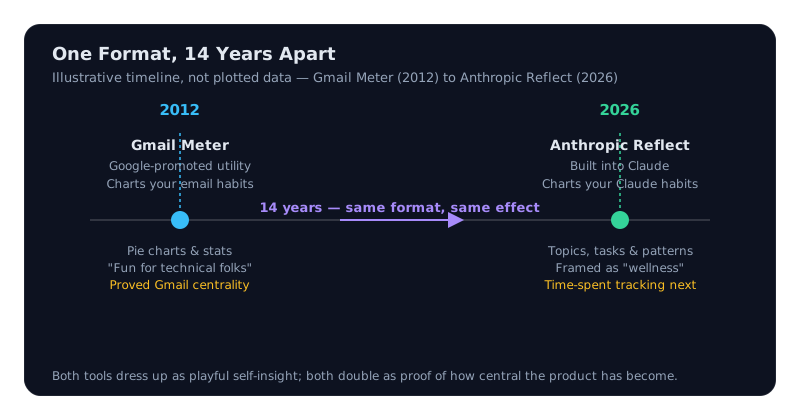
The comparison critics keep reaching for is Gmail Meter, the 2012 utility Google promoted to chart email habits into numbers and graphs. TechCrunch’s framing is blunt about what that tool actually did: “While navel-gazing over this type of data is fun for some technical folks, the meter also served as a way to display, in numbers and charts, how Gmail had become central to people’s digital lives.” Reflect follows the same shape — a fun, shareable, seemingly neutral data visualization that happens to double as evidence of dependency, delivered by the company with the most to gain from that dependency continuing.
Timing sharpens the critique further. TechCrunch situates the launch against a backdrop where “AI backlash and data center protests are making headlines” — meaning Reflect landed into a climate already primed to read any new AI feature skeptically, not a neutral moment where a wellness dashboard could be taken purely at face value. That context is also why the AI backlash keeps getting worse is worth reading alongside this story — Reflect isn’t happening in a vacuum, it’s happening while public trust in AI companies is actively eroding.
Wellness feature or retention feature — what’s the actual difference?
The honest answer is that Reflect can be both at once, and the two framings aren’t easy to separate from the outside. A break reminder is genuinely useful if you’re the kind of person who loses three hours to a Claude session without noticing. The same break reminder, shipped by the company whose growth depends on session frequency, is also a soft signal that light, sustainable use is the sanctioned use — which is a much lower bar to clear than “stop relying on Claude for tasks you used to do yourself.” Anthropic’s own privacy claim — that Reflect’s insights aren’t used for other purposes — addresses the data-handling half of the concern. It does nothing to address the behavioral half: a dashboard that shows you your own dependency, no matter how the underlying data is stored, still shapes how you feel about that dependency.
Break reminders and quiet hours address real burnout risk. The reflection prompt actively asks users to protect skills they don’t want to lose. Sensitive-topic summaries stay high-level, health-integration conversations are excluded outright, and Anthropic says the insights aren’t repurposed elsewhere.
A running visualization of “everything Claude did for you” reads structurally as a sunk-cost display — TechCrunch’s own reporting says it will make you “see Claude as a tool you’ve come to rely on.” The Gmail Meter precedent shows this exact format has served as a centrality-proof before. Time-spent tracking is coming next.
What does this mean for developers building on Claude?
If you’re building products on top of Anthropic’s models, Reflect is worth watching less as a consumer feature and more as a signal of where Anthropic thinks the product battle is headed: not just capability, but embeddedness. A dashboard that tracks task types and nudges recurring work into Projects is Anthropic doing habit formation on your behalf, whether or not that’s the stated goal. For teams building their own AI-assisted tools, the lesson isn’t “add a usage dashboard” reflexively — it’s that any interface showing users how much they rely on your product needs to be built with the same scrutiny you’d apply to a retention metric, because functionally, that’s what it is. Presenting it as wellness doesn’t change the incentive underneath it.
That tension — a tool that’s supposed to extend your capability quietly becoming a thing you can’t operate without — isn’t unique to Anthropic. It’s the same dynamic explored in what heavy AI use does to critical thinking, where the risk isn’t a single dramatic failure but a slow transfer of capability away from the user. Reflect is the first major consumer AI feature to make that transfer visible on a dashboard, and to frame the visibility itself as a form of care.
Do
- Read Reflect’s usage summaries as a genuine audit tool — use them to spot tasks you’ve fully offloaded and decide, deliberately, whether that’s fine
- Treat the reflection prompts as real questions, not a UI decoration — actually name the skill you don’t want to lose
- Watch for the time-spent metrics rollout; that’s the version of this feature that will most resemble Screen Time
Don't
- Assume a wellness label means the feature has no retention function — TechCrunch’s own reporting says otherwise
- Treat “insights aren’t used for other purposes” as covering the behavioral effect of seeing your own dependency charted
- Confuse quiet hours with a limit — nothing in Anthropic’s design stops usage, it only asks you to notice it
Where does this go next?
Reflect is a beta, and Anthropic has already signaled the roadmap: time-spent metrics are coming, which will push the dashboard from “what did you use Claude for” toward “how much of your day did Claude occupy” — a meaningfully sharper mirror. That’s also the point where the wellness-versus-retention debate stops being theoretical. A topic-and-task dashboard can plausibly be framed as self-insight. A running minutes counter, shipped by the vendor whose revenue scales with those minutes, is a harder sell as pure altruism, even with break reminders attached.
Anthropic didn’t build Reflect in secret and didn’t hide the reflection prompts or the Gmail Meter-style visualization behind marketing language that obscures what it does. That transparency is itself notable in an industry not known for it. But transparency about the mechanism doesn’t resolve the incentive underneath it: a company that needs Claude embedded in your daily workflow has now built the tool that shows you, in black and white, exactly how embedded it already is — and asked you to call that wellness.
Frequently asked questions
What is Anthropic's Reflect feature?
Reflect is a built-in Claude dashboard, launched July 9, 2026, that lets users track and visualize their Claude usage: topics discussed, task types, and overall AI habits. It ships with break reminders, quiet-hours settings, and periodic reflection prompts, and is in beta for Free, Pro, and Max users with memory enabled.
Does Reflect show how much time I spend on Claude?
Not yet. At launch on July 9, 2026, Reflect surfaces topics, usage patterns, and task types rather than raw time-on-app metrics. TechCrunch reported that time-spent tracking is planned for a future expansion, which would bring it closer to a full attention dashboard.
Why are critics comparing Reflect to Gmail Meter?
Gmail Meter was a 2012 Google-promoted utility that turned email habits into charts and statistics. TechCrunch's Sarah Perez drew the parallel because both tools dress up as playful self-insight while their real effect is demonstrating, in hard numbers, how central a product has become to someone's daily life.
Does Anthropic use Reflect data for anything else, like training or ads?
According to TechCrunch's reporting on Anthropic's announcement, the insights generated by Reflect are not used for other purposes beyond the dashboard itself. Sensitive conversations get summarized only at a high level, and any conversation tied to a health integration tool is excluded from those insights entirely, by design.
Is Reflect available to all Claude users right now?
It's in beta as of July 9, 2026, rolling out to Free, Pro, and Max tier users who have memory enabled. Anthropic has signaled more capabilities are coming, including time-spent metrics, suggesting the current release is a first version rather than the finished product.
/* Comments */
Comments are offline right now — we reconnect automatically, nothing is lost.