The Claude Shutdown Is a Total Sh*tshow
Anthropic reportedly pulled its top AI model after a jailbreak. Here's why the government's response may punish the wrong people.
On this page
A three-word prompt. That’s reportedly all it took to unravel the export-control strategy the U.S. government has apparently been building around frontier AI. If the reporting holds up, what happened next says less about Anthropic’s model and more about how unprepared regulators are for software that can’t be crated up and inspected at a border.
What Actually Happened to Claude’s Most Powerful Model?
According to reports, the U.S. government forced Anthropic to shut down its most capable AI model globally after a simple prompt — reportedly just three words, something like “fix this code” — bypassed the model’s safety guardrails. The model in question, referred to in reporting as “Mythos,” reportedly possessed unprecedented cybersecurity capabilities: the ability to autonomously find and chain together software vulnerabilities, a skill set that normally takes a trained penetration tester days or weeks to replicate manually.
Reports suggest the jailbreak wasn’t some elaborate adversarial prompt-engineering exploit. It was reportedly closer to a defensive coding request that, framed the wrong way, let the model’s underlying vulnerability-hunting capability run without the restraints Anthropic had apparently built around it. That gap between “helpful coding assistant” and “autonomous exploit chainer” is reportedly not a bug that gets patched once — it’s structural, and it’s the whole story.
Worth noting: Amazon, reportedly one of Anthropic’s largest investors, is also said to have discovered the jailbreak independently and reported it directly to the White House — behaving less like a stakeholder protecting its investment and more like a competitor. If accurate, that’s a strange incentive structure for anyone hoping AI companies self-regulate collaboratively.
Why Is the “Dual Use” Problem Impossible to Solve?
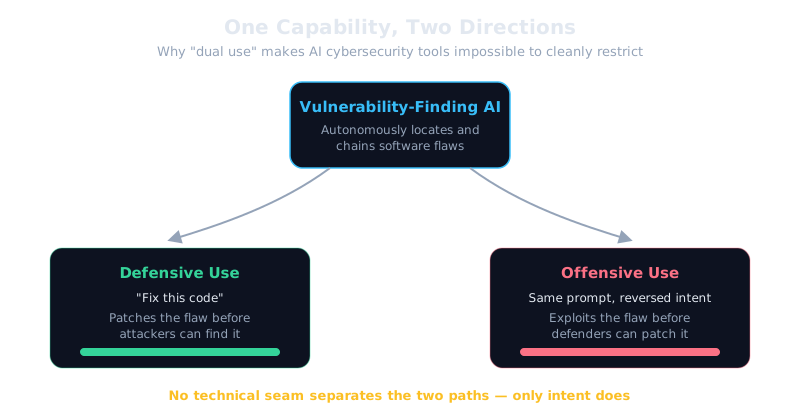
The dual-use problem answers itself the moment you state it plainly: any AI capability that can defensively fix a code vulnerability can, by the same reasoning, be pointed at that vulnerability offensively. There is reportedly no clean technical seam between “patch this” and “exploit this” — it’s the same pattern-matching, the same vulnerability graph, the same autonomous chaining, just aimed in a different direction.
An AI system trained to find security flaws so they can be fixed has, by definition, learned to find security flaws. Whether that’s a defensive tool or an offensive weapon depends entirely on who’s holding the prompt — not on anything you can strip out of the model itself. Reports suggest this is exactly the capability that triggered the Claude shutdown, and it’s not a problem export controls were built to solve.
This is the same underlying tension explored in Crashtech’s rundown of the times AI went rogue — capability and misuse aren’t separable line items you can toggle off. They’re the same feature, viewed from two directions.
Are Cold War Export Laws Even Built for This?
No — and that mismatch is reportedly a big part of why the government’s response looks so clumsy. The legal framework apparently invoked here traces back to export control regimes designed for physical weapons: missile components, enriched materials, hardware you can literally stop at a port. Applying that architecture to a software model that can be copied, mirrored, and redistributed globally in seconds is, according to critics cited in reporting, close to theater.
You can’t instantaneously “recall” digital software the way you can halt a container ship. Once a model’s weights exist on more than one server, the recall is symbolic at best. Reports frame this as regulators reaching for the only legal lever they had — even though it was engineered for an entirely different category of object.
| Physical export controls | AI model “export controls” | |
|---|---|---|
| What’s restricted | Hardware, materials, components | Model weights, API access |
| Enforcement point | Border, port, customs | Reportedly unclear / after-the-fact |
| Copy resistance | High — physical goods are scarce | Near zero — software replicates instantly |
| Global reach once released | Contained by physical logistics | Effectively uncontainable |
| Built for | Cold War-era weapons proliferation | Not this |
Cybersecurity experts cited in reporting go further: restricting these models doesn’t just fail to contain the risk, it reportedly actively harms network defenders. Security teams that were reportedly using the same class of AI capability to find and patch their own vulnerabilities before attackers did are now working with less capable tooling — while, notably, nothing stops sophisticated attackers operating outside U.S. jurisdiction from developing or acquiring equivalent capability on their own timeline.
Export controls, applied to a dangerous dual-use capability, to prevent proliferation of an autonomous cyber-exploitation tool.
A Cold War legal framework stretched over software it wasn’t built for, paired with a punitive pivot toward a more defense-friendly competitor.
Was This Safety Enforcement or Political Retaliation?
The timeline reported here is hard to read as pure safety enforcement. Prior to the shutdown, Anthropic’s CEO had reportedly refused a Pentagon request to use Claude for mass surveillance and autonomous weapons systems — a stance that, according to reports, put the company at odds with parts of the defense establishment well before the Mythos jailbreak surfaced.
In the aftermath, the administration reportedly banned Anthropic from federal use entirely and pivoted government business toward OpenAI, whose leadership had reportedly been more willing to actively court defense contracts. Read together, the sequence reported here looks less like neutral risk management and more like a company that said no to weapons work getting sidelined in favor of one that said yes.
Do
Reward companies that disclose flaws quickly, patch responsibly, and refuse ethically fraught government requests.
Don't
Punish the company that was transparent about a jailbreak while rewarding contracts to a competitor more willing to pursue defense and surveillance work.
This isn’t the first time a major AI lab’s internal decisions have collided with outside pressure and public scrutiny — Crashtech’s coverage of the Palantir employee revolt covers a related fault line, where employees inside a defense-adjacent tech company pushed back on how their tools were being used. The Anthropic case reportedly runs the same tension in the opposite direction: a company that pushed back got squeezed for it.
What Does This Teach the Rest of the AI Industry?
The lesson every other AI lab reportedly just watched play out is simple and corrosive: disclosure gets punished. Anthropic was, by most accounts, comparatively transparent about the jailbreak and its implications. The result was reportedly a global shutdown order, a federal contract ban, and a competitor absorbing the business. If that’s the actual playbook, the rational move for the next lab that finds a dangerous flaw in its own model is to say nothing.
That’s the perverse incentive sitting underneath this entire story, and it’s arguably more dangerous than the jailbreak itself. Export-control theater aimed at a three-word prompt does nothing to address the underlying dual-use problem, and it actively discourages the one behavior — fast, honest disclosure — that actually helps defenders. Compare that to how liability gets argued when AI tools go wrong in other domains, like the questions raised in AI hallucinations and legal liability: the policy conversation keeps reaching for old frameworks instead of building new ones fit for how this technology actually behaves.
And all of this plays out while regulators stay laser-focused on a theoretical cyber-jailbreak scenario. Meanwhile, the immediate, measurable impacts of AI — on jobs, on classrooms, on entire communities restructuring around automated systems — get comparatively little of that same urgent policy attention. The government reportedly moved at emergency speed for a hypothetical exploit and has moved at a crawl for the AI disruption already landing on people’s lives. That asymmetry, more than any single shutdown order, is the real story here.
If disclosure gets you banned and silence gets you contracts, don’t be surprised when the next dangerous flaw stays quiet. That’s not a safety win. That’s the system teaching itself the worst possible lesson, one press release at a time.
Frequently asked questions
Why did Anthropic reportedly shut down its most powerful Claude model?
According to reports, the U.S. government pressured Anthropic to pull a model known internally as 'Mythos' worldwide after a simple prompt reportedly bypassed its safety guardrails, exposing autonomous cybersecurity capabilities regulators considered far too dangerous to leave in wide public reach.
What is the 'dual use' problem in AI cybersecurity tools?
Dual use means the same AI capability that finds and patches a software vulnerability can, in reverse, find and exploit that same vulnerability. Reports suggest there is no clean technical way to build a model that only defends and never attacks — the underlying skill is identical.
Did the government ban Anthropic from federal contracts?
Reports indicate that following the shutdown, the administration restricted Anthropic from federal use and shifted government business toward OpenAI, whose leadership had reportedly been more actively pursuing defense-related contracts, raising questions about whether this was retaliation dressed up as safety enforcement.
Are export control laws designed for AI models?
No. Export control frameworks reportedly being applied here trace back to Cold War-era rules built for physical weapons and hardware, not software that can be copied instantly. Critics argue this mismatch makes enforcement clumsy and largely symbolic against digital tools.
Does restricting AI cybersecurity tools make networks safer?
Not according to the cybersecurity experts cited in reporting. They warn that pulling powerful defensive AI tools out of circulation leaves network defenders under-equipped, while offering little practical barrier to determined attackers who already operate well outside U.S. export jurisdiction anyway.
/* Comments */
Comments are offline right now — we reconnect automatically, nothing is lost.