
Google’s AI Search Just Exposed the Whole Sh*tshow
AI Overviews cite sources that don't back their claims and kill 93% of outbound clicks. Here's why Google can't opt users out.
On this page
Google didn’t tweak its results page. It replaced the fundamental contract of search — type a query, get a ranked list, click through, decide for yourself — with a single authoritative paragraph generated by a model that cannot reliably show its work. Users noticed immediately, and a lot of them are furious.
For twenty-five years, “Google it” meant Google handing you a ranked menu of places to go read. The judgment call — which source to trust — stayed with you. AI Overviews collapse that menu into one synthesized answer sitting above the links, and for a huge share of queries, the links never get opened at all. That’s not a UI refresh. It’s a change in what search is, and the backlash is the sound of millions of users realizing it happened without their consent.
Why Are Users Actually Rebelling Against AI Overviews?
Because Google shipped an interface change that fundamentally alters how people interact with information, and did it without a real off switch. Search stopped being a retrieval tool you control and became an answer engine that talks at you — and the reaction wasn’t quiet.
Reports indicate downloads of DuckDuckGo, the privacy-focused search engine that still defaults to a plain results list, surged roughly 30% in the wake of the rollout. That’s not noise. A 30% jump in migration to a competitor is a market signal that a meaningful slice of Google’s user base would rather leave the platform than accept the new default. People weren’t rejecting AI in the abstract — they were rejecting having it forced into the one product they used dozens of times a day, with no durable way to say “no thanks.”
This isn’t really about AI Overviews being bad software. It’s about a monopoly-scale product changing its core behavior for billions of users at once, with adoption treated as inevitable rather than optional. The backlash is a demand for agency, not a rejection of the technology itself.
When Google Says 91% Accurate, What Does That Actually Mean at Scale?
It means the “acceptable” failure rate still produces an enormous volume of wrong answers, because Google’s search volume is so large that even a small error percentage becomes a massive absolute number. Accuracy claims that sound reassuring in a press statement look very different once you do the arithmetic.
Google has pointed to a roughly 91% accuracy figure for its AI Overviews. Take that number at face value and apply it to reports of Google handling on the order of 5 trillion searches: a 9% failure rate isn’t a rounding error, it’s a firehose. Spread across an hour of global query volume, that gap in accuracy math implies around 57 million wrong answers generated every single hour — stated with total confidence, formatted identically to the correct 91%, and indistinguishable from a right answer unless you already know better.
Has Google Quietly Shifted from “Relevant” to “Correct” — And Is That the Real Problem?
Yes, and it’s the pivot the rest of this backlash sits on top of. A search engine that shows you ranked links is making a claim about relevance — “these pages are likely to have what you’re looking for.” An AI Overview that states an answer in a paragraph is making a claim about correctness — “this is what’s true.” Those are very different promises, and Google’s interface now makes the second one by default, on every query, whether or not the underlying model can back it up.
That distinction is why the citation problem below matters so much more than it would have in the ten-blue-links era. A ranked list that points you to a bad page is annoying. An authoritative paragraph that states a wrong fact — and looks exactly as confident as a right one — is a different category of risk entirely. This is the same correctness-without-verification failure mode covered in our piece on AI hallucinations and legal liability, just moved from a chatbot into the world’s default information gateway.
Even when the underlying answer is right, the sourcing frequently isn’t. Reports have found that in 56% of cases, the citation attached to an AI Overview claim points to a page that doesn’t actually support what the AI said it supports. The little link that’s supposed to let you verify the claim is, more often than not, decorative.
| What search used to promise | What AI Overviews promise now |
|---|---|
| A ranked list of relevant pages | A single stated answer |
| You decide what to trust | Google decides, then shows you a footnote |
| Wrong page = you notice and move on | Wrong answer = stated with full confidence |
| Citation link = the actual source | Citation link = correct only ~44% of the time (per reports) |
Why Do Publishers Say AI Overviews Are Killing Their Traffic?
Because the AI answer satisfies the query directly on Google’s own page, so the user has no reason to click through anymore — and reports suggest that’s now happening on an overwhelming majority of searches. The traffic that used to flow to the sites that wrote the original reporting, ran the tests, or built the guide simply stops arriving.
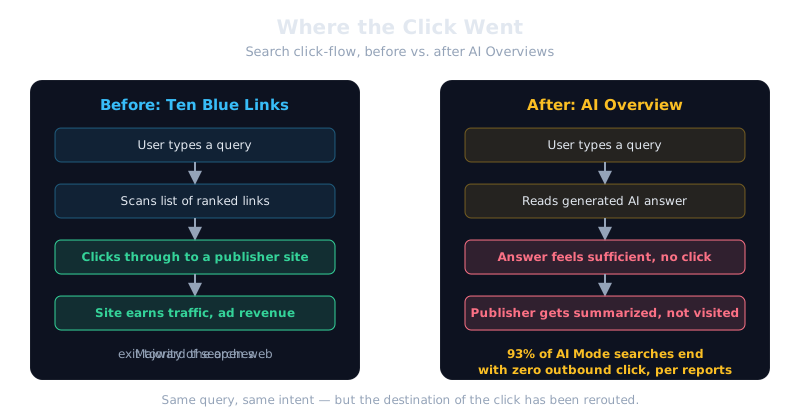
Reports peg the number at roughly 93% of AI Mode searches ending without a single outbound click. If nine out of ten searches never send a visitor anywhere, the economic model that funded the open web for two decades — publish useful content, earn a visit, earn a fraction of an ad dollar — breaks. Below is the shape of that shift:
Do
- Treat AI Overviews as a distribution channel you have to design for, not just around
- Structure content so the direct answer is quotable in one self-contained paragraph
- Track “AI-referred impressions” separately from click-through traffic, since the two now diverge sharply
Don't
- Assume the old “rank #1, get the click” model still applies uniformly
- Bury your actual answer under throat-clearing intros AI summarizers will skip anyway
- Ignore citation-accuracy monitoring — a wrong AI summary of your own page can now misrepresent you to millions
That’s the paradox at the center of this whole mess: Google’s AI Overviews are trained on and summarize the work of journalists, bloggers, and independent publishers — then route the resulting attention back to Google, not to them. Summarizing content without driving traffic doesn’t just dent a metrics dashboard; it defunds the very creators whose reporting the model depends on to stay current. It’s the search-traffic version of strip-mining: extract the value, leave the source depleted. Our developer’s guide to GEO, AEO, and LLMO covers the tactical response — how to structure content so it still gets cited, even when it doesn’t get clicked.
Why Won’t Google Add an Opt-Out — And What Does the Backlash Actually Prove?
Because Google’s AI adoption numbers are a story it tells shareholders to justify its AI infrastructure spending, and a mass opt-out would undercut that story — so the backlash becomes a demand for the agency Google won’t hand over voluntarily. A simple toggle to permanently disable AI Overviews would be trivial to build. The reason it doesn’t durably exist isn’t technical.
There’s a deeper layer underneath the accuracy and traffic numbers, too: the AI’s decision-making is genuinely opaque. Users can’t see why the model weighted one source over another or what it silently left out. That opacity forces people to trust an unverifiable output or fall back to the manual research the interface was supposed to eliminate — the same trust-without-visibility problem our coverage of Pew’s big-tech AI reality check found across the industry, not just at Google.
Google’s own accuracy claim, run through its own search volume, produces an error count too large to quietly absorb.
More than half the time, the link attached to an AI answer doesn’t actually back up what the answer says.
The DuckDuckGo surge, the accuracy math, the citation mismatch, and the traffic collapse aren’t four separate complaints — they’re one complaint wearing four hats: a tech monopoly imposed a fundamentally different product on billions of people and called it an upgrade, without giving them the agency to say no. Search built its credibility by pointing you toward the truth and letting you verify it yourself. An answer engine that states the truth on your behalf, gets it wrong at scale, and starves the publishers who did the original work isn’t a refinement of that model — it’s a different product wearing the old one’s name, and the backlash is what happens when people notice the substitution before the shareholder letter admits it.
Frequently asked questions
Why did DuckDuckGo downloads surge after Google's AI Overviews rollout?
Reports indicate DuckDuckGo downloads jumped roughly 30% as users actively sought an AI-free search experience. The surge reflects a rebellion against Google forcing AI-generated summaries above traditional results, with no simple, permanent way for users to disable them and return to a plain ranked list.
How accurate are Google AI Overviews really?
Google has claimed around 91% accuracy for AI Overviews. Applied to the trillions of searches Google reportedly processes, even that 9% failure rate translates into tens of millions of wrong answers generated every hour, at a scale no human review team could ever catch.
Do Google AI Overviews cite sources correctly?
Not reliably. Reports have found that in over half of cases, the cited source does not actually support the claim the AI Overview attributes to it. That mismatch means the citation link functions more as a trust signal than as verifiable proof.
Do AI Overviews hurt website traffic?
Yes. Reports suggest roughly 93% of AI Mode searches end without a single outbound click. Because Google's summaries answer the query directly on the results page, publishers who created the underlying information see visits, ad revenue, and referral traffic collapse even when their reporting was accurate.
Can users turn off Google AI Overviews?
Not in any durable, official way. Workarounds exist, but Google has not shipped a persistent opt-out. AI adoption numbers are a metric Google reports to shareholders to justify its infrastructure spending, so a mass opt-out button would undercut its own investment story.
Keep reading

Meta’s New Feed Controls Make a Promise. The Ranking System Still Decides.
Facebook’s natural-language feed controls make preference editing easier, but the platform still translates each request into ranking signals.

RTX Spark Could Bring AI Development to Your Desk—With New Tradeoffs
NVIDIA’s compact GB10 system promises local coding and model work, but shared memory, ARM software support and workload fit still decide its value.

Reflection Beam Is Open-Weight. Your Deployment Still Has a Memory Problem.
Beam’s Apache-licensed weights widen access, but 501 billion total parameters make hosting, memory and evaluation the real decisions.
/* Comments */
Comments are offline right now — we reconnect automatically, nothing is lost.