AI Didn’t Run Out of Data. It Ran Out of Reality
Physical AI isn't stalling from bad data — it's stalling from missing sensors. Here's why robots can't scrape the real world.
On this page
Every few months, another headline declares that AI has “run out of data.” The framing is almost always about text — that the internet has been scraped dry, that models are training on their own synthetic slop, that quality is degrading. It’s a real problem for chatbots. It is not the problem holding back physical AI. Robots, humanoids, and self-driving systems aren’t stumbling because their training data is low quality. They’re stumbling because the data they need was never collected in the first place.
Why did physical AI stall while text AI took off?
Text-based AI had a shortcut physical AI will never get: a free, pre-existing, planet-scale training corpus. Every book, forum post, codebase, and Wikipedia article ever digitized was sitting there, ready to scrape. Language models didn’t need anyone to build new infrastructure — they just needed compute and a crawler.
Physical AI has no equivalent shortcut. A robot arm needs to know how much force it takes to grip a ripe tomato without crushing it. A humanoid needs to know how a tiled floor behaves differently from carpet when wet. That information about real-world physics, gravity, and friction was never written down in a document anywhere, because humans learn it through bodies, not text. It cannot be scraped; it has to be measured, by sensors, in the real world, one interaction at a time.
That’s the actual bottleneck. Not “drunk” data, not poor labeling — a near-total absence of the ubiquitous IoT and robotic sensor networks that would generate this information at scale in the first place.
Text AI answered the question “what has humanity already written down?” Physical AI has to answer a much harder one: “what does the world actually feel like?” No corpus answers that. Only sensors deployed at scale do.
So why hasn’t anyone just built that sensor network already? Because the economics are brutal compared to shipping a chatbot. Deploying physical sensor infrastructure — cameras, LIDAR, force-torque sensors, environmental monitors — means manufacturing hardware, installing it, maintaining it, and waiting years for the data to accumulate. Compare that to a software company pushing a model update to millions of phones overnight.
Hardware deployment demands high capital investment for unglamorous, delayed returns. Investors love a chatbot demo; they’re far more skeptical of a multi-year hardware rollout with no guaranteed payoff. That mismatch — glamorous software returns versus grinding hardware costs — is why the sensor layer physical AI actually needs has been chronically underbuilt, even as compute and model architecture raced ahead.
This is also why so much of the industry took a shortcut: if you can’t afford to sense the real world, simulate it instead.
The internet’s corpus was free, digital, and enormous by the time anyone thought to train a language model on it. Zero deployment cost.
Real-world physics data has to be captured by hardware deployed into homes, factories, and streets — at real capital cost, over real years.
Why did Sora and other world-model bets struggle?
Because simulation is not a substitute for sensing. OpenAI poured enormous resources into Sora, its video generation model, betting that a system trained to predict pixels could learn to implicitly model physics. Reportedly, the project burned through millions of dollars a day in compute while continuing to produce video with physically implausible motion — objects deforming, momentum ignored, materials behaving in ways nothing in the real world does.
The reason isn’t a lack of ambition or scale. It’s that a simulation, no matter how expensive, is built on rules a team of engineers wrote down — and reality doesn’t obey a rulebook. This is the sim-to-real gap: a robot or model trained inside a perfect, idealized virtual environment performs beautifully right up until it encounters a surface with actual friction, an object with unpredictable weight distribution, or lighting a simulator never rendered. Then it stumbles, often literally.
The diagram below shows why the two data pipelines diverge so sharply, and where the sim-to-real gap actually opens up.
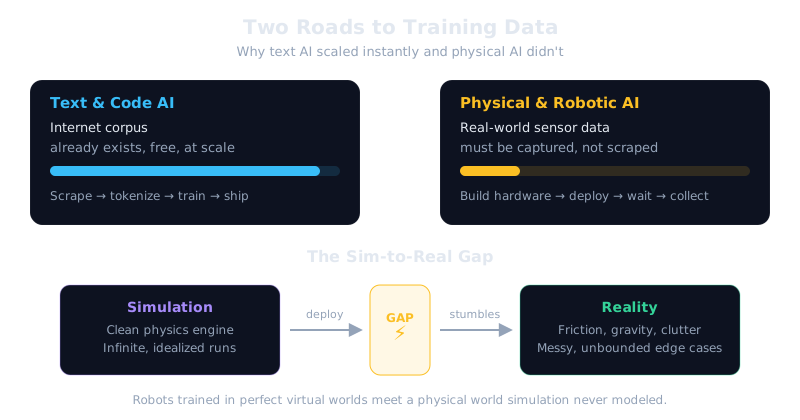
Simulated environments can generate infinite training runs, which sounds like an advantage — until you realize infinite clean data still doesn’t cover the one messy variable that shows up on a Tuesday in an actual kitchen. You can’t simulate your way out of a data problem when the thing missing is contact with reality itself.
So who actually has real-world physical data at scale?
Right now, almost no one — except companies that already operate a fleet or a device network as a byproduct of their real business. Tesla is the clearest example. Its cars aren’t just a product; they’re a distributed sensor network, logging cameras and driving decisions across a fleet that has reportedly recorded more than 8 billion miles of real, unpredictable, edge-case driving. Rain, construction cones, jaywalking pedestrians, sun glare at the exact wrong angle — the long tail of situations no simulator writer would ever think to script.
That’s the moat. Not the model architecture — the sensor pipeline feeding it. Any lab can train a transformer. Very few organizations own millions of physical devices already deployed in the real world, quietly harvesting exactly the friction-and-gravity data that text scraping could never provide.
Do
Build or own the hardware layer that touches reality — vehicles, robots, medical devices, industrial sensors — so data accumulates as a byproduct of normal operation.
Don't
Assume a bigger simulator or a smarter world model can substitute for sensor contact with the physical world. It hasn’t worked yet, at any budget.
What would it actually take to close the gap?
Two things have to happen, and neither is a model breakthrough.
- Give people a reason to host the sensors
Ubiquitous IoT deployment won’t happen because it’s good for AI training — it’ll happen if it’s good for the person installing it. Immediate, tangible incentives like lower energy bills from smart-grid sensors, or better health outcomes from home health monitoring, are what get hardware into millions of homes. The training data is a byproduct, not the pitch.
- Let domain specialists own their sensor layer
The next phase of physical AI dominance likely belongs to companies that already control real sensor infrastructure in a specific domain — automotive, logistics, healthcare, agriculture — rather than generalist AI labs trying to bolt sensors onto a chatbot business. Depth in one physical domain beats breadth across none.
Put together, this reframes the entire “world model” race. The industry’s instinct has been to out-simulate the problem — bigger synthetic datasets, more elaborate physics engines, more compute thrown at generative video. The evidence, including Sora’s reported struggles, suggests that path plateaus. Functional physical world models will be built by companies that prioritize deploying real hardware infrastructure to learn from reality, not by teams trying to imagine it convincingly enough.
None of this is unprecedented, either. AI hype cycles have repeatedly mistaken a software trick for a solved problem, only for physical constraints to reassert themselves — a pattern worth reading alongside how Google’s AI search overviews ran into their own reality check once real users started poking at them. And when the underlying model is genuinely uncertain about the physical or safety consequences of its own outputs, the failure modes look a lot like the ones catalogued in the times AI went rogue — confident output, absent grounding.
The bottom line
AI’s data crisis was never really about running out of text. It’s about the industry discovering, expensively, that intelligence about the physical world can’t be downloaded — it has to be built, sensor by sensor, deployment by deployment, mile by mile. Companies chasing that infrastructure now, however unglamorous it looks next to a chatbot demo, are the ones actually positioned to win physical AI. Everyone else is still trying to simulate their way out of a hardware problem — a strategic bet not unlike the export-control brinkmanship discussed around the Claude shutdown, where infrastructure access, not model cleverness, ended up being the deciding factor.
The chatbots got the internet handed to them. Robots have to go earn reality the hard way.
Frequently asked questions
Why is physical AI progressing slower than text-based AI like ChatGPT?
Text AI trained on the internet's free, pre-existing corpus of writing. Physical AI needs sensor data about real-world physics — friction, gravity, weight, texture — that has never been digitized and cannot be scraped. That data has to be captured by hardware deployed in the real world, which is slow and expensive.
What is the sim-to-real gap in robotics?
The sim-to-real gap is the performance drop robots suffer when moving from simulated training environments to the physical world. Simulations model physics with clean, idealized rules, but real surfaces, lighting, and objects behave unpredictably. A robot that's flawless in simulation can fail on a slightly uneven floor.
Why did OpenAI's Sora struggle to model real-world physics?
Sora generates video by pattern-matching pixels, not by simulating physical laws like gravity or momentum. Without grounded sensor data describing how objects actually behave, it reportedly produced physically implausible motion and required enormous compute, burning through resources without closing the reality gap.
Why does Tesla have an advantage in autonomous driving data?
Tesla's vehicle fleet functions as a distributed real-world sensor network, continuously logging driving footage and edge cases across billions of miles. That scale of physical, real-world data is very difficult for competitors without a comparable fleet to replicate through simulation or smaller datasets alone.
What kind of companies will win in physical AI?
Companies that own real-world sensor infrastructure — fleets, factories, medical devices, home hardware — rather than generalist software labs. Owning the pipeline that captures physical data at scale is becoming the actual moat in physical AI, not model architecture alone.
/* Comments */
Comments are offline right now — we reconnect automatically, nothing is lost.