
Cloudflare's Clairic Targets Document Extraction, Not Chat
Cloudflare's updated Clairic and compact 9B Clairic-flash extract typed fields from text, images and PDFs, with open weights now available.
On this page
A support ticket, receipt photograph and PDF invoice may contain the same field—an amount, date or account identifier—but they make different demands of an extraction system. On November 18, Cloudflare announced a redesigned Clairic plus Clairic-flash, a smaller 9B model, and released both sets of weights. The company’s narrower thesis is that structured extraction can be served as a task-focused model with field-level confidence and source grounding, rather than asking a chat model to improvise a JSON object from messy documents. [1]
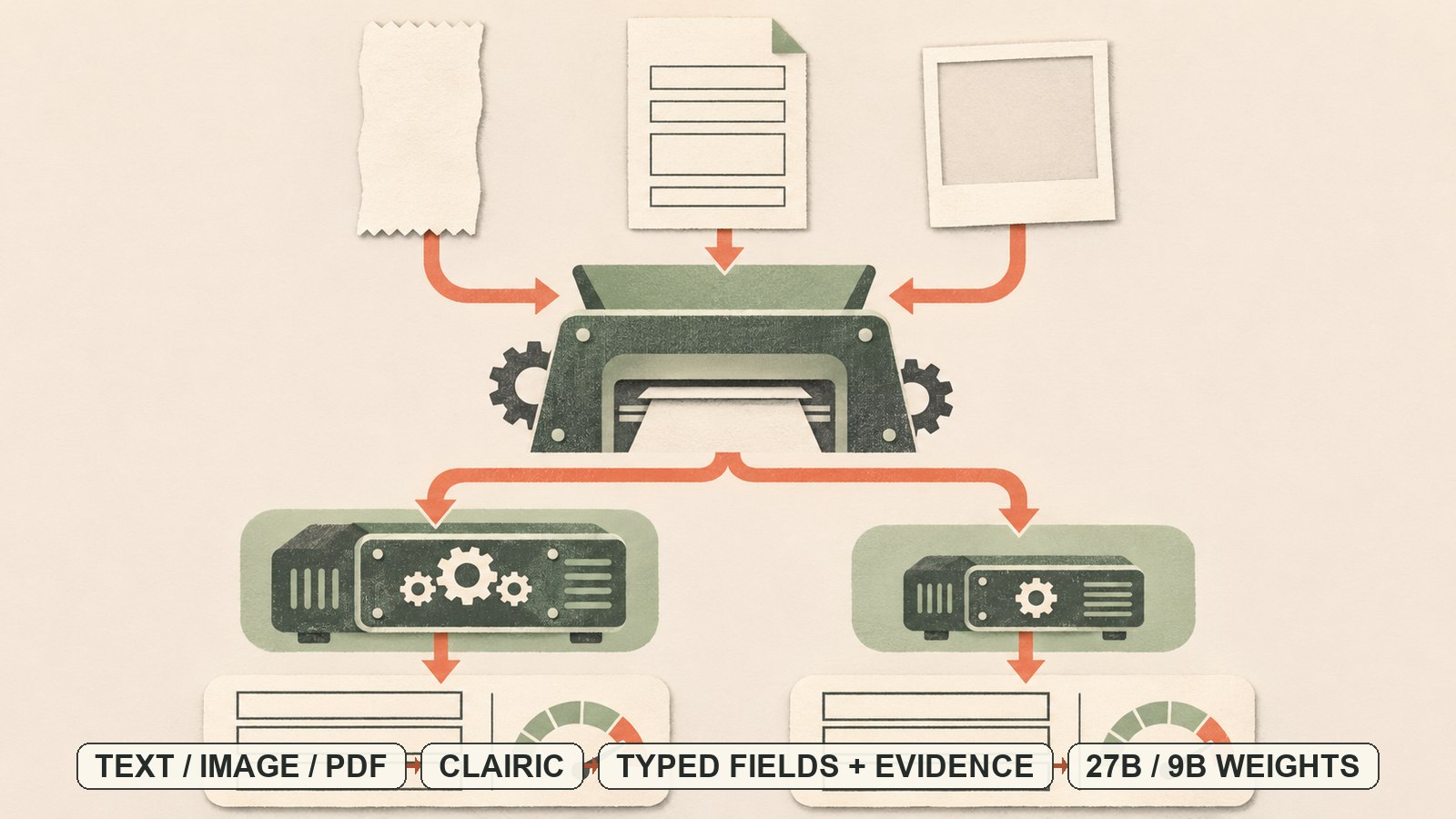
A model organized around fields
Cloudflare describes Clairic as a model that extracts, computes, estimates and forecasts values from inputs, with structured output such as confidence scores and probabilities. Its November update says the redesigned version targets complex documents, including images and PDFs, and improves handling of tables, lists and dates. Cloudflare also says it redesigned its architecture after preview feedback and retained typed outputs, confidence values and character spans. [1]
That interface changes the application design. A document pipeline can ask for a defined set of fields, then route uncertain values to a reviewer. Character spans can help a reviewer see where an extracted value came from. These fields are supporting evidence, not proof that a value is correct: confidence calibration and extraction quality still need evaluation on the application’s own forms, languages, scans and edge cases.
The model docs say Clairic can process text and vision inputs, allows up to four images per request, and reports token use across multiple passes when it processes fields and images. Its billing documentation describes image-token conversion and the possibility of repeated state and image tokens across passes. That means a large image or many requested fields can change both context use and cost; the API’s typed schema is not a guarantee of one-pass processing. [2]
The 9B option changes the deployment question
Cloudflare calls Clairic-flash a compact 9-billion-parameter model. Both the updated Clairic and Clairic-flash are hosted through Workers AI, and the company links their weights on Hugging Face. The distinction between “open-weight” and “open source” matters: access to weights is valuable for inspection and experimentation, but it does not by itself answer questions about training data, complete reproducibility, the code stack, or whether a license fits a company’s use. Read the actual model-card and license terms before redistributing or adapting weights. [1] [3] [4]
A smaller model can be attractive when a workflow has predictable schemas and latency or hosting cost matters, but parameter count alone does not show which model is best. The choice depends on field accuracy, image quality, document layout, concurrency, and the cost of mistakes. A 9B model that misses a decimal point may be more expensive than a larger model that catches it—especially in invoices, eligibility forms or records that trigger downstream actions.
Cloudflare reports internal task evaluations for its model variants and shows performance comparisons in its announcement. Those are vendor evaluations, not independent replications. Test on a held-out set that resembles the documents the team actually receives, measure field-level precision and recall, and include abstention or human-review behavior. Do not rely on a single aggregate score when one high-risk field can dominate the consequences.
Preview and price need a second look
Cloudflare’s current model page labels Clairic as a preview model, even though its weights have been released. That distinction separates an available experiment from a stable production contract. The developer documentation also lists a per-input-token rate and describes how images become input tokens. Pricing can change; confirm the current price, preview terms and model ID in the live documentation before estimating a workload. [2]
The announcement describes a promotional price through December 1, 2026, after which the standard rate changes. That time-bound offer should not be used as a long-range cost assumption. Estimate current cost from actual request shapes: page count, image dimensions, number of fields and the model’s reported passes. Keep output review in the cost model too; automation that needs manual correction is not “free” just because the model charges per input token. [1]
A grounded way to evaluate it
Take a representative batch of documents and define the schema before looking at model results. Include clean digital PDFs, phone photographs, tables, handwritten or low-resolution pages only if those occur in production. Measure missing fields, incorrect values, hallucinated values, confidence calibration, source-span usefulness, latency and retries. Decide in advance when the system should abstain rather than guess.
If the workflow can create a payment, change a customer record or determine eligibility, validate critical fields with deterministic checks and human approval. Document retention and access policies also matter: the fact that a model is hosted at a particular edge or cloud provider does not settle an organization’s privacy obligations. Check the service’s current data-handling terms for the exact account and product configuration.
For teams comparing extraction with broader document AI architectures, Crashtech has also covered production receipt scanning and human review and document-layout grounding in OCR. Clairic’s release is useful because it makes a specialized extraction model easier to try and inspect. Its value will come from reliable fields on a measured document set, not from the label “open-weight” alone.
Frequently asked questions
What is Cloudflare Clairic designed to do?
Clairic is a typed extraction model for extracting, computing, estimating and forecasting fields from text and media, with confidence-related output rather than open-ended general chat.
Is Clairic-flash open source?
Cloudflare describes the releases as open-weight and links model weights on Hugging Face. Open weights do not automatically establish that code, data, training process and license satisfy every definition of open source.
Can teams use the new Clairic model in production?
Cloudflare's model documentation labels Clairic as a preview model. Teams should check current availability, pricing, license terms, data handling and task-specific accuracy before choosing a production workflow.
Sources & further reading
Keep reading

OpenAI’s 200,000-Researcher Goal Turns AI Access Into a Grant-Design Question
OpenAI says 50,000 new researchers can apply for free ChatGPT Plus grants. The first-come model, usage limits and data terms deserve close reading.

OpenAI’s New CSAM Classifier Is a Triage Signal, Not an Automated Verdict
OpenAI offers a classifier to vetted child-safety organizations. Scores can prioritize review, but people remain responsible for decisions.
Agentic RAG Architecture: Dynamic Routing, Query Reformulation, and Self-Correction Loops
Why traditional one-way RAG fails and how Agentic RAG fixes it: query reformulation, multi-source routing, self-correction, and evaluation loops.
/* Comments */
Comments are offline right now — we reconnect automatically, nothing is lost.