topic: dev-practices
author: Crashtech Editorial
date: Oct 7, 2026 · read: 2 min
updated: October 8, 2026
---
Context Rot and Coding-Agent Loops: Recovering Without Losing Work
Long contexts and repeated failed edits derail coding agents. Bounded retries, useful summaries and recoverable checkpoints help, without guaranteeing success.
On this page
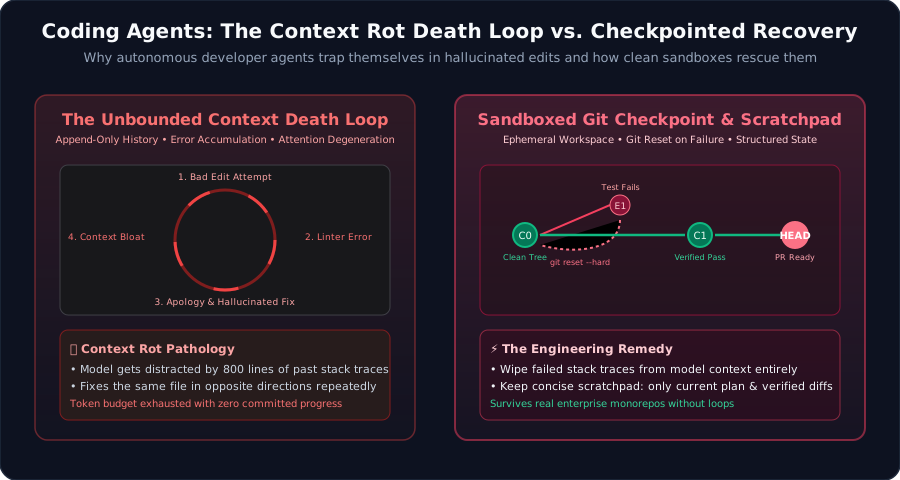
Conceptual architecture; arrows show relationships, not measured latency, energy or safety guarantees.
Capacity is not reliable recall
A large context window can hold many files and logs. That does not mean the model will consistently use the most relevant passage. The Lost in the Middle study examined sensitivity to where relevant information appears in long inputs. It supports caution about retrieval and context layout, not a diagnosis that every coding failure has the same cause. [1]
A useful working summary identifies the objective, constraints, changed files, latest failure and the next hypothesis. Keep the original evidence available so a mistaken summary can be checked.
Benchmarks measure a defined task
SWE-bench is based on real GitHub issues and repository changes, not merely synthetic coding puzzles. Results depend on the benchmark variant, agent setup, evaluation date and tools. A percentage without those details is a poor basis for predicting performance on an unfamiliar production system. [3]
An agent can pass a curated evaluation and still struggle with undocumented interfaces, absent credentials or unclear requirements. Those failures need investigation rather than a claim that benchmark performance is meaningless.
Recoverable checkpoints beat blind rollback
Before an agent edits a repository, identify dirty files and preserve unrelated work. A separate checkout or checkpoint can make experiments recoverable. A branch name alone does not protect uncommitted changes.
After a failed check, distinguish a useful partial change from a mistaken approach. Revert only the relevant experiment when appropriate. Automatically running a hard reset in the user’s working tree can destroy the very work the agent was meant to help complete.
Stop repeating the same experiment
Set practical limits on repeated failures, tool output and cost. When the same error recurs, inspect the assumption behind the attempted fix. A missing dependency, wrong interface or unavailable service will not be solved by endlessly rewriting a nearby line.
Anthropic’s agent guidance emphasizes simple patterns, clear tool interfaces and feedback from the environment. It does not require a universal subagent handoff or a fixed maximum number of calls for every task. [2]
Choose the smallest recovery step that produces new evidence. Context management can improve the process, but successful engineering still depends on understanding the system and verifying the resulting behavior.
Frequently asked questions
Does a larger context window prevent agent loops?
No. Context capacity and effective use of context differ. Relevant evidence, task state and a sensible recovery policy still matter.
Should every failed test trigger git reset --hard?
No. Preserve user work and inspect the failure first. A destructive reset is only appropriate inside a disposable, recoverable environment whose contents are understood.
/* Comments */
Comments are offline right now — we reconnect automatically, nothing is lost.