
The Embedding Model Decides What Your RAG Can Answer: Retrieval Failures and Migration Costs
Why changing your embedding model requires re-indexing millions of vectors, the limits of cosine similarity, and zero-downtime migration.
On this page
When software teams design a Retrieval-Augmented Generation (RAG) system, the debate almost always focuses on the generative model: Should we use Claude 3.5 Sonnet, GPT-4o, or DeepSeek-V3?
The embedding model, by contrast, is treated as an afterthought. A developer selects whatever default embedding model is featured in their vector database tutorial (text-embedding-ada-002 or all-MiniLM-L6-v2), generates vectors for 5 million company documents, and deploys to production.
Six months later, users complain that the AI chatbot cannot find answers to obvious questions.
The generative model is brilliant, but it is starving: the retrieval stage consistently feeds it the wrong paragraphs.
In a RAG architecture, the embedding model is the absolute ceiling of system capability. The generative model can only synthesize what the retriever finds. If your embedding model cannot represent domain-specific nuances, the best reasoning model in the world will hallucinate.
Worse, swapping an embedding model is one of the most operationally expensive migrations in machine learning: because vector spaces are non-interoperable, changing models requires re-embedding 100% of your historical documents from scratch.
+--------------------------------------------------------------------------+
|                  THE INCOMPATIBLE VECTOR SPACE TRAP                      |
|                                                                          |
|  Model A (e.g., text-embedding-3-small): 1,536-dimensional space         |
|  Model B (e.g., BGE-Large-EN):           1,024-dimensional space         |
|                                                                          |
|  You CANNOT query Model B's vector against Model A's index!              |
|  Cosine similarity between different models produces pure mathematical   |
|  noise. Migration demands complete corpus re-indexing.                   |
+--------------------------------------------------------------------------+
The Anatomy of Embedding Retrieval Failures
Why do generic embedding models fail on enterprise text? Standard dense embedding models compress an entire 500-word paragraph into a single vector of numbers. This compression breaks under four common data patterns:
1. The Asymmetric Query Trap
In search, user queries are short (“401k match limit”), while document passages are long (a 4-page HR benefits handbook).
- In symmetric vector models, the vector for a 3-word query lands far away from a 500-word detailed legal paragraph in vector space, causing retrieval failure.
- Modern architectures require Asymmetric Embedding Models (e.g., models trained with explicit
query:andpassage:prefix instructions) that project questions and answers into shared retrieval coordinates.
2. Lexical Negation Blindness
Dense vector similarity calculates cosine distance in semantic space. It struggles with microscopic negation tokens:
- Passage A: “The server must reboot after installing the driver.”
- Passage B: “The server must NOT reboot after installing the driver.” To a generic embedding model, these two sentences share 95% identical vocabulary and context. Their vectors are almost indistinguishable. If a user asks “When should I avoid rebooting?”, the model frequently retrieves Passage A, giving dangerously wrong instructions.
3. The Number and Acronym Void
Dense embeddings are trained on general internet prose. In specialized enterprise verticals (semiconductors, finance, aerospace), documents are saturated with part numbers, error codes, and financial tickers (ERR_4091_TIMEOUT, NVDA_2026_CALL_120).
- Vector models tokenize these strings into fragmented byte-pair syllables, blurring their meaning.
- Pure vector search fails where classical BM25 lexical search succeeds instantly.
The Solution: Hybrid Search (Sparse + Dense)
To eliminate retrieval failures, production RAG systems abandon pure vector search in favor of Hybrid Search with Reciprocal Rank Fusion (RRF):
[User Query: "Error 4091 database timeout on Azure"]
                         |
           +-------------+-------------+
           |                           |
           v                           v
  [BM25 Lexical Engine]       [Dense Vector Engine]
  - Matches exact code "4091" - Matches semantic concept "timeout"
  - Inverted index lookup     - HNSW cosine similarity
           |                           |
           +-------------+-------------+
                         |
                         v
          [Reciprocal Rank Fusion (RRF)]
                         |
                         v
           [Top-20 Combined Candidates]
                         |
                         v
[Cross-Encoder Reranker] ---> Top-5 Fed to LLM Context- BM25 Lexical Search: Catches exact keyword matches, SKU numbers, acronyms, and negated strings.
- Dense Vector Search: Catches semantic synonyms, conceptual paraphrasing, and multilingual queries.
- Cross-Encoder Reranker (Cohere / BGE-Reranker): Evaluates the top 20 combined candidates through a deep transformer that computes cross-attention between query and passage, outputting a calibrated relevance score.
The Cost of Migration: The Dual-Index Strategy
What happens when your team outgrows an obsolete embedding model and needs to upgrade to a state-of-the-art model?
Because vector representations are mathematically locked to the specific neural weights that generated them, you cannot perform an in-place upgrade. You cannot embed new documents with Model B while querying an index containing vectors from Model A.
Achieving a zero-downtime migration requires the Dual-Index Migration Pattern:
[Phase 1: Dual-Write Pipeline]
Every incoming document update is embedded twice:
- Index A (Legacy Embedding Model)
- Index B (New Embedding Model)
                               |
                               v
[Phase 2: Historical Corpus Backfill]
A batch worker reads all 5,000,000 historical documents,
runs them through New Embedding Model, and populates Index B.
                               |
                               v
[Phase 3: Shadow Evaluation & Quality Verification]
Gateway duplicates live search queries:
Sends to Index A (Live) and Index B (Shadow).
Compares retrieval recall and NDCG scores.
                               |
                               v
[Phase 4: Atomic Traffic Cutover]
API Gateway flips query routing from Index A to Index B.
                               |
                               v
[Phase 5: Decommission]
Index A is safely dropped from the vector database.
Migration Cost Calculation
Before picking an embedding model, calculate the total cost of ownership (TCO):
Re-indexing Cost = ((Total Corpus Words / 0.75) * Embedding Token Price) + Worker GPU HoursFor an enterprise with 10 million documents (averaging 1,000 words each), re-indexing requires ~13.3 billion tokens:
- API token fees: $1,300 to $3,000 per migration run.
- Vector database dual-storage cost: 2x RAM overhead for several weeks during backfill and validation.
Architectural Takeaway
Choose your embedding model as if it were a permanent database schema migration. Favor models with wide domain pre-training, support for Matryoshka dimension truncation, and paired asymmetric query-passage prefixes.
Above all, never rely on pure vector similarity alone: anchor your retrieval stack with hybrid BM25 and cross-encoder rerankers.
Keep reading
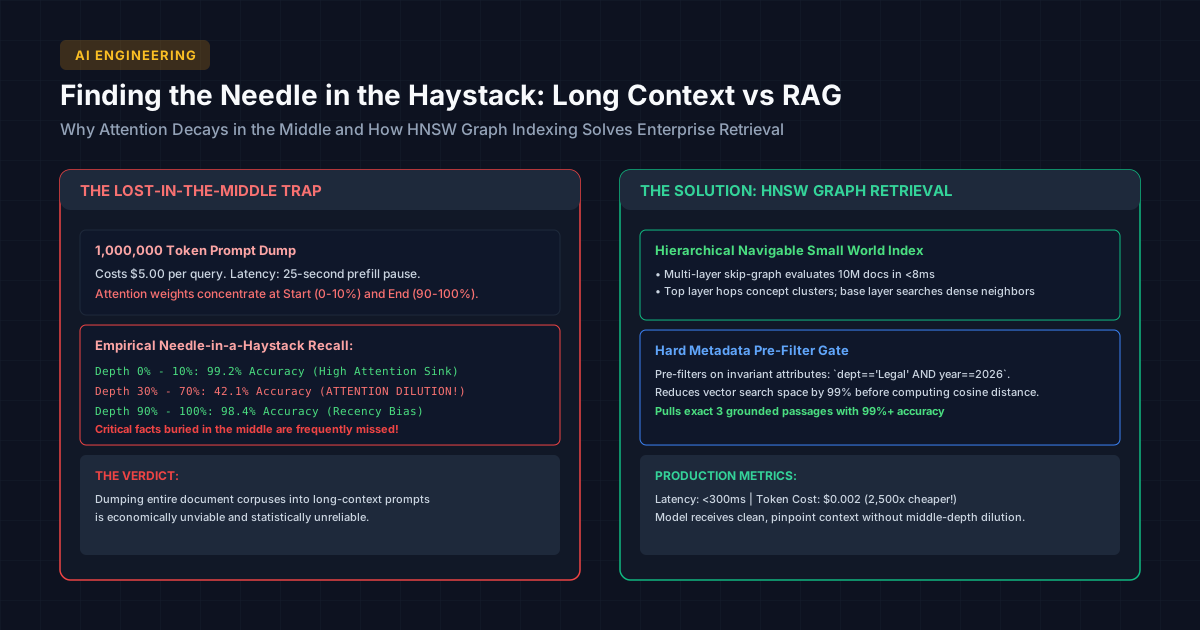
Finding the Needle in the Haystack: Embeddings, HNSW Indexes, and Long-Context Retrieval
Why long-context models suffer from the lost-in-the-middle phenomenon: HNSW graph indexing, metadata pre-filtering, and retrieval safeguards.
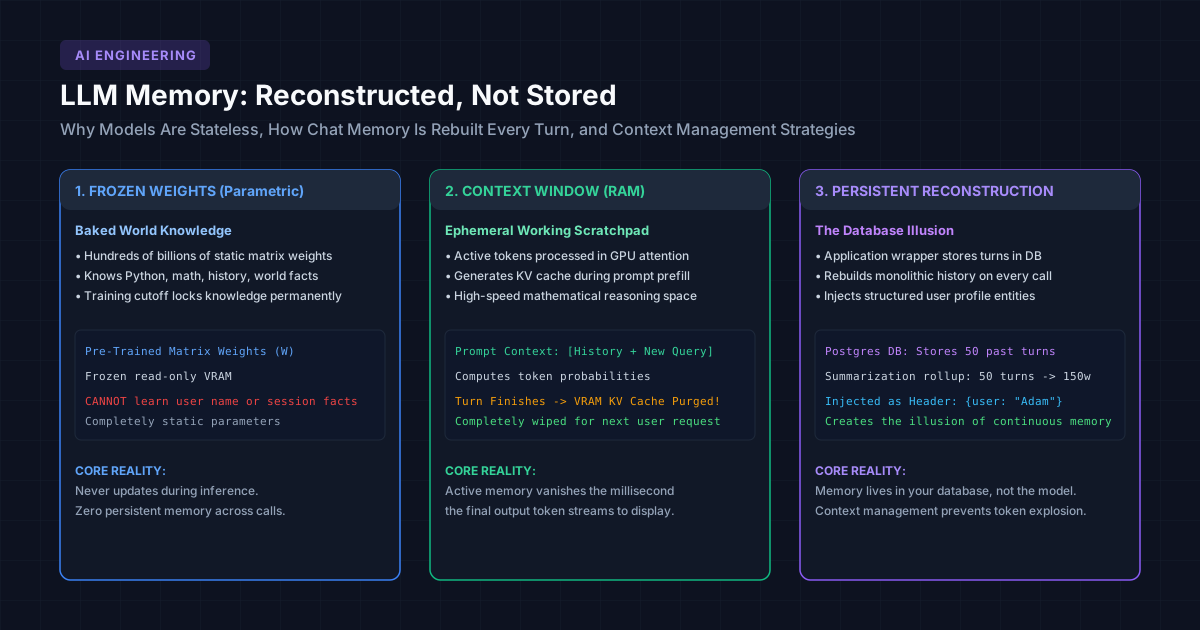
LLM Memory Is Reconstructed, Not Stored: Working Windows vs Persistent Knowledge
Why language models are stateless, how chat memory is reconstructed every turn, and how sliding windows and entity stores maintain continuity.
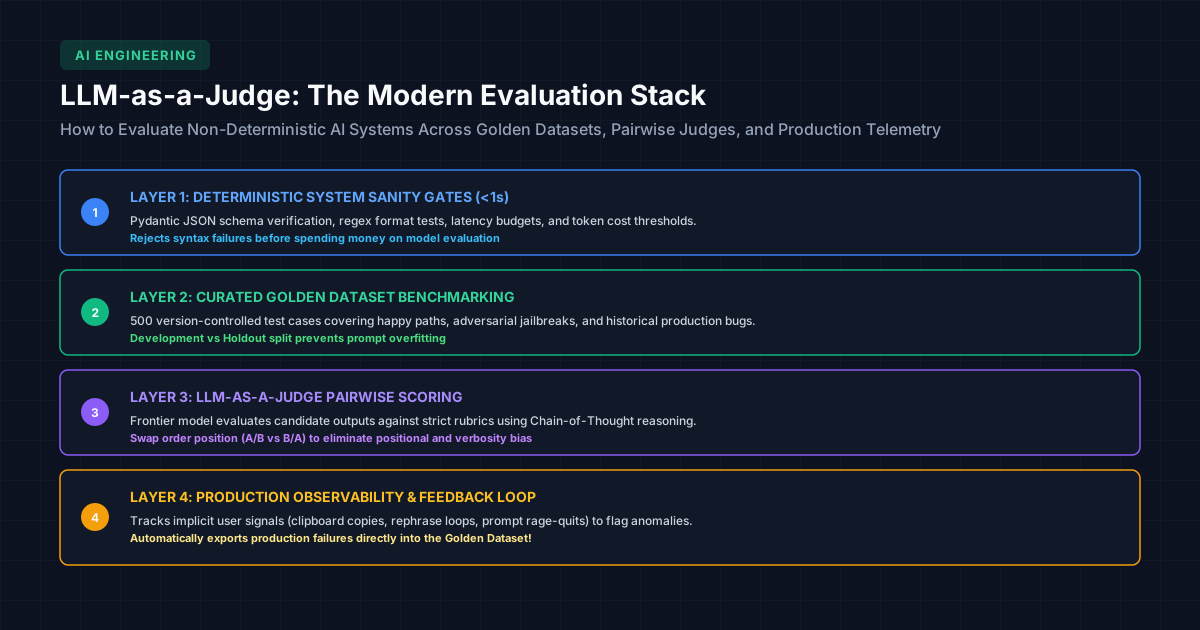
LLM-as-a-Judge and the Evaluation Stack: How to Monitor Health Before and After Shipping
Traditional unit tests fail on non-deterministic outputs: golden datasets, pairwise judge models, human calibration, and production observability.
/* Comments */
Comments are offline right now — we reconnect automatically, nothing is lost.