
LLM Memory Is Reconstructed, Not Stored: Working Windows vs Persistent Knowledge
Why language models are stateless, how chat memory is reconstructed every turn, and how sliding windows and entity stores maintain continuity.
On this page
When human users interact with an AI chatbot, an intuitive illusion quickly forms: the AI feels like an attentive conversational partner that remembers what you discussed ten minutes ago.
You say: “My name is Adam.” The AI replies: “Nice to meet you, Adam!” Five messages later, you ask: “What is my name?” The AI replies: “Your name is Adam.”
To human psychology, this looks like biological memory.
To a systems engineer, this is an optical illusion. Large language models possess zero memory of previous conversations. They do not form synapses, they do not update internal storage, and they do not save session records.
Every single turn of an AI chat is a completely stateless, isolated HTTP request. The feeling of memory is entirely engineered outside the model: an application harness reading from a database, reconstructing the entire conversational past, and resending it as a fresh monolithic document on every single turn.
Understanding the three distinct layers of AI memory is essential for scaling long-running agent workflows without triggering latency spikes or memory exhaustion.
+--------------------------------------------------------------------------+
|                  THE THREE LAYERS OF MACHINE LEARNING MEMORY             |
|                                                                          |
|  1. Frozen Weights (Long-Term Storage)   : World facts baked during train|
|  2. Context Window (Working RAM)         : Active tokens in GPU attention|
|  3. Application Store (Persistent Drive) : External Postgres / Redis DB  |
+--------------------------------------------------------------------------+
Layer 1: Parametric Memory (Frozen Weights)
Parametric memory represents the hundreds of billions of floating-point numbers embedded in the model’s neural network layers.
- It stores general world facts: the boiling point of water, the syntax of Python list comprehensions, the history of the Roman Empire.
- The Limitation: It is completely static and frozen. Once training completes, the model cannot learn your name, your company’s latest security policies, or what happened five seconds ago.
Layer 2: The Context Window (Ephemeral Working RAM)
The context window is the dynamic scratchpad of the transformer.
- When an LLM processes text, its attention mechanism computes mathematical dot products across all tokens currently resident inside its active window (e.g., 8,000 to 128,000 tokens).
- The Limitation: The context window is completely ephemeral. The instant the GPU finishes generating the final output token, the active Key-Value (KV) cache is purged from memory. When the user types their next question, the model starts from a blank slate.
Layer 3: Application-Level Memory (The Reconstructed Illusion)
To make a stateless model appear stateful, the software wrapper surrounding the model implements Memory Reconstruction:
Turn 1:
User: "My name is Adam."
Payload Sent: [User: "My name is Adam."]
LLM Emits: "Nice to meet you, Adam!"
Harness writes Turn 1 to Postgres DB: [{user: "My name is Adam."}, {assistant: "Nice to meet you, Adam!"}]

Turn 2:
User: "What is my name?"
Harness reads Postgres DB -> Assembles complete history!
Payload Sent:
  [User: "My name is Adam."]
  [Assistant: "Nice to meet you, Adam!"]
  [User: "What is my name?"]
LLM Emits: "Your name is Adam."
The model did not remember the name Adam. It simply read the name Adam in the input prompt that the application harness secretly stitched together.
The Cost Arithmetic of Conversation Growth
Because every turn resends the entire history, token consumption expands quadratically over long sessions:
Total Tokens Processed = sum_{i=1}^{N} (System Prompt + Turn_i)- Turn 1: 500 tokens
- Turn 10: 5,000 tokens
- Turn 50: 25,000 tokens
- Turn 100: 50,000 tokens
By Turn 50, a simple conversational back-and-forth burns 25,000 tokens per interaction. In addition to escalating API bills, massive context windows suffer from Attention Dilution (the “lost-in-the-middle” phenomenon), where the model misses critical instructions buried midway through a sprawling history.
Context Management Strategies for Production Agents
Production AI systems maintain long-running context using four distinct pruning and compression patterns:
[Raw 50,000-Token History]
             |
             +---> Strategy 1: Sliding Window (Keep last N turns, discard rest)
             |
             +---> Strategy 2: Incremental Summarization (Compress older turns)
             |
             +---> Strategy 3: Structured Entity Extraction (Facts to SQL/KV)
             |
             +---> Strategy 4: Vector Retrieval (RAG over past chat history)
1. The Sliding Window (FIFO Buffer)
The simplest approach: maintain only the last $N$ turns (e.g., the last 10 messages) in active context, discarding older turns.
- Advantage: Bounded latency and constant token costs.
- Flaw: Complete amnesia regarding instructions or preferences established at the start of the session.
2. Hierarchical Summarization (Roll-Up Memory)
When the active conversation reaches 80% of the token budget:
- An asynchronous background worker takes the oldest 20 messages and prompts a small model: “Summarize the key facts, decisions, and outcomes from this conversation in 150 words.”
- The raw 20 messages are removed from context and replaced by a compact system block:
[Summary of earlier discussion: User is building an iOS app with Swift...].
3. Structured Entity Stores (Extract and Persist)
Instead of keeping natural language chat logs, deploy an automated extraction worker that parses verified facts into a structured relational profile:
{
  "user_name": "Adam",
  "preferred_language": "TypeScript",
  "framework": "Next.js",
  "auth_provider": "OAuth",
  "active_ticket_id": "TCK-8821"
}
This structured profile is injected at the top of every prompt as a compact 30-token header, giving the model perfect memory across months of interactions while consuming negligible context space.
4. Vector-Augmented Memory (Semantic Recall)
For deep multi-day research agents:
- Historical turns are embedded and stored in a vector database.
- When the user asks a question referencing past work (“What was that Docker command we tested last Tuesday?”), the system runs a vector similarity query against past chat history and injects only the matching 2-turn exchange into the prompt.
Memory in artificial intelligence is not an inherent capability of neural weights; it is an active systems engineering discipline. Manage your context as carefully as you manage memory allocations in C.
Keep reading
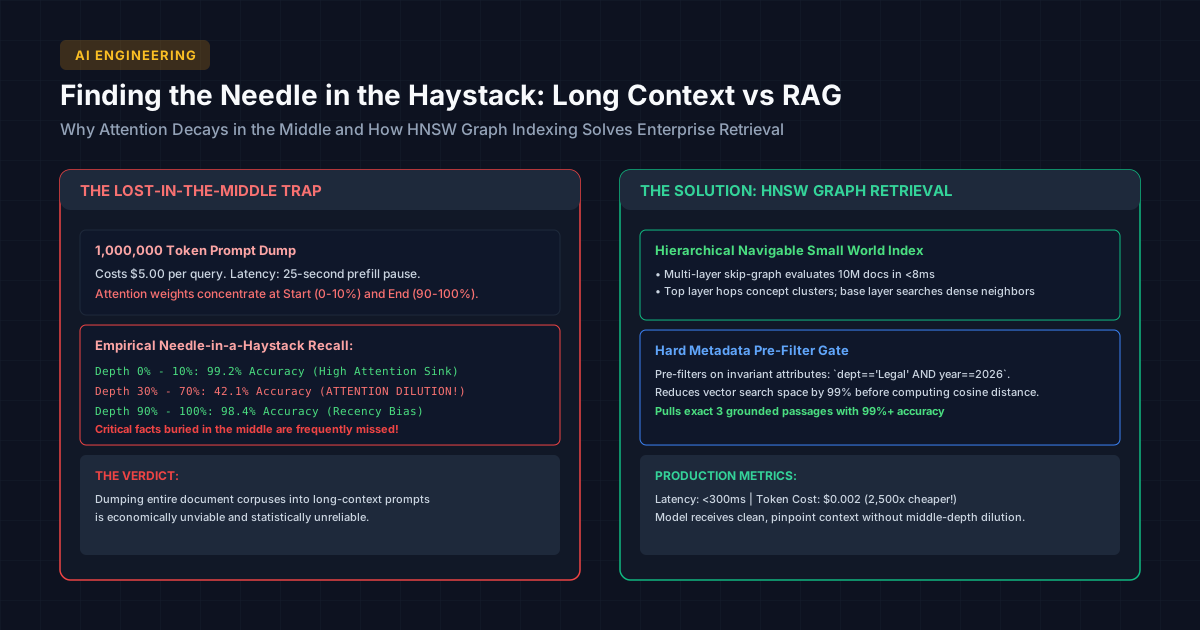
Finding the Needle in the Haystack: Embeddings, HNSW Indexes, and Long-Context Retrieval
Why long-context models suffer from the lost-in-the-middle phenomenon: HNSW graph indexing, metadata pre-filtering, and retrieval safeguards.
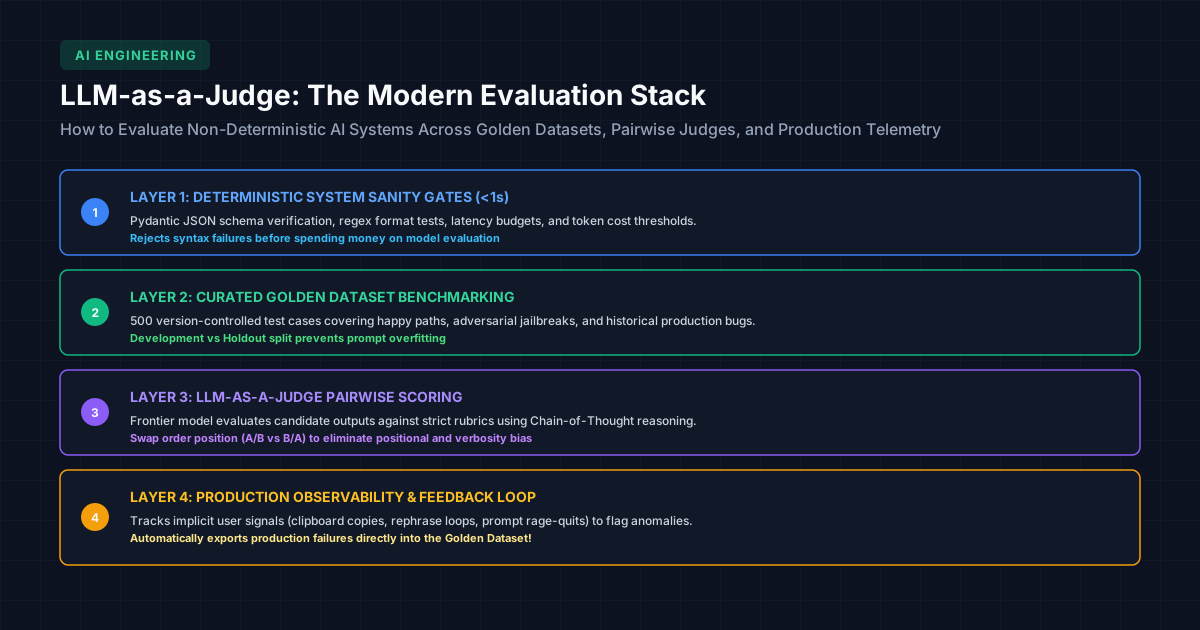
LLM-as-a-Judge and the Evaluation Stack: How to Monitor Health Before and After Shipping
Traditional unit tests fail on non-deterministic outputs: golden datasets, pairwise judge models, human calibration, and production observability.
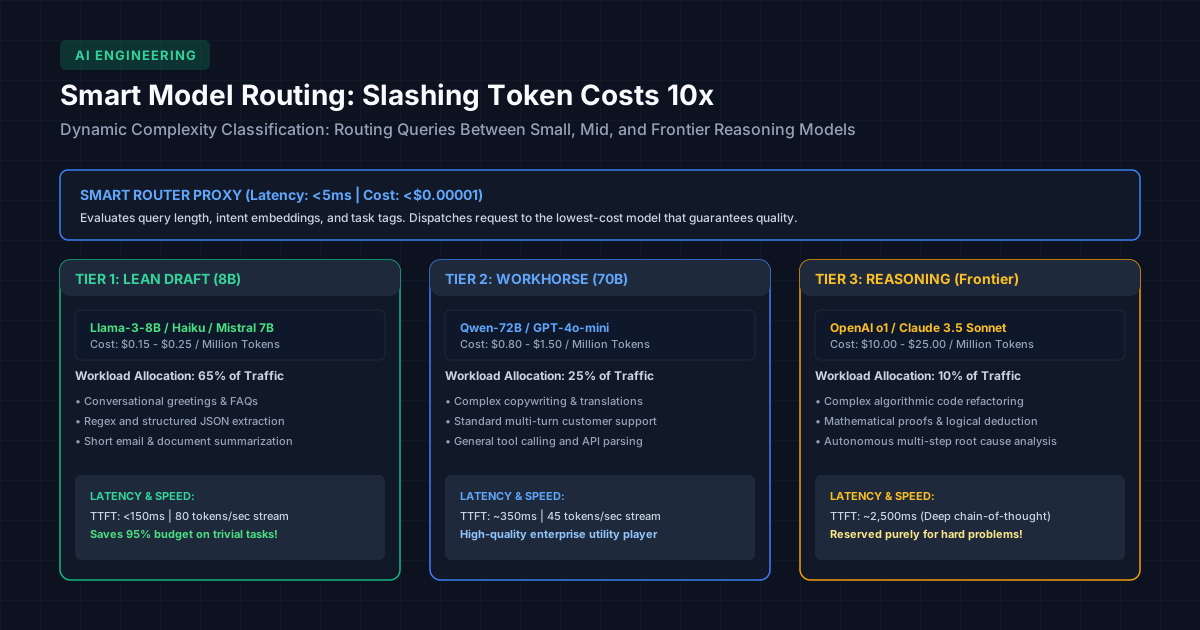
Smart Model Routing: Cutting LLM Token Costs Tenfold Without Sacrificing Output Quality
Route queries dynamically between small draft models, mid-tier workhorses, and frontier reasoning engines to slash inference bills by 90%.
/* Comments */
Comments are offline right now — we reconnect automatically, nothing is lost.