
Finding the Needle in the Haystack: Embeddings, HNSW Indexes, and Long-Context Retrieval
Why long-context models suffer from the lost-in-the-middle phenomenon: HNSW graph indexing, metadata pre-filtering, and retrieval safeguards.
On this page
When foundation model providers announced context windows expanding from 8,000 tokens to 128,000, 1,000,000, and 2,000,000 tokens, industry commentators rushed to declare the death of Retrieval-Augmented Generation (RAG): “Why bother building complex vector databases and chunking pipelines when you can simply dump the entire 500-page corporate documentation directly into the prompt?”
In real-world production systems, dumping 1,000,000 tokens into an LLM fails immediately on three commercial and physical fronts:
- Financial Disaster: Processing 1,000,000 input tokens on every turn costs $2.50 to $10.00 per query. A customer support bot handling 10,000 queries burns $50,000 daily.
- Latency Collapse: Computing the prefill attention across 1,000,000 tokens takes 15 to 30 seconds on a cluster of H100 GPUs before the first word streams.
- The Lost-in-the-Middle Phenomenon: As context size expands, the model’s empirical retrieval accuracy degrades significantly.
Testing and overcoming this retrieval failure is the domain of the Needle-in-a-Haystack (NIAH) benchmark and modern Approximate Nearest Neighbor (ANN) vector indexing.
+--------------------------------------------------------------------------+
|                  THE NEEDLE-IN-A-HAYSTACK (NIAH) TEST                    |
|                                                                          |
|  [The Haystack] : 200,000 tokens of boring, dense legal text.            |
|  [The Needle]   : "The secret passphrase for Server 9 is PurpleKangaroo."|
|                                                                          |
|  Test: Insert needle at 5%, 25%, 50%, 75%, 95% depth of the context.    |
|  Prompt: "What is the secret passphrase for Server 9?"                   |
+--------------------------------------------------------------------------+
The Lost-in-the-Middle Degradation
Researchers evaluating transformer attention across long sequences revealed an unmistakable U-shaped accuracy curve:
Retrieval Accuracy (%)
100% |  ***                                                     ***
     |     *                                                   *
 75% |      *                                                 *
     |       *                                               *
 50% |        *                                             *
     |         *                                           *
 25% |          *******************************************
  0% +-----------------------------------------------------------
     0% (Start)                  50% (Middle)              100% (End)
Context Window Position- When the critical fact (“the needle”) is placed at the very beginning of the prompt (the first 5%), accuracy approaches 99%.
- When the needle is placed at the very end of the prompt (right before the final query), accuracy approaches 98%.
- When the needle is buried in the middle (between 30% and 70% depth), retrieval accuracy plummets, sometimes dropping below 40%.
Why Transformers Forget the Middle
Transformers use self-attention to calculate pairwise token relevance. Due to positional encoding decays and softmax normalization across thousands of tokens, attention weights naturally concentrate on:
- The initial tokens (which anchor the global topic and carry high attention sink values).
- The most recent tokens (which immediately precede the prediction target). Information buried in the vast expanse of the middle gets diluted in the noise of millions of competing attention scores.
The Scaled Solution: Hierarchical Navigable Small World (HNSW)
Rather than forcing the LLM to search through millions of tokens in its context window, high-performance architectures use HNSW (Hierarchical Navigable Small World) vector indexing to locate the needle before touching the model.
       Layer 2 (Express Links):     [ Node A ] ======================> [ Node Z ]
                                         |                                  |
       Layer 1 (Medium Links):      [ Node A ] ----> [ Node M ] ----> [ Node Z ]
                                         |                |                 |
       Layer 0 (Dense 1-hop):       [A] -> [B] -> [C] -> [M] -> [P] -> [Z]
The Skip-List Graph Architecture
HNSW draws inspiration from the multi-level Skip-List data structure:
- Top Layers (Sparse): Contain long-distance highway links connecting distant semantic clusters. The search algorithm hops across massive concept spaces in single steps (jumping from “Finance” to “Database Systems”).
- Bottom Layer (Dense): Contains fine-grained, short-distance links between closely related passages.
When a query arrives, the search algorithm begins at the sparse top layer, quickly zooms into the nearest semantic neighborhood, drops down to the dense base layer, and performs a local greedy search.
Performance: HNSW evaluates a database of 10,000,000 documents in under 8 milliseconds, returning the exact 3 relevant paragraphs with 98%+ recall.
Metadata Pre-Filtering: Eliminating Mathematical Drift
A common mistake in vector retrieval is relying purely on cosine similarity across an unpartitioned index.
If an enterprise user queries: “Show me the severance terms for UK employees in 2026,” pure vector similarity might retrieve:
- A 2021 US severance policy (high semantic similarity, wrong jurisdiction).
- A 2026 UK marketing contractor agreement (wrong topic).
High-scale RAG systems enforce Hard Metadata Pre-Filtering:
[User Query + Tenant Auth Claims]
                 |
                 v
   +---------------------------+
   | Hard Metadata Filter Gate | ---> Filters index: `country == 'UK' AND year == 2026`
   +---------------------------+
                 | (Only searches within 5,000 pre-filtered vectors)
                 v
   [HNSW Vector Distance Traversal]
                 |
                 v
   [Top-3 Exact Grounded Chunks] ---> Injected into focused 1,500-token LLM context!
By pre-filtering candidate vectors on physical database attributes (tenant ID, country, document date, permission ACLs), the search space shrinks by 99%, eliminating vector drift and guaranteeing that the retrieved context is legally and chronologically valid.
Long-Context vs. RAG: The Engineering Verdict
| Metric | Dump 1,000,000 Tokens into LLM | HNSW Vector RAG (Filtered) |
|---|---|---|
| Query Latency | 15 to 30 seconds (Prefill stall) | Sub-500 milliseconds |
| Financial Cost | $5.00 per query | $0.002 per query (2,500x cheaper) |
| Middle-Depth Recall | 40% to 70% (Lost-in-middle) | 98%+ (Pinpoint extraction) |
| Corpus Freshness | Must re-upload files every turn | Updates in real-time via CDC |
Long context is an incredible capability for analyzing a single massive artifact (such as a 400-page legal brief or an entire codebase repository during refactoring).
For enterprise-scale information retrieval across millions of corporate documents, HNSW-indexed RAG is mathematically, economically, and operationally superior.
Keep reading
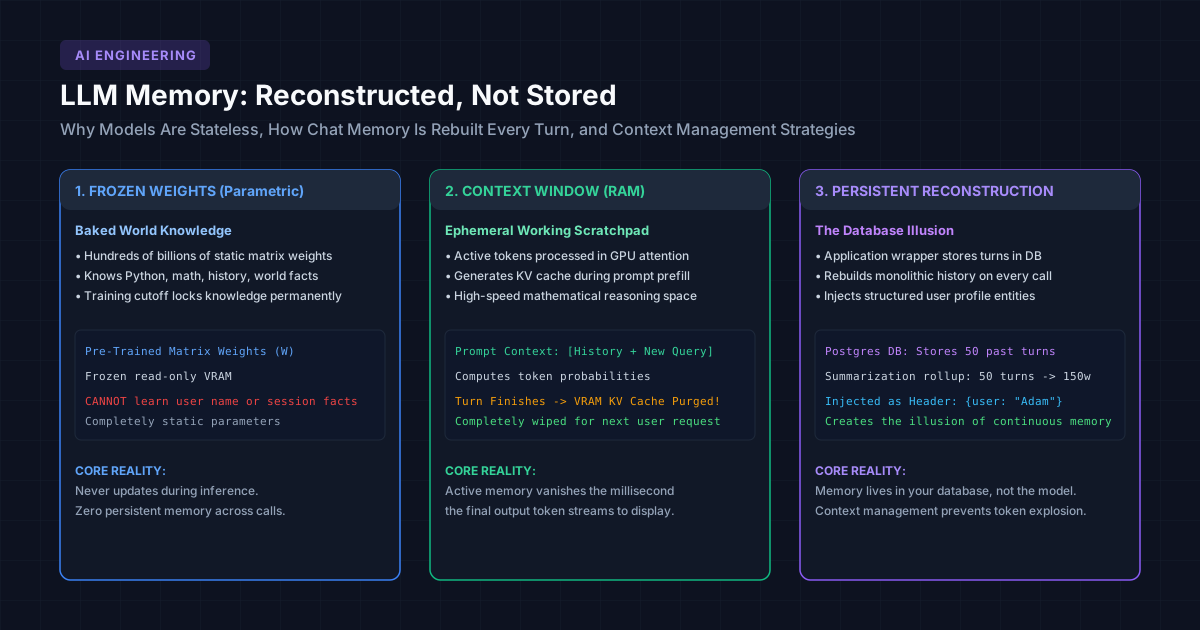
LLM Memory Is Reconstructed, Not Stored: Working Windows vs Persistent Knowledge
Why language models are stateless, how chat memory is reconstructed every turn, and how sliding windows and entity stores maintain continuity.
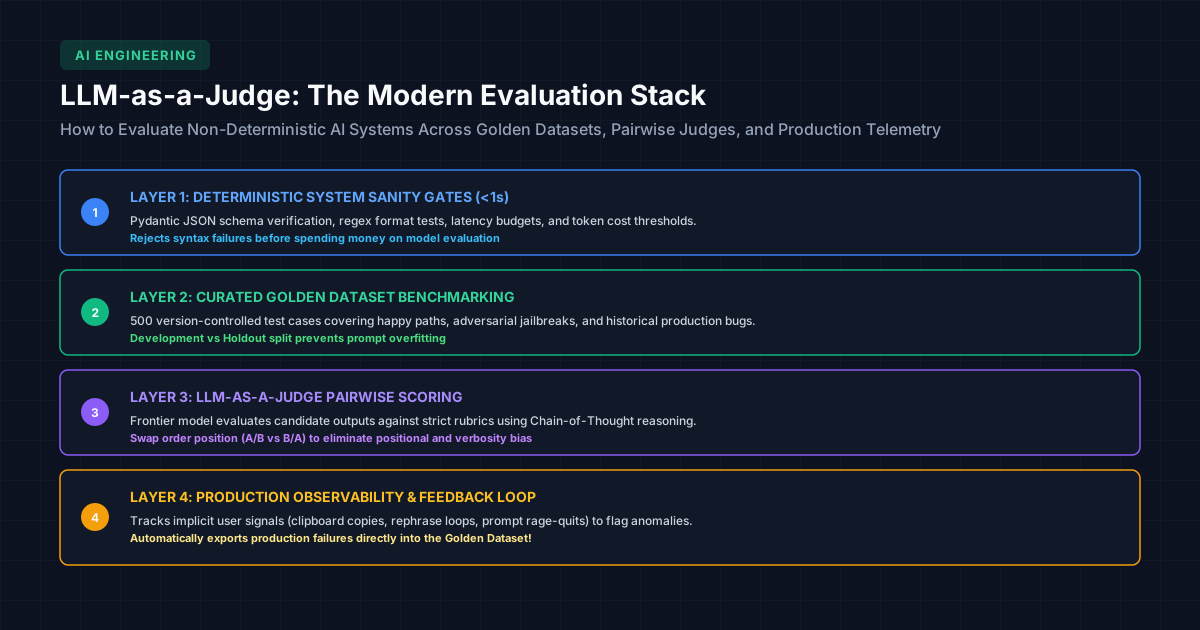
LLM-as-a-Judge and the Evaluation Stack: How to Monitor Health Before and After Shipping
Traditional unit tests fail on non-deterministic outputs: golden datasets, pairwise judge models, human calibration, and production observability.
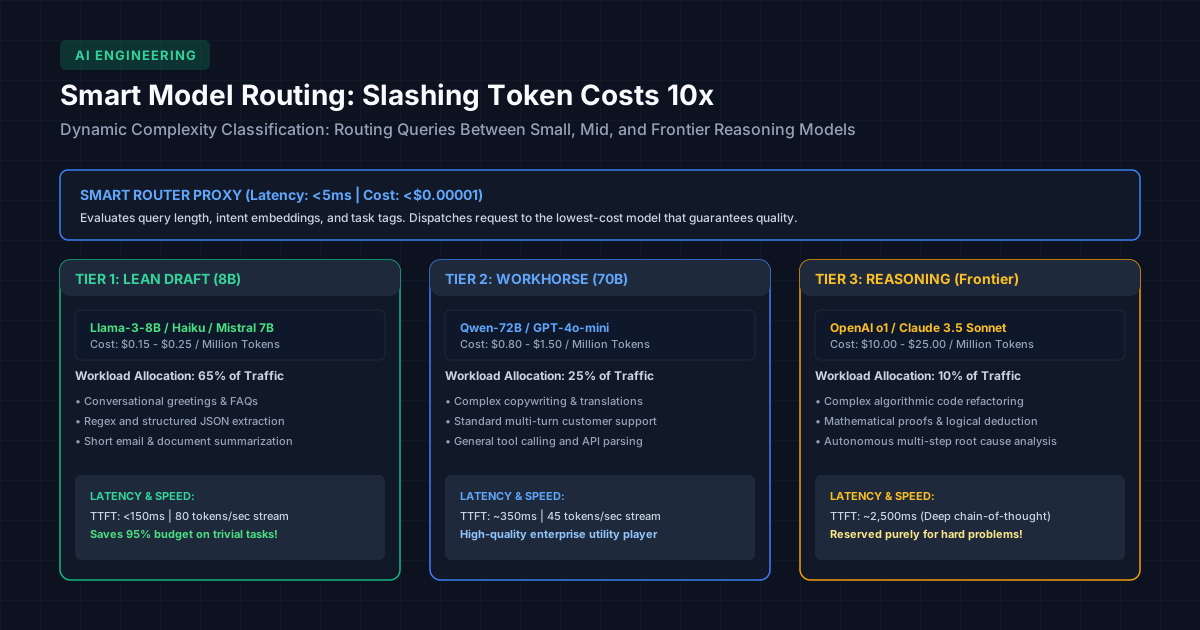
Smart Model Routing: Cutting LLM Token Costs Tenfold Without Sacrificing Output Quality
Route queries dynamically between small draft models, mid-tier workhorses, and frontier reasoning engines to slash inference bills by 90%.
/* Comments */
Comments are offline right now — we reconnect automatically, nothing is lost.