
LLM-as-a-Judge and the Evaluation Stack: How to Monitor Health Before and After Shipping
Traditional unit tests fail on non-deterministic outputs: golden datasets, pairwise judge models, human calibration, and production observability.
On this page
In traditional software engineering, testing is deterministic and binary. You write a test: assert add(2, 2) == 4. If the function returns 4, the test passes; if it returns 5, the build breaks.
In applications powered by Large Language Models, this deterministic testing paradigm collapses completely.
If you prompt an LLM twice with the exact same customer support inquiry, it will produce two differently phrased answers:
- Attempt 1: “We have refunded your transaction. You will see the credit in 3 to 5 business days.”
- Attempt 2: “Your $50 refund has been processed successfully. Please allow up to five business days for your banking institution to post the funds.”
Both answers are factually correct, polite, and helpful. But an automated exact-match string assertion (assert output == expected) fails 100% of the time.
Conversely, a model might return an answer that matches your regex pattern perfectly while hallucinating a dangerous security violation.
Evaluating an LLM application requires building a Multi-Tiered Evaluation Stack: combining deterministic sanity tests, curated golden datasets, model-based judging (LLM-as-a-Judge), and continuous production monitoring.
+--------------------------------------------------------------------------+
|                  THE PRODUCTION LLM EVALUATION STACK                     |
|                                                                          |
|  [Layer 1: Deterministic Gates]   : JSON schema, latency & token budgets |
|  [Layer 2: Golden Benchmark Sets] : 500 hand-curated multi-turn cases    |
|  [Layer 3: LLM-as-a-Judge]        : Pairwise comparison via frontier CoT |
|  [Layer 4: Human Calibration]     : Periodic inter-annotator alignment   |
|  [Layer 5: Production Telemetry]  : Implicit user signals (thumbs, copy) |
+--------------------------------------------------------------------------+
Layer 1: The Golden Dataset (Ground Truth Engineering)
You cannot evaluate what you do not measure. The foundation of any evaluation harness is the Golden Dataset: a version-controlled repository of 200 to 1,000 real-world input-output pairs.
A production golden dataset must contain three distinct slices:
- The Happy Path (Core Competency): Common customer inquiries, standard documentation queries, and expected tool-use sequences.
- The Adversarial Edge Cases: Malformed prompts, jailbreak attempts, indirect injection strings, and queries lacking necessary context.
- The Regression Archive: Every time a user reports a hallucination or production bug, that specific prompt and context must be scrubbed, labeled with the correct resolution, and permanently committed to the golden dataset.
Crucially: Separate development sets from holdout sets. Never allow prompt engineers or fine-tuning pipelines to optimize against your holdout evaluation suite, or the system will overfit to the test cases.
Layer 2: Automated Classical Metrics vs. Semantic Scores
Before calling expensive judge models, evaluate changes using cheap classical heuristics:
- Schema Validation: Pydantic / Zod verification that all required keys exist and match types.
- BLEU and ROUGE: Measures n-gram overlap between generated text and reference text. (Useful for translation and summarization, but useless for conversational chat).
- Semantic Embedding Similarity: Computes cosine similarity between embeddings of the generated response and the reference answer. (Detects whether the answer is in the right semantic ballpark).
Layer 3: LLM-as-a-Judge (The Automated Referee)
For subjective qualities (helpfulness, tone, reasoning depth, policy compliance), human review is the gold standard, but human review cannot evaluate 5,000 test cases on every git push.
LLM-as-a-Judge deploys a superior frontier model (e.g., Claude 3.5 Sonnet or GPT-4o) prompted with an explicit rubric to evaluate candidate outputs.
[Candidate Output] + [Golden Ground Truth] + [Evaluation Rubric]
                         |
                         v
              +---------------------+
              | Frontier Judge LLM  |
              +---------------------+
                         |
      +------------------+------------------+
      |                                     |
(Chain-of-Thought)                     (Final Score)
"The response correctly lists all 3     Score: 5 / 5
refund steps without hallucination."   Verdict: PASS
The Three Judging Methods
- Direct Scoring (1 to 5 Likert Scale): The judge evaluates a single response against a detailed criteria rubric. (Problem: models suffer from scale compression, rarely using scores 1 or 2).
- Binary Pass / Fail with Error Classification: The judge answers specific yes/no questions: Did the model output accurate pricing? Did the model refuse inappropriately?
- Pairwise Comparison (A/B Arena): The judge is given the prompt and two anonymized outputs (Model A vs. Model B) and asked: Which output is more helpful, concise, and accurate? Pairwise comparison is vastly more reliable and correlates tightly with human preference.
The Three Biases of Judge Models
When implementing LLM-as-a-Judge, you must correct for three documented systemic biases:
- Position Bias: Models tend to favor Option A over Option B regardless of quality. Fix: Run the evaluation twice, swapping the order of the candidates (A/B then B/A), and only record a win if the model chooses the same candidate in both orientations.
- Verbosity Bias: Judge models consistently favor longer, wordier answers over concise, direct answers. Fix: Add an explicit penalty in the judge prompt: “Penalize responses that include unnecessary conversational filler.”
- Self-Enhancement Bias: A model (e.g., GPT-4) tends to rate its own generations higher than outputs produced by Claude or Gemini. Fix: Use cross-family judge models or calibrate scores against human reviews.
Layer 4: Production Observability (The Real World)
Evaluation does not terminate at deployment. In production, evaluate real user signals:
- Explicit Feedback: Thumbs-up / thumbs-down buttons, CSAT ratings, customer feedback modals.
- Implicit Telemetry:
- Did the user copy the generated text to their clipboard? (Positive signal).
- Did the user immediately rephrase the prompt three times? (Frustration signal).
- Did the user click the support escalation link within 30 seconds? (Failure signal).
Any production interaction that triggers an implicit failure signal is automatically tagged, anonymized, and exported to the golden dataset review queue.
Model evaluation is not an offline event; it is an active continuous loop that protects your software against drift, regressions, and silent degradation.
Keep reading
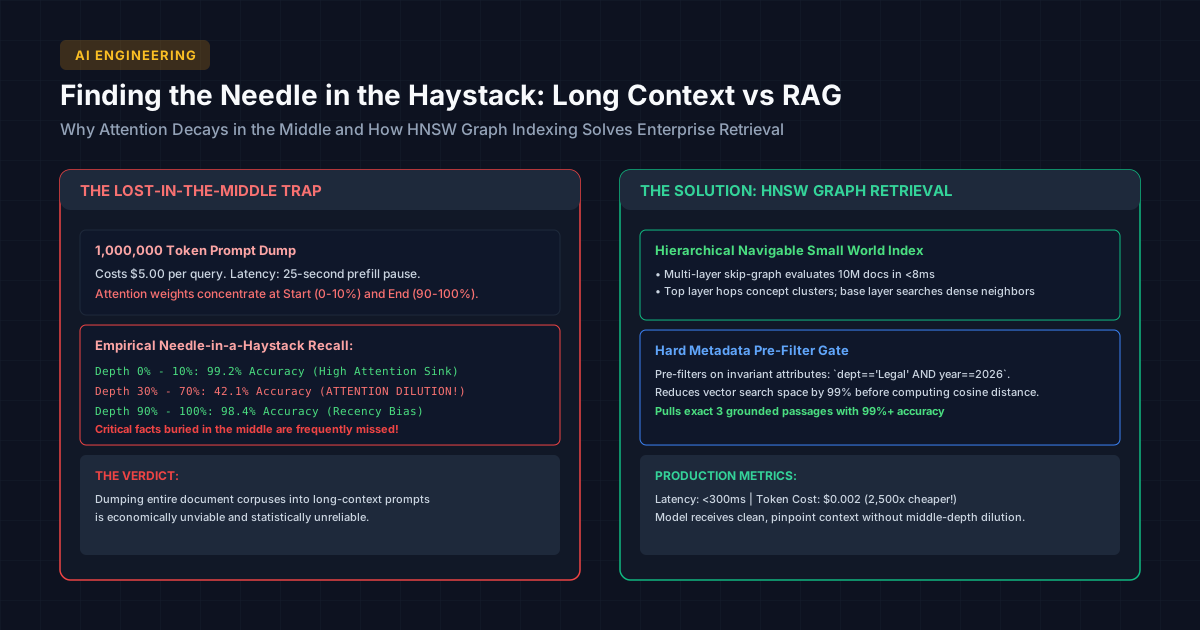
Finding the Needle in the Haystack: Embeddings, HNSW Indexes, and Long-Context Retrieval
Why long-context models suffer from the lost-in-the-middle phenomenon: HNSW graph indexing, metadata pre-filtering, and retrieval safeguards.
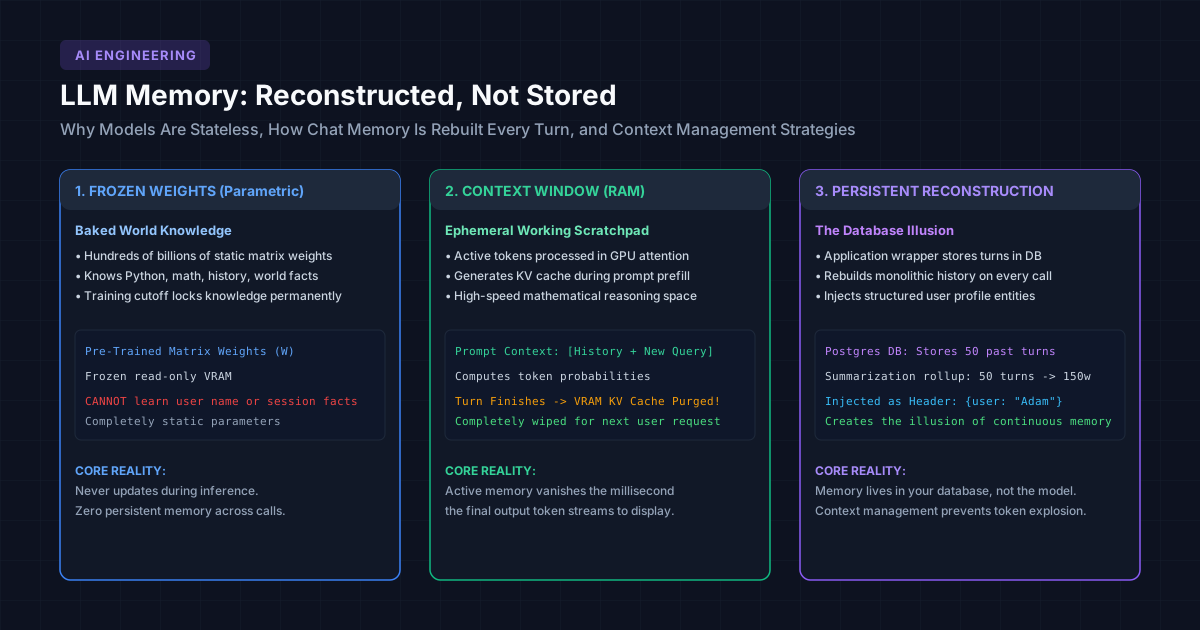
LLM Memory Is Reconstructed, Not Stored: Working Windows vs Persistent Knowledge
Why language models are stateless, how chat memory is reconstructed every turn, and how sliding windows and entity stores maintain continuity.
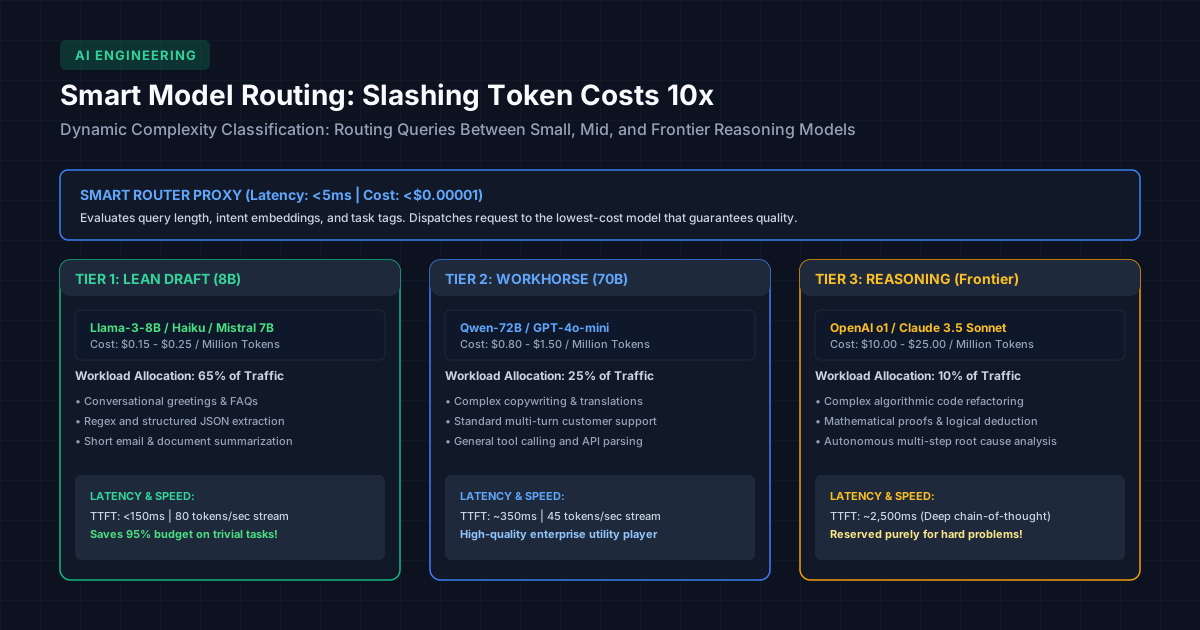
Smart Model Routing: Cutting LLM Token Costs Tenfold Without Sacrificing Output Quality
Route queries dynamically between small draft models, mid-tier workhorses, and frontier reasoning engines to slash inference bills by 90%.
/* Comments */
Comments are offline right now — we reconnect automatically, nothing is lost.